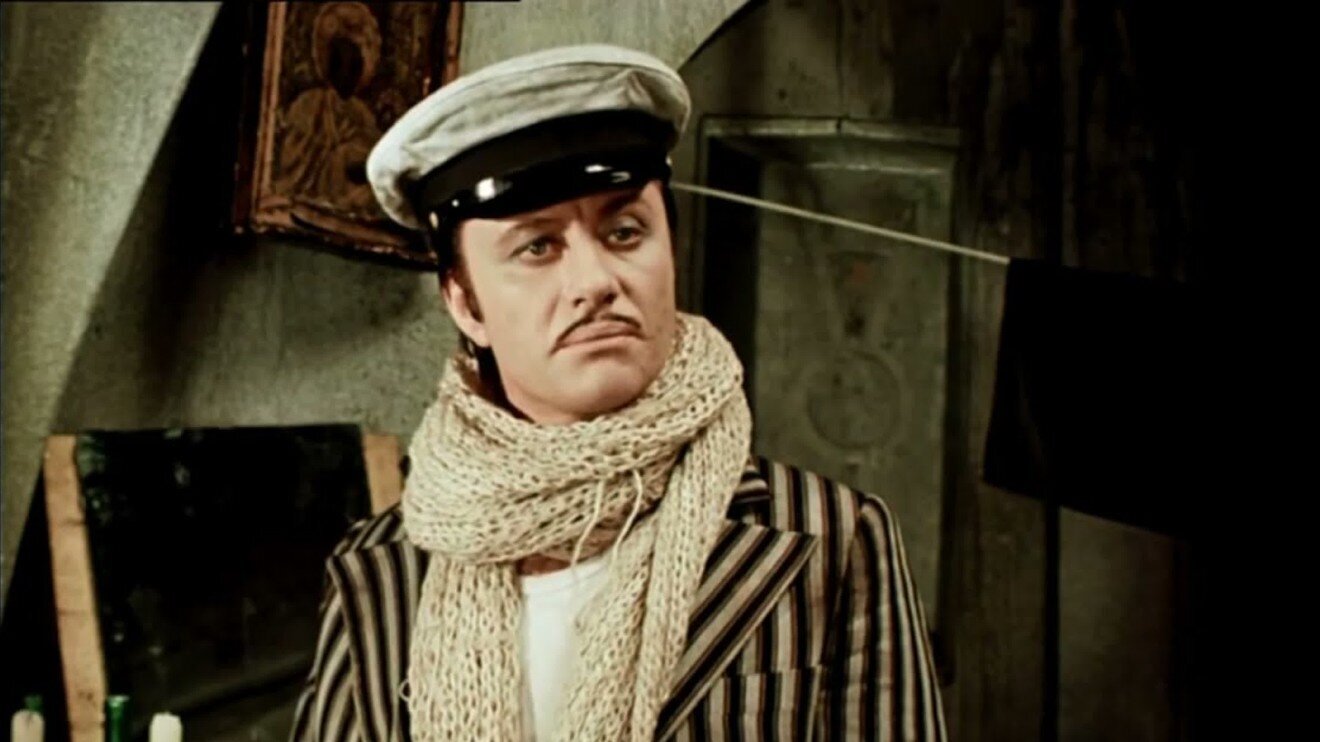
Andrei Alexandrovich Mironov (1941–1987) was a celebrated Soviet stage and film actor, a People’s Artist of the RSFSR, and one of the brightest stars of Soviet cinema, whose sudden death in 1987 shocked millions of viewers.
Origins and Early Life
Andrei Mironov was born on March 7, 1941, in Moscow, into a family of well-known variety-stage performers. His father was Alexander Semyonovich Menaker; his mother, Maria Vladimirovna Mironova. Interestingly, at birth the future actor carried his father’s surname, Menaker, but in the late 1940s, during the antisemitic «anti-cosmopolitanism» campaign, his parents decided to switch his surname to his mother’s.
Andrei’s artistic talents showed themselves already in school. Classmates remembered him as the informal leader of the class, blessed with natural wit and a fiery temperament. He loved jazz, organized a jazz band among his classmates, spoke fluent English, and staged «performances» for friends at home, doing impressions of well-known actors and singers.
Theater Career
In 1958, Mironov enrolled at the Boris Shchukin Theatre Institute, affiliated with the Vakhtangov Theatre. Even as a student, his teachers noted his particular gift — a drive to «break through laughter to tears, and through tears to laughter.» That duality, the ability to fuse the comic and the lyrical, became one of the defining traits of his art.
After graduating, Mironov worked at the Satire Theatre, then at the Lenin Komsomol Theatre. His stage work spanned a wide range, from classical roles to contemporary productions. In his final years, he took up directing as well, staging several productions of his own.
Cinematic Success
Mironov’s true nationwide fame came from his roles in film comedies. In 1972 came The Republic’s Wealth, in which he played the romantic adventurer Shilovsky, nicknamed «the Marquis.» Critics noted that «the concealed lyricism of Mironov’s performance transformed the entire structure of the film,» turning its «one-dimensionality into multivalence.»
Especially successful was the comedy An Unbelievable Adventure of Italians in Russia (1974), in which Mironov played a police captain named Vasilyev. The actor performed many of his own dangerous stunts — sliding down a carpet from the sixth floor of a hotel, hanging over the Neva on a drawbridge as it rose, chatting with a lion. Director Eldar Ryazanov later recalled: «Andrei amazed me with his courage and daring.»
Ostap Bender: The Role of a Lifetime
Perhaps Mironov’s most famous role was Ostap Bender, in the four-part television film The Twelve Chairs (1977), directed by Mark Zakharov. Critic V. S. Kichin wrote that «Bender was a role Mironov simply had to play.» Everything aligned in this part: his vivid talent, natural elegance, stage polish, and the actor’s own obvious flair for mischief.
Mironov shaped Ostap as a poet of «the beautiful life,» a bard of flashy schemes, for whom life itself was a game, a performance, a show. The TV film was structured like a musical, with songs used to reveal the protagonist’s character. Especially memorable was «Ostap’s Song,» which laid bare Bender’s nature as both gambler and performer. Mironov’s Ostap was a dual figure — audiences could admire the beauty of the performance while also sensing the character’s underlying tragedy.
A Range of Roles
Mironov wasn’t limited to comedic roles. In the TV film Faryatyev’s Fantasies (1979), he played a shy dentist — the complete opposite of his usual image. Critics noted «this actor’s rare plasticity,» his ability at «totally rebuilding his entire human structure.»
In Alexei German’s My Friend Ivan Lapshin (1984), the actor created the character of Khanin, a visiting writer — a 1930s intellectual whose outward naivety concealed «a man of iron.»
His last major role was as Mr. First in A Man from Boulevard des Capucines (1987). Director Alla Surikova recalled that the film began, for her, with the realization that this role had to be played by Andrei Mironov specifically. In a readers’ poll conducted by the magazine Soviet Screen, he was named Best Actor of 1987 for this role.
Craft and Character
Contemporaries noted Mironov’s remarkable optimism and zest for life. He had a gift for delighting in life and passing that sense of happiness on to audiences. At the same time, he was highly analytical and deliberate in building a role, relying on logical analysis of the character.
A defining trait of Mironov’s acting style was his extraordinarily flexible speech. Over the years, his shading of individual words reached near-musical virtuosity. Colleagues recalled that he never delivered the same line the same way twice.
Mironov was constantly improvising, imagining, giving everything he had in every performance, fully surrendering to the current of creative work. Directors valued his discipline and reliability — rare qualities in the theatrical world.
A Tragic End
On August 14, 1987, while on tour with his theater in Riga, during a performance of The Marriage of Figaro, Mironov lost consciousness onstage, never finishing the final scene. He had suffered a ruptured cerebral aneurysm, diagnosed as a massive brain hemorrhage. Andrei Mironov died without regaining consciousness on August 16, 1987, at age 46.
His funeral took place on August 20, 1987, at Vagankovskoye Cemetery in Moscow, and turned into a genuine public farewell. Mironov’s death came to symbolize the close of an entire era in Soviet cinema.
Legacy
By 1996, when the novel is set, nine years had passed since the actor’s death, but his roles remained vivid in viewers’ memory. Films featuring Mironov were regularly rerun on television, and his lines had become popular catchphrases. The Twelve Chairs and An Unbelievable Adventure of Italians in Russia remained especially popular.
Andrei Mironov is remembered as a uniquely gifted actor, unlike anyone else. Director A. V. Efros wrote of him: «There’s a softness in him, a kind of plasticine quality, very appealing both on film and onstage, especially when that actor’s nature is lit from within by intelligence. Mironov could mold himself into almost anything.»
In the context of the novel’s reference, comparing a character to Andrei Mironov most likely evokes energy, showmanship, the ability to «blow in like a hurricane» — qualities his contemporaries especially prized in this remarkable performer.