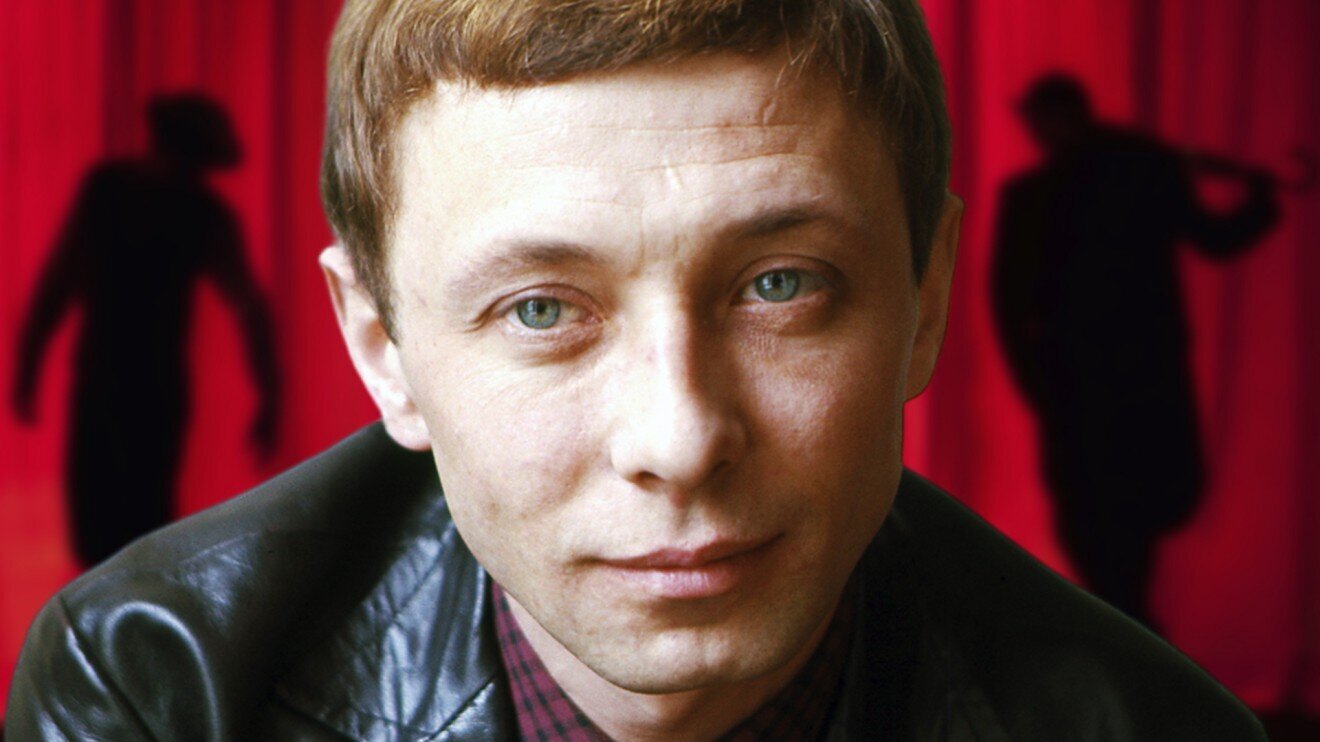
Oleg Ivanovich Dal was a celebrated Soviet stage and film actor whose work came to symbolize an entire generation and continued to shape Russian culture a decade and a half after his death.
Life and Career
Born May 25, 1941, in Lyublino (now part of Moscow), Oleg Dal became one of the brightest stars of Soviet cinema. After graduating from the Shchepkin Theatre School at the Maly Theatre in 1963, he made his film debut while still a student, playing Alik Kramer in Alexander Zarkhi’s film My Younger Brother.
A significant part of Dal’s creative life was tied to the Sovremennik Theatre, which he joined after graduating. It was there that his singular acting style took shape, one that later carried over into his film work.
Film Legacy
Oleg Dal’s filmography includes many memorable roles, each of which became part of the golden fund of Soviet cinema. In the 1960s, he created a gallery of romantic heroes of the «Thaw» era: the dreamer Zhenya Kolyshkin in Zhenya, Zhenechka, and «Katyusha» (1967), the ironic Yevgeny Sobolevsky in Chronicle of a Dive Bomber (1967), and a role in the fairy tale The Old, Old Tale (1968).
The 1970s brought more complex, psychologically layered roles. Dal played the Fool, «broken by human deafness,» in Grigori Kozintsev’s King Lear (1970); a dual role as the Scientist and his Shadow in the parable film The Shadow (1971); and created one of his most significant characters, engineer Viktor Zilov, in the TV film Duck Hunting (released as September Vacation) (1979).
Major Films
- 1962 — My Younger Brother
- 1967 — Zhenya, Zhenechka, and «Katyusha»
- 1967 — Chronicle of a Dive Bomber
- 1968 — The Old, Old Tale
- 1970 — King Lear
- 1971 — The Shadow
- 1973 — A Bad Good Man
- 1979 — Duck Hunting (September Vacation)
- 1980 — The Adventures of Prince Florizel
- 1981 — An Uninvited Friend
Creative Legacy
Beyond acting, Dal wrote poetry and prose and tried his hand at directing. From 1980, he taught acting at VGIK, the Russian State Institute of Cinematography.
«Duck Hunting»: A Peak of Craft
The role of Viktor Zilov, in the screen adaptation of Alexander Vampilov’s play Duck Hunting, was, in the view of many critics, the peak of Dal’s acting career. Director Vitaly Melnikov knew from the outset that Oleg Dal had to play the lead. Completed in 1979, the film was banned after its premiere and shelved for eight years.
Dal’s «hero» is a figure of suffering. He feels no sense of purpose in this life, in this society. He remains unrealized. For all his talents, he turned out to be superfluous.
In 1987, six years after the actor’s death, Dal was posthumously awarded a special prize by the USSR Union of Cinematographers at the All-Union Festival of Television Films, specifically for the role of Zilov.
Artistic Method and Talent
Critics noted that Dal was an actor for «no mass audience,» «a difficult-to-digest talent» who was «always far ahead» of his time. His creative range was remarkably wide, spanning fairy-tale heroes to deep psychological portraits of the 20th century’s «superfluous men.»
A distinctive feature of Dal’s method was his ability to convey a character’s inner world through outward restraint. As film scholar Kira Klyuevskaya noted, his characters were «always slightly detached,» and so «unafraid of ridiculous situations.»
Personality and Character
Contemporaries remembered Dal as a complicated, contradictory man, incapable of compromise. Director Alexander Zarkhi noted that Oleg «couldn’t adapt to the accepted way of living,» while Vladimir Motyl stressed that the actor was «utterly without practicality or self-promotion.»
Anatoly Efros called him «a cross between a giraffe cub and a panther,» while critics described him as «a man split in two.» Beneath his outward restlessness and solitude, a childlike perception of life sometimes surfaced, making him especially natural in roles of «eternal boys.»
Cultural Influence
By 1996, when the novel’s events take place, fifteen years had passed since the actor’s death, but his influence on Russian culture remained significant. Films featuring Dal continued to air on television, his characters had become classics, and the actor himself had become a cult figure.
A comparison to Oleg Dal in the mid-1990s signaled a particular type of demeanor and inner state — melancholy, a tendency toward reflection, a certain detachment from events. That resonated especially strongly in an era of upheaval, when many members of the intelligentsia felt lost and «superfluous» in the new reality.
A Tragic End
Oleg Dal died on March 3, 1981, at the Studiynaya Hotel in Kyiv, while on a work trip. He was just 39. He is buried at Vagankovskoye Cemetery in Moscow. After his death, part of his handwritten creative archive — diaries, poems, letters, script drafts — was published.
His final film, An Uninvited Friend, was released after his death. As critics noted, the character of Viktor Sviridov he created was «utterly incompatible with life» — a description that proved prophetic.
Conclusion
Oleg Dal remains, in the history of Soviet and Russian cinema, an actor of unique gifts, who created a gallery of unforgettable «heroes of his time.» His work continued to inspire directors, actors, and audiences for decades after his tragic death.
Mentioning Oleg Dal in the context of 1996 isn’t just a reference to a specific actor — it’s a symbol of a particular sensibility characteristic of the Russian intelligentsia during a period of sweeping social change.