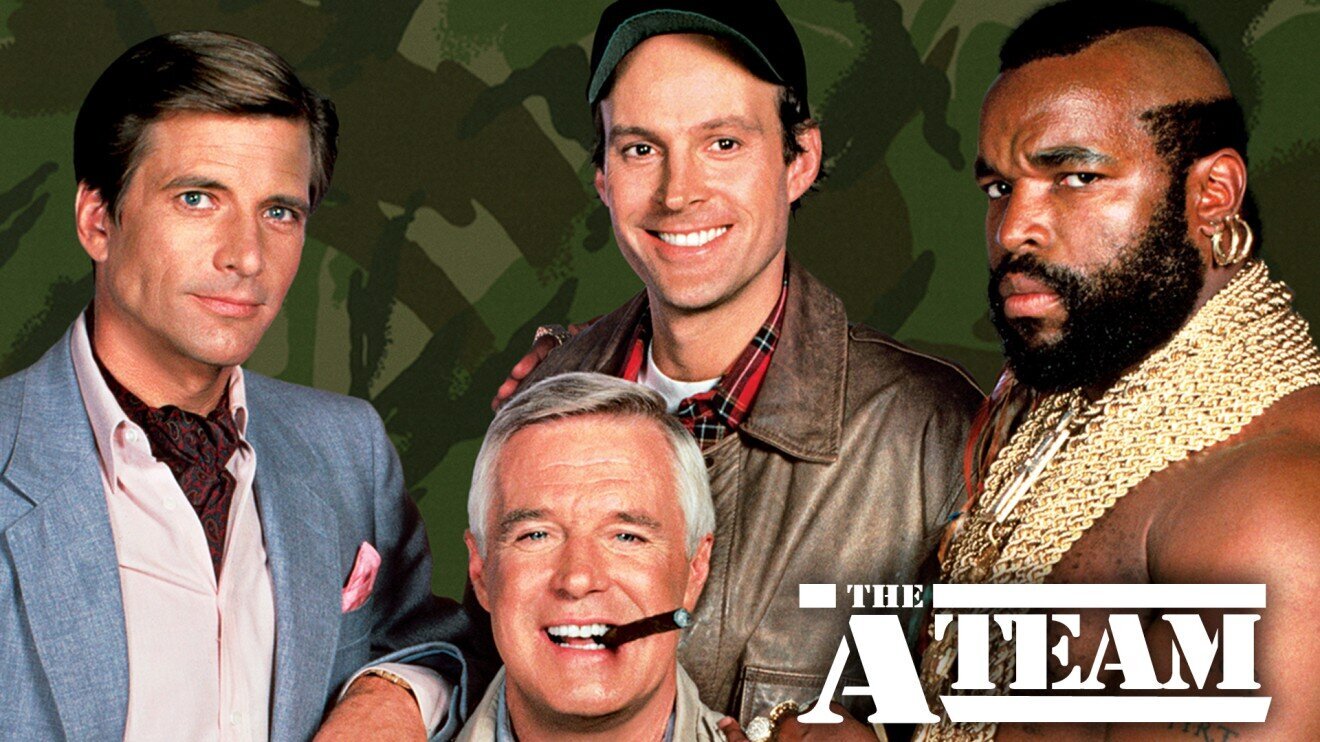
The A-Team was an American action series that aired on NBC from January 23, 1983, to March 8, 1987. In the USSR and Russia, the show became a genuine cultural phenomenon, especially during perestroika and the 1990s, when Western pop culture was flooding into the Soviet and Russian media landscape.
Origins and Concept
The series was created by writer-producers Stephen J. Cannell and Frank Lupo, at the request of NBC Entertainment president Brandon Tartikoff. Tartikoff asked Cannell to create a show blending elements of The Dirty Dozen, Mission: Impossible, The Magnificent Seven, Mad Max, and Hill Street Blues, adding: «And let Mr. T drive the car.»
The project wasn’t initially seen as commercially promising, but George Peppard (who played Hannibal) predicted the show would be a hit «before we ever rolled camera.» He was right — the first full episode, aired after Super Bowl XVII on January 30, 1983, drew a 26.4% audience share, landing fourth in the Nielsen top 10.
Plot and Characters
The show’s premise was laid out in its famous opening narration: «In 1972, a crack commando unit was sent to prison by a military court for a crime they didn’t commit. These men promptly escaped from a maximum-security stockade to the Los Angeles underground. Today, still wanted by the government, they survive as soldiers of fortune.»
The team had four core members:
- Lieutenant Colonel John «Hannibal» Smith (George Peppard) — the team leader, a master of unconventional but effective plans
- Lieutenant Templeton «Faceman» Peck (Dirk Benedict) — a charming con artist and the team’s supply man
- Captain H.M. «Howling Mad» Murdock (Dwight Schultz) — the team’s pilot, officially declared insane
- Sergeant B.A. «Bad Attitude» Baracus (Mr. T) — the team’s mechanic and muscle
Cultural Impact and Popularity
The show became a cultural phenomenon of the 1980s thanks to its memorable characters, spectacular action, and light, comedic tone. It spawned a slew of catchphrases that entered pop culture: «I love it when a plan comes together» (Hannibal), «I ain’t gettin’ on no plane!» (B.A. Baracus), «Hannibal’s on a roll.»
Mr. T played an especially big role in the show’s popularity — his charismatic turn as B.A. Baracus made him an international star. The character became a symbol of strength and justice, and Mr. T’s signature haircut and gold chains became an icon of the 1980s.
The black-and-gray GMC Vandura van the team drove became one of the show’s legendary symbols — as recognizable a part of the show as the characters themselves.
The Formula
The A-Team was known for a predictable but gripping formula. Each episode followed a standard structure: the team took on a job helping the wronged and oppressed, cooked up an elaborate plan, ran into obstacles, and then won the day using homemade weapons and vehicles cobbled together from whatever was on hand.
A defining trait of the show was its «cartoonish» violence — despite endless gunfights, explosions, and brawls, the characters almost never suffered serious injury or death. That made the show family-friendly entertainment, suitable for kids to watch.
Popularity in the USSR and Russia
In the Soviet Union, the show became known during perestroika, as Western culture began actively seeping in. VHS tapes of A-Team episodes spread through unofficial channels and quickly gained popularity among Soviet youth.
In the 1990s, as Russian television began actively buying up Western content, The A-Team became one of the most popular foreign shows on the air, broadcast on various channels including ORT, RTR, and regional stations. It was especially beloved by male audiences for its dynamic action scenes and vivid male characters.
By 1996 — when the novel is set — The A-Team was well known to Russian TV audiences. The show had been rerun repeatedly, and its characters had become recognizable cultural symbols. The phrase «A-Team» entered everyday speech as a label for an elite, professional group capable of solving any problem.
Influence on Business Culture
Interestingly, the «A-Team» concept made its way into 1990s business culture too. In Russia’s rapidly shifting economy, many companies formed special squads of their most capable employees to tackle tough problems or break into new lines of business. Such squads were often informally called «A-Teams,» borrowing the terminology from the popular show.
This practice was especially common in large corporations, banks, and retail chains, where quick adaptation to new market conditions was essential. In a corporate context, an «A-Team» meant a group of versatile specialists able to work across different regions and handle unconventional problems.
Ratings and Cancellation
For its first three seasons, The A-Team ranked among America’s top 10 most-watched TV shows, drawing an average 20–24% audience share. By the fourth season, though, ratings began to slide — critics blamed the repetitive plot formula.
Attempts to revive audience interest by changing the format in season five (the team was officially brought into the CIA) didn’t pay off. In November 1986, NBC canceled the show, declining to order the final nine episodes of a planned 22-episode season.
Legacy
Despite ending in 1987, The A-Team remained popular through reruns and international syndication. In a 2003 Yahoo! poll of 1,000 American TV viewers, the show was named the «oldie» series people most wanted to see revived, beating out other cult 1980s shows like The Dukes of Hazzard and Knight Rider.
A feature film based on the series was released in 2010, confirming the staying power of the A-Team brand in mass culture. The show had a significant influence on later action TV shows and films, setting the template for team-based adventure stories.
The term «A-Team» is now firmly embedded in everyday language as shorthand for an elite, highly skilled group capable of handling the toughest tasks — a meaning especially relevant to 1990s corporate culture, when Russian companies were actively borrowing Western management practices and terminology.