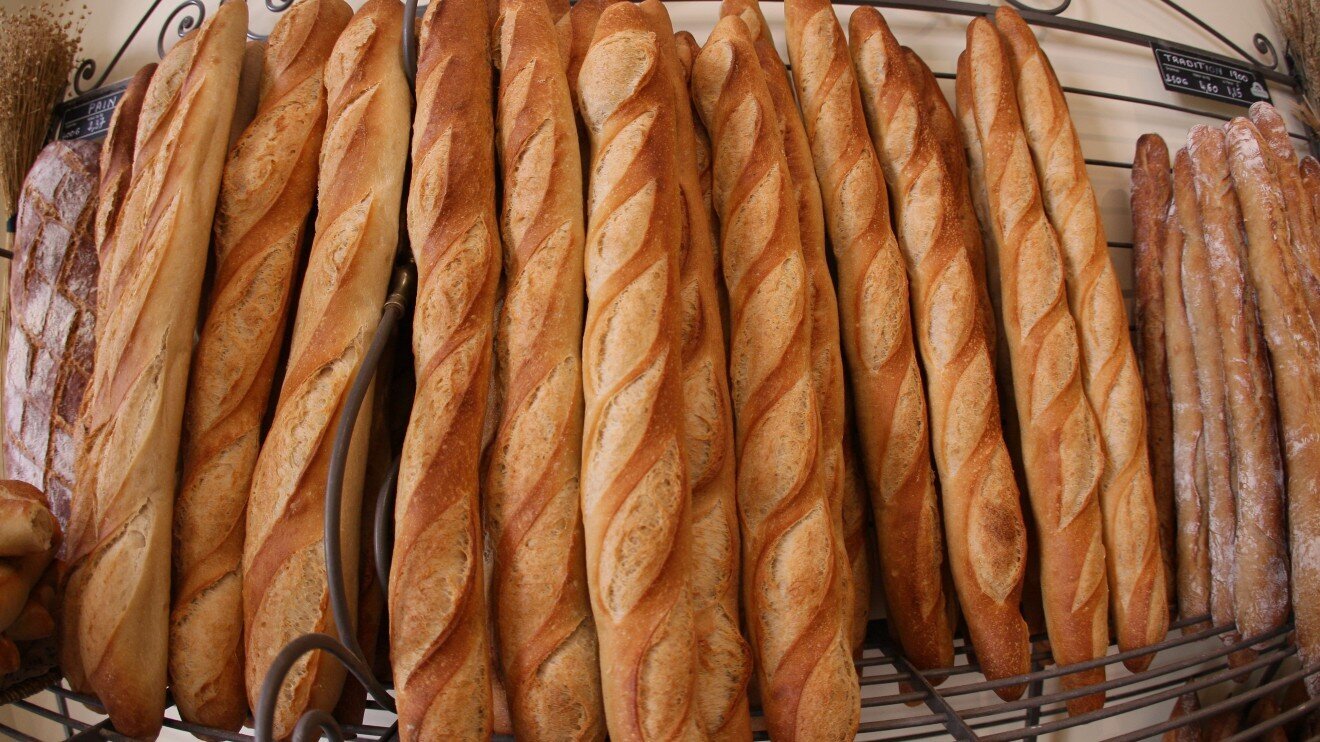
What is a baguette
The baguette (from French baguette, «stick» or «wand») is a traditional elongated French bread that has become a symbol of French culinary culture. A classic baguette is roughly 65 cm long and 5–6 cm in diameter, though it can run to a meter in length. Its distinguishing features are a crisp golden crust and an airy crumb with characteristically large holes.
The word «baguette» was first officially applied to bread in a Seine department regulation of August 1920, which stipulated: «A baguette, weighing a minimum of 80 grams and a maximum length of 40 cm, may not be sold for more than 0.35 francs apiece.» The bread shape itself, however, appeared considerably earlier – prototypes existed as far back as the eighteenth century.
The history of the baguette
The baguette took shape as a distinct type of bread gradually. In the eighteenth century, long, stick-shaped loaves became popular in France. In the early nineteenth century, French bakers began using a high-grade Hungarian flour called «gruau,» and in 1839 August Zang brought Viennese steam ovens to Paris. In 1867, at the World’s Fair, Adolf Ignaz Mautner von Markhof presented a compact yeast starter.
There are several legends about the baguette’s origin. One credits its invention to Napoleon Bonaparte, who supposedly ordered bread made in the shape of a stick so soldiers could carry it more easily. Another links the baguette’s appearance to the Paris Métro – the story goes that management demanded a bread workers could tear apart by hand, so they wouldn’t carry knives and get into fights.
The most plausible version ties it to a 1919 law (which took effect in October 1920) banning bakers from working between 10 p.m. and 4 a.m. That made it impossible to produce the traditional round loaves in time for breakfast, so bakers switched to faster-baking long shapes.
Soviet bread products vs. the French baguette
The USSR had a well-developed bread-production system, but it had no classic French baguette. According to a 1971 catalogue, the Soviet Union produced roughly a hundred different types of bread and baked goods, including:
- Loaves of various kinds (plain, scored, «city,» «capital,» raisin)
- Rolls (honey, glazed sweet, poppy-seed, school, puff pastry)
- Buns («Russian,» «city,» «Moscow-region»)
- Sayki, challahs, braided loaves
- Various kinds of kalach (Moscow, Leningrad, Saratov)
The closest Soviet equivalent to the baguette was the baton – an elongated loaf made of wheat flour. But the baton differed substantially from the French baguette:
Key differences between the baton and the baguette
| Characteristic | Soviet baton | French baguette |
|---|---|---|
| Shape | Oval, thicker | Long, thin stick |
| Length | 30–40 cm | 65 cm or more |
| Crust | Soft, not crisp | Hard, crisp |
| Crumb | Dense, fine-pored | Airy, large-pored |
| Ingredients | Flour, water, yeast, salt, sugar, margarine | Only flour, water, yeast, salt |
| Shelf life | 2–3 days | A few hours before losing freshness |
The fundamental difference lay in the baking technology. Soviet batons were baked in ordinary bread ovens, while a real baguette requires special steam ovens with high heat (over 200°C) and a steam injection, which produces its characteristic crisp crust.
The baguette in pre-revolutionary Russia
Surprisingly, the baguette was much better known in pre-revolutionary Russia than it was in the USSR. Major cities of the Russian Empire had French bakeries producing genuine baguettes to Parisian recipes. This was especially true of St. Petersburg and Moscow, where French cuisine was fashionable among the aristocracy and the bourgeoisie.
It was precisely that era the band «Bely Oryol» («White Eagle») sang of in its famous song «Kak Upoitelny v Rossii Vechera» («How Intoxicating the Evenings Are in Russia,» 1998): «And Schubert’s waltzes, and the crunch of the French loaf.» The «French loaf» in question was precisely the baguette – a symbol of refinement and the European lifestyle of the Russian nobility.
The French as «baguettes»: linguistic slang
In the English-speaking world, especially in Britain and the US, the French are often referred to with the slang term «baguettes» or simply «frogs.» This stems from persistent stereotypes about French cuisine.
Examples of English slang for the French
- Baguettes – a direct reference to the national bread
- Frogs – from the stereotype of eating frogs’ legs
- Cheese-eaters – a nod to French cheeses
- Garlic-munchers – a reference to garlic in French cooking
- Frog and toad – Cockney rhyming slang, shortened to «frogs»
American slang also has the ironic phrase «cheese-eating surrender monkeys» – a line popularized by «The Simpsons» that stuck as a stereotypical characterization of the French.
Interestingly, no equivalent culinary slang for the French ever developed in Russian. They were traditionally called «little Frenchmen» or «frog-eaters,» but never «baguette-eaters,» even though that would have been a fairly natural coinage.
How a real baguette is made
The classic «baguette de tradition française» is made from just four ingredients: wheat flour, water, yeast, and salt. French law strictly regulates the composition of a traditional baguette – it may contain no additives beyond a small amount of bean flour (up to 2%), soy flour (up to 0.5%), and malt flour (up to 0.3%).
The process involves several stages:
- Kneading the dough – a long knead to develop the gluten
- First fermentation – the dough rises for 2–3 hours
- Shaping – the dough is rolled out and formed into long loaves
- Proofing – the shaped baguettes rise on special grooved cloths
- Scoring – diagonal slashes are cut into the surface with a blade
- Baking – in a steam oven at 220–240°C, with a steam injection
It’s precisely that steam baking that produces the crisp crust distinguishing a true baguette from every other kind of bread.
Varieties of French bread
France has several varieties of long bread:
- Baguette ordinaire – the standard baguette (250 g)
- Baguette de tradition – a traditional baguette made to the old recipe
- Ficelle – a thin baguette weighing about 100 g
- Flûte – a baguette twice the usual size
- Bâtard – a short, thick baguette weighing 500 g
- Pain de campagne – country bread
Baguettes can vary in taste, texture, and even shape across different regions of France, but the core production principles remain unchanged.
The baguette in modern Russia
Genuine French baguettes only appeared in Russia in the 1990s, with the arrival of Western bakeries and restaurants. During the period the novel is set in (1997), they remained something of an exotic item, available mostly at expensive establishments in Moscow and St. Petersburg.
Mass production of baguettes in Russia began only in the 2000s, once domestic bakeries adopted French technology and acquired the necessary equipment. Today, baguettes can be bought in practically any Russian supermarket, though their quality often falls well short of French standards.
The band «Bely Oryol» and the «crunch of the French loaf»
The song «Kak Upoitelny v Rossii Vechera» by the band «Bely Oryol» («White Eagle») became a genuine cultural phenomenon of the late 1990s. The band’s founder, businessman Vladimir Zhechkov, recorded the track «out of boredom,» as he himself admitted: «I felt like singing, so I sang; I felt like falling in love, so I fell in love… When you’ve got money, you don’t need brains.»
The lyrics were written by poet Viktor Pelenyagre, with music by Alexander Dobronravov. Interestingly, the poem was originally not about Russia at all, but about Samara – «How intoxicating the evenings are in Samara.» The lines came to the poet during a walk through the city with a local girl.
The phrase «the crunch of the French loaf» from this song got a second life in 2001, when sociologist Sergei Kara-Murza used it in his book «Soviet Civilization» as a symbol of idealized notions about pre-revolutionary Russia. Since then the phrase has become a stock expression, widely used in Russian social and political discourse.
The song won the «Golden Gramophone» award (1999) and a prize at the «Song of the Year» festival (2000), and by the early 2000s it had even acquired the informal status of Russia’s unofficial anthem. The music video, directed by Vladimir Yankovsky and featuring actress Marina Mogilevskaya, still racks up millions of views today.
The band «Bely Oryol» was founded in 1996 and reached the height of its popularity in 1997–1999. After the tragic death of Vladimir Zhechkov’s daughter in 2002, he stepped back from the band’s active work and moved to France. The group continued on with various lineups, but never again reached its earlier popularity.
Conclusion
The history of the baguette is not just the history of a bread, but a history of cultural ties between France and Russia. In pre-revolutionary Russia, the French baguette was a symbol of European refinement; in the Soviet era it was replaced by the more practical baton; and in the post-Soviet period it returned as a symbol of openness to Western culture.
The use of the word «baguettes» as slang for Frenchmen in a novel set in 1997 reflects not just the hero’s command of English, but his ironic attitude toward European realities. At the time, real baguettes were still an exotic foreign item for most Russians, a symbol of an unattainable Western lifestyle.
Today the baguette has become firmly established in Russian culinary culture, but its journey – from the aristocratic drawing rooms of the nineteenth century, through the Soviet baton, to today’s supermarkets – reflects the full complexity of Russian-French cultural relations.