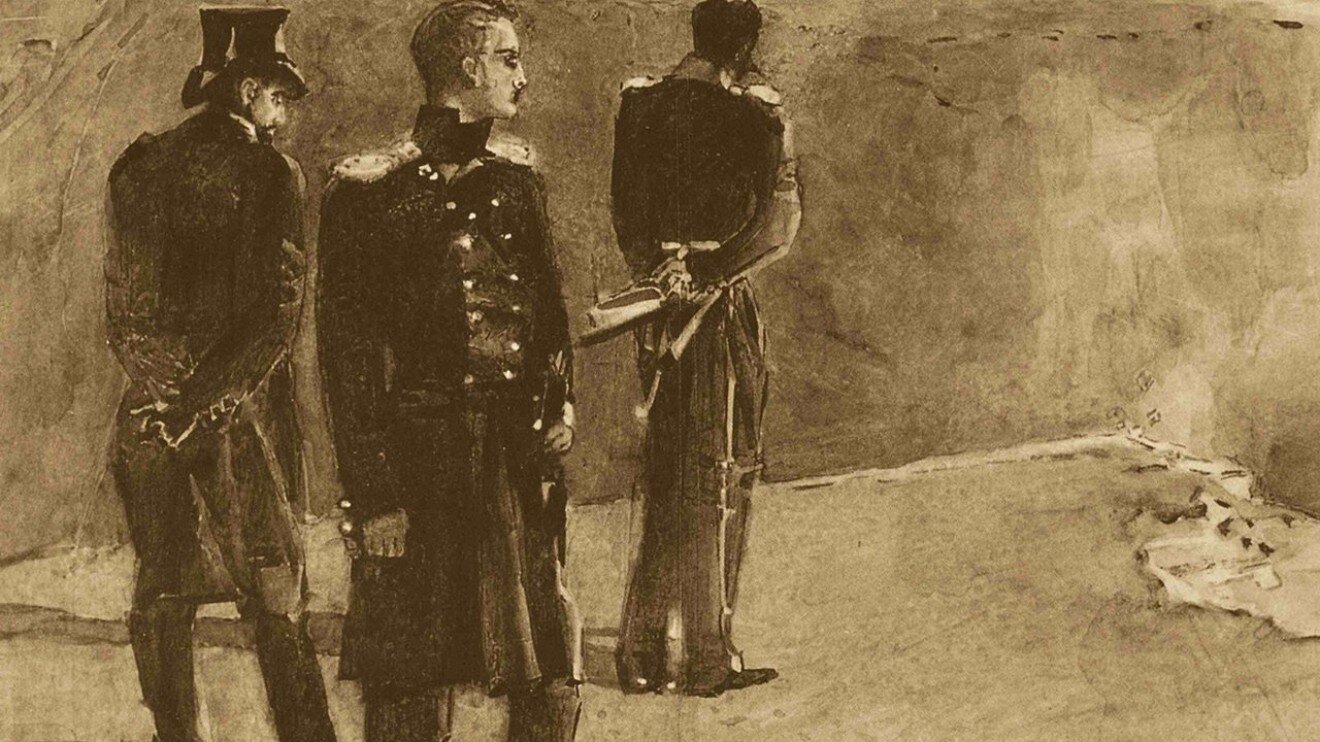
The «superfluous man» («лишний человек») is one of the defining character types of 19th-century Russian literature: an intelligent, often well-educated man, disaffected and purposeless, unable or unwilling to put his talents to any real use in society. Alexander Pushkin’s Eugene Onegin, Mikhail Lermontov’s Pechorin (the brooding antihero of «A Hero of Our Time,» 1840), and Ivan Turgenev’s Bazarov (the nihilist of «Fathers and Sons,» 1862) are its most canonical examples, alongside Alexander Chatsky, the frustrated truth-teller of Alexander Griboyedov’s 1823 verse comedy «Woe from Wit,» whose furious closing exit from a ballroom of hypocrites is one of the most quoted scenes in Russian theater. Zhorik, catching Roman lost in thought, needles him with three of these names in a row purely as an insult, dawdling, brooding intellectuals with nothing to show for themselves, right before ordering him to go do something useful for once.
The "Superfluous Man" in Russian Literature