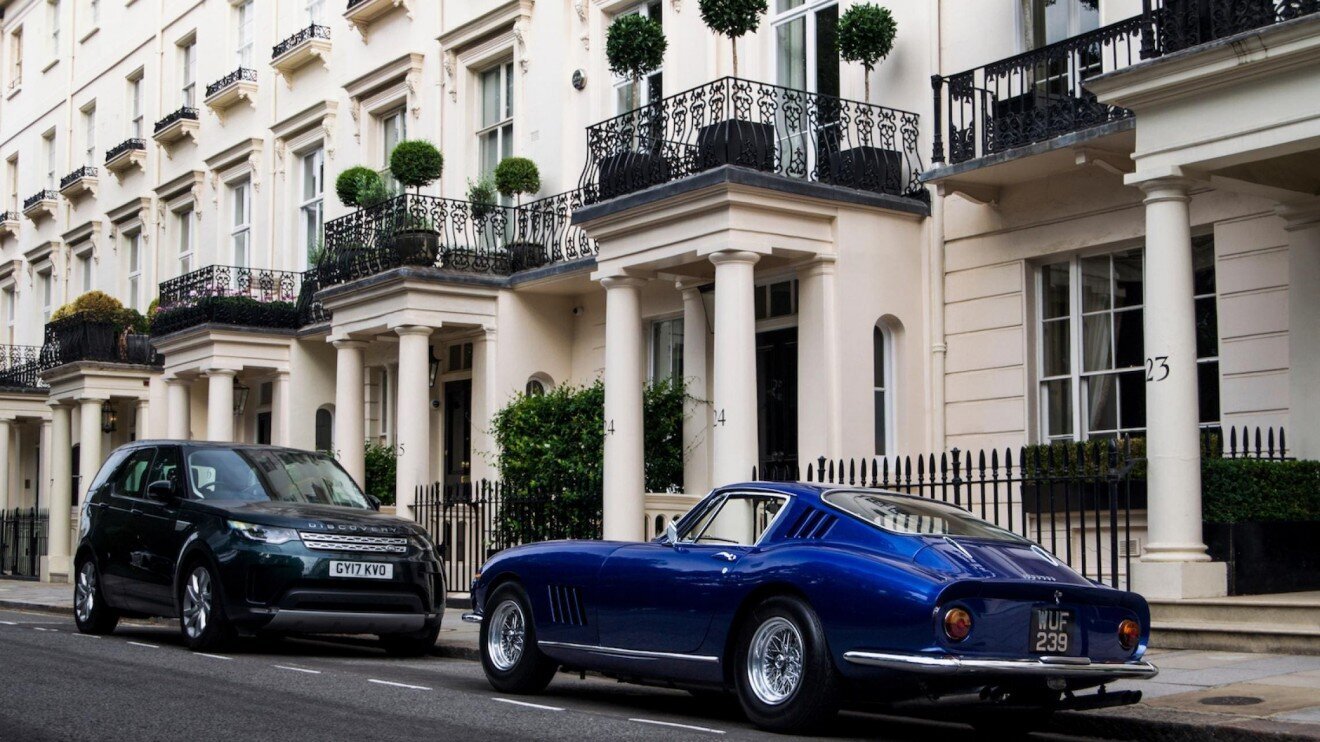
Belgravia is one of the most prestigious districts of central London, straddling Westminster and the Royal Borough of Kensington and Chelsea. For a long time this district has been considered a symbol of British aristocracy and high society, home to nobility, diplomats, and wealthy businesspeople.
Geographic location
Belgravia occupies a strategically important position in central London, southwest of Buckingham Palace. The district is bounded by Knightsbridge to the north, Grosvenor Place and Buckingham Palace Road to the east, Pimlico Road to the south, and Sloane Street to the west. Hyde Park lies to the north, Mayfair and Green Park to the northeast, and Westminster to the east.
The nearest Underground stations are Hyde Park Corner, Knightsbridge, and Sloane Square. The major transport hub of Victoria, with its rail, bus, and Underground lines, lies just east of the district. The A4 motorway and London’s Inner Ring Road both run along Belgravia’s edges.
Historical development
Early history: the «Five Fields»
In the Middle Ages, the land now occupied by Belgravia was known as the «Five Fields» – a series of pastures crossed by footpaths. The Westbourne, a tributary of the Thames, ran through these lands, crossed by the so-called «Bloody Bridge.» The bridge earned its ominous name from frequent attacks by highwaymen and robbers – the area was unsafe after dark.
Chronicles preserve grim accounts of crimes there: in 1728 the body of a man with a mutilated face and severed fingers was found near the bridge, and in 1749 a pastry seller was robbed and blinded there. Its distance from the main part of London made the «Five Fields» a popular site for duels.
Despite its bad reputation, the area was pleasant enough during the day, with market gardens scattered about. That began to change once King George III moved into Buckingham House and built a row of houses on what is now Grosvenor Place.
The creation of modern Belgravia
In 1826, Richard Grosvenor, 2nd Marquess of Westminster, obtained parliamentary approval to develop the land that would become Belgravia. He struck a deal with the eminent architect and builder Thomas Cubitt to design and build the new district.
Construction of the magnificent white stucco terraces ran from 1830 to 1847. The district took its name from the village of Belgrave in Cheshire, two miles from the Grosvenor family’s main country seat, Eaton Hall. One of the Duke of Westminster’s subsidiary titles is Viscount Belgrave.
Belgravia was conceived from the outset as London’s most fashionable residential district. Its architectural ensemble was centered on two main squares – Belgrave Square and Eaton Square – forming a singular example of nineteenth-century urban design.
Architectural features
Belgrave Square
Belgrave Square is the district’s central jewel, one of the grandest squares in Victorian London. It was designed by Thomas Cubitt for the 2nd Earl Grosvenor (later 1st Marquess of Westminster), beginning in 1826, with construction largely complete by the 1840s.
The original layout consisted of four terraces, each made up of eleven large white stucco houses (except for the southeast terrace, which had twelve). Individual mansions stood on three of the corners, with a private garden at the center. The terraces were designed by George Basevi (a cousin of Benjamin Disraeli). The largest of the corner mansions, Seaford House on the east corner, was designed by Philip Hardwick, while the mansion on the west corner was designed by Robert Smirke.
The square holds statues of Christopher Columbus, Simón Bolívar, José de San Martín, Prince Henry the Navigator, and the 1st Marquess of Westminster, along with a bust of Basevi and a sculpture, «Homage to Leonardo, Vitruvian Man,» by the Italian sculptor Enzo Plazzotta.
Eaton Square
Eaton Square is one of three garden squares built by the Grosvenor family, named after Eaton Hall. It is longer but less grand than Belgrave Square, shaped as an elongated rectangle. The first block was laid out by Cubitt in 1826, but construction of the square wasn’t finished until 1855, the year of the architect’s death. That long construction period shows in the variety of architectural styles along the square.
The houses on Eaton Square are large buildings, mostly three bays wide, joined into regular classical-style terraces, with four or five main floors plus an attic and basement, and mews houses behind. The square is divided into six sections by the upper end of King’s Road and two smaller cross streets.
At the east end of the square stands St Peter’s Church, designed by Henry Hakewill and built between 1824 and 1827. The original church was destroyed by fire in 1836 and rebuilt by Hakewill, then restored again in 1987 by the Braithwaite partnership. It’s a Grade II*-listed building in the Greek Revival style, with a six-column Ionic portico and a clock tower.
Other notable streets and squares
Upper Belgrave Street was built in the 1840s to connect King’s Road with Belgrave Square. It’s a wide, one-way residential street of grand white stucco buildings, running from the southeast corner of Belgrave Square to the northeast corner of Eaton Square.
Chester Square is a smaller residential garden square, the last of the three built by the Grosvenor family. It’s named after the city of Chester, near Eaton Hall. Its garden, just under 1.5 acres, is planted with shrubs and herbaceous borders.
Wilton Crescent was created by Thomas Cundy II, surveyor to the Grosvenor estate, following Wyatt’s original 1821 plan for Belgravia. It’s named after the 2nd Earl of Wilton, second son of the 1st Marquess of Westminster. Like much of Belgravia, Wilton Crescent has grand terraces of luxurious white houses arranged in a crescent shape.
Lowndes Square is named after the Secretary to the Treasury, William Lowndes. Like much of Belgravia, it has grand terraces of white stucco houses. Many of the houses on the square were designed by George Basevi.
Social history and famous residents
The Victorian era
From its earliest days, Belgravia was home to British aristocrats, politicians, and cultural figures. George FitzClarence, 1st Earl of Munster, William IV’s illegitimate son, lived at 13 Eaton Square, as did prime ministers Stanley Baldwin (No. 93) and Neville Chamberlain (No. 37).
Chester Square was home to the poet Matthew Arnold (No. 2) and the writer Mary Shelley (No. 24), and later to Margaret Thatcher (No. 73) and Queen Wilhelmina of the Netherlands (No. 77, 1940–1945).
Upper Belgrave Street housed the writer and economist Walter Bagehot (No. 12) and the poet Alfred Tennyson (No. 9). The notorious John Bingham, 7th Earl of Lucan, lived at No. 46 and vanished without a trace in 1974 after his children’s nanny was murdered.
Louis Mountbatten, 1st Earl Mountbatten of Burma, lived at 2 Wilton Crescent for many years, as did the two-time president of Colombia, Alfonso López Pumarejo (No. 33).
The twentieth century: the district transformed
After the Second World War, some of the largest houses ceased to be used as residences for country gentry and aristocracy, and were increasingly occupied by embassies, charity headquarters, professional institutions, and other businesses. Belgravia came to host numerous embassies, especially around Belgrave Square, including those of Bolivia (106 Eaton Square) and Belgium (103 Eaton Square).
By the end of the twentieth century, Belgravia had become a relatively quiet district at the heart of London, in contrast to neighboring areas with their bustling shops, large modern office buildings, hotels, and entertainment venues.
Economic significance
Property and real estate
Most of Belgravia, known as the Grosvenor Estate, is still owned by the Duke of Westminster’s family company, the Grosvenor Group. However, under the Leasehold Reform Act 1967, the estate has been required to sell many freeholds to its former leaseholders.
By the end of the twentieth century, the average house price in Belgravia was £6.6 million (as of March 2010), though many houses rank among the most expensive in the world, priced as high as £100 million. On Lowndes Square, Russian businessman Roman Abramovich bought two stucco houses in 2008; the combined eight-bedroom property was valued at £150 million.
International property ownership
By the early twenty-first century, many residential properties in Belgravia belonged to wealthy foreigners who kept other luxury residences in exclusive locations around the world. Many houses stand empty for long stretches, as their owners are elsewhere. The sharp rise in land values, out of step with the UK average, has made the district increasingly insular.
Some houses began being converted back into residential use in the early twenty-first century, as offices in older buildings became less in demand than in the postwar decades, even as the number of the ultra-wealthy in London reached levels unseen since 1939.
Cultural influence
Literature
Belgravia has repeatedly appeared in British literature as a symbol of the aristocratic way of life. Anthony Trollope’s novels «The Way We Live Now,» «Phineas Finn,» «Phineas Redux,» «The Prime Minister,» and «The Duke’s Children» give precise depictions of nineteenth-century Belgravia.
E. F. Benson used Lowndes Square as the setting for his novel «The Countess of Lowndes Square.» Mick Jagger and James Fox filmed scenes at Leonard Plugge’s house on Lowndes Square.
Film and television
Belgravia has served as a backdrop for many films and television productions. A 1967 episode of the «Batman» television series was set in Belgravia. The popular British TV series «Upstairs, Downstairs» (1971–1975) was set at Richard Bellamy’s house, 165 Eaton Place, Belgravia (the exterior shots used 65 Eaton Place).
The first episode of the second season of «Sherlock» is titled «A Scandal in Belgravia,» based on Arthur Conan Doyle’s story «A Scandal in Bohemia.» The 2018 Netflix film «The Princess Switch,» starring Vanessa Hudgens, is largely set in the fictional kingdom of Belgravia.
In 2020, a historical TV series titled «Belgravia» was released, based on Julian Fellowes’s 2016 novel, which Fellowes himself adapted for television.
Belgravia today
Today Belgravia remains one of London’s most prestigious districts, a symbol of British elegance and tradition. The district blends historical heritage with modern amenities, remaining attractive to the international elite, diplomats, and wealthy businesspeople.
The district’s architectural integrity is carefully protected, with most buildings holding some grade of listed status. The white stucco terraces and gardens continue to define Belgravia’s look, making it one of London’s most recognizable districts.
Its transport links and proximity to central London make Belgravia attractive not only as a place to live but also as a location for the offices of prestigious companies, cultural institutions, and diplomatic missions. The district remains a living testament to nineteenth-century British urban design and a symbol of London’s enduring elegance.