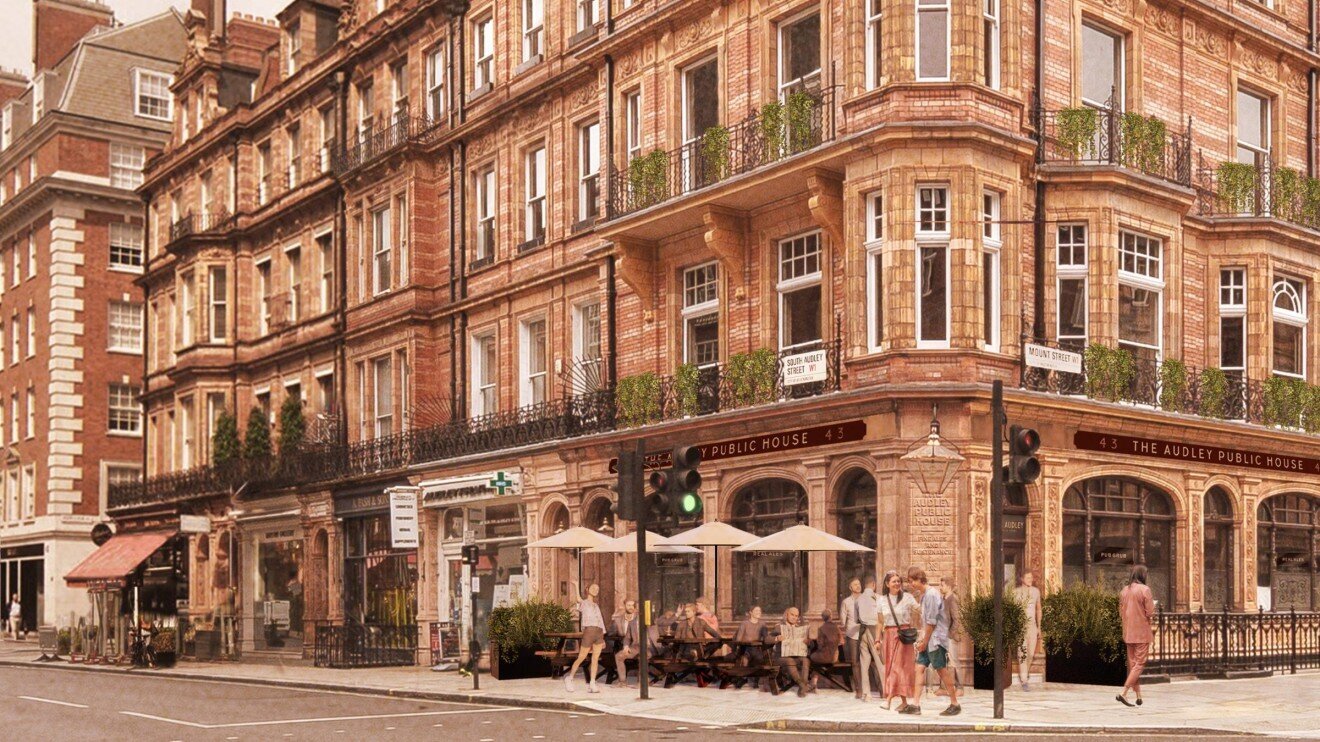
London’s most prestigious district
Mayfair is one of London’s most prestigious and expensive districts, located in the heart of the city in the borough of Westminster. This elite quarter is bounded by Oxford Street to the north, Regent Street to the east, Piccadilly to the south, and Park Lane to the west. Mayfair is considered one of the most expensive districts not just in London, but in the entire world.
Geographic location and boundaries
Mayfair occupies a strategically important position at the very heart of London, forming part of the West End. The district is bordered by some of London’s most famous parks – Hyde Park runs along its western edge, and Green Park along its southern one. This proximity to green space has always been one of the factors that made the district attractive to the aristocracy and the wealthy.
The district’s central point is Grosvenor Square, an 8-acre (3.2-hectare) space that serves as a kind of heart for the neighborhood. It’s London’s second-largest square, after Lincoln’s Inn Fields. Numerous prestigious buildings and residences cluster around it.
Historical development
Early history
Before the eighteenth century, the land now occupied by Mayfair was mostly open fields. The district’s name comes from the annual May Fair, held here from 1686 to 1764 on what is now Shepherd Market. The fair was originally moved here from Haymarket in St James’s because of overcrowding.
By the eighteenth century, the fair had acquired a shady reputation and become a public nuisance. The Earl of Coventry, who lived on Piccadilly, led a campaign against it, and the fair was finally banned in 1764. It was after this that active construction of elite housing in the district began.
The Grosvenor family and estate development
Mayfair’s large-scale development began after Sir Thomas Grosvenor, 3rd Baronet, married Mary Davies in 1677, heiress to part of the Manor of Ebury. The Grosvenor family received 500 acres of land, of which about 100 acres lay south of Oxford Street and east of Park Lane.
In 1721, Sir Richard Grosvenor, 4th Baronet, commissioned the surveyor Thomas Barlow to design a street layout, which has largely survived to this day. Barlow proposed a grid of wide, straight streets, with a large park (today’s Grosvenor Square) as the central feature.
The Grosvenor family became Dukes of Westminster in 1874 and remains the owner of much of the land in Mayfair to this day. By the late nineteenth century the family was described as «the richest family in Europe,» and the annual rental income from their Mayfair property reached roughly £135,000 (equivalent to about £18.5 million today).
Famous squares
Grosvenor Square
Grosvenor Square was laid out as the centerpiece of the Mayfair estate. The square was developed between 1725 and 1731, with 51 individual building plots. Until the mid-twentieth century, it was home to numerous members of the aristocracy. The square has never lost its cachet and remains a prestigious London address.
Only two of the original houses survive: No. 9, once home to John Adams (the future US president), and No. 38, now the Indonesian embassy. The US embassy was located on the square for many years before relocating to Nine Elms in 2017 for security reasons.
Hanover Square
Hanover Square was the first of the three great squares built in Mayfair. It was named after King George I, Elector of Hanover, shortly after his accession to the throne in 1714. The original houses were occupied by «persons of distinction,» such as retired generals. A large statue of William Pitt the Younger stands at the south end of the square.
The Hanover Square Rooms became a popular venue for classical concerts, hosting musicians such as Johann Christian Bach, Joseph Haydn, Niccolò Paganini, and Franz Liszt.
Berkeley Square
Berkeley Square was laid out in the 1730s behind Berkeley House on Piccadilly. Because of the terms of the land sale, houses were only built on the east and west sides of the square. The west side still retains a variety of mid-eighteenth-century buildings, while the east side now holds offices, including Berkeley Square House.
Architecture and property
Mayfair’s architectural character took shape over the centuries, but its main features were established in the eighteenth century. The district is defined by elegant Georgian houses, wide streets, and spacious squares. Many buildings are built of red brick with white stone detailing, a hallmark of London architecture from this period.
Chesterfield Street is one of the few streets to retain eighteenth-century buildings on both sides (with one exception), and is probably the least altered road in the district. It offers a glimpse of what Mayfair looked like during its original development.
The demands of the aristocracy led to the creation of stables, coach houses, and servants’ quarters along the mews (narrow lanes) running parallel to the main streets. Some of these stables have since been converted into garages and offices, but many mews have retained their historic character.
Commercial development
After the First World War, the British upper class went into decline, leading to a shortage of servants and rising wages. Mayfair’s grandest houses became too expensive to maintain, and many were converted into foreign embassies.
After large parts of the City of London were destroyed in the Blitz, Mayfair attracted commercial development, and numerous corporate headquarters were established in the district. Several historically significant houses were demolished, including Aldford House, Londonderry House, and Chesterfield House.
The district grew increasingly commercial, with many offices in converted houses and new buildings, though this trend has reversed in some areas. Since the 1990s, residential property has again become more available, even as rents remain among the highest in London.
Elite shopping and dining
Savile Row
From the early nineteenth century, tailors drawn by the district’s wealthy and influential residents began opening workshops on Savile Row, in southeast Mayfair. The earliest still-operating tailor to move to Savile Row was Henry Poole & Co, in 1846. The street’s reputation grew steadily through the late nineteenth and early twentieth centuries, patronized by monarchs, magnates, and film stars, and it became the world center of men’s tailoring.
Bond Street
Bond Street and its surroundings are home to numerous commercial art galleries and international auction houses, such as Bonhams, Christie’s, and Sotheby’s. This concentration of the art trade has made Mayfair an international hub for art dealing.
Burlington Arcade
Burlington Arcade is one of London’s most luxurious shopping areas, located next to Burlington House. It was designed by Samuel Ware for George Cavendish, 1st Earl of Burlington, in 1819. The arcade was designed with high walls on both sides to keep rubbish from being thrown into the Earl’s garden.
Prestigious hotels
Mayfair is home to some of the most prestigious hotels in the world, underscoring its status as an elite district.
Brown’s Hotel
Opened in 1837, Brown’s is considered one of London’s oldest hotels. It was a favorite spot for Queen Victoria’s tea, and it was from this hotel in 1876 that Alexander Graham Bell made the first successful telephone call in Britain.
Claridge’s
Claridge’s was founded in 1812 as Mivart’s Hotel on Brook Street. It was acquired by William Claridge in 1855. During the Second World War it hosted several European royal families in exile.
The Dorchester
The Dorchester is named after Joseph Damer, 1st Earl of Dorchester. The hotel opened on April 18, 1931, and served as General Dwight Eisenhower’s London headquarters during the Second World War.
The Ritz
The Ritz opened on Piccadilly on May 24, 1906. It was the first steel-framed building constructed in London and remains one of the most prestigious and famous hotels in the world.
Cultural institutions
The Royal Academy of Arts
Housed at Burlington House, the Royal Academy of Arts was founded in 1768 by George III and is the world’s oldest fine-arts society. Its first president was Sir Joshua Reynolds. The Academy holds classes and exhibitions, and its students have included John Constable and J. M. W. Turner.
The Handel House Museum
The Handel House Museum at 25 Brook Street opened in 2001. George Frideric Handel was the house’s first resident, living there from 1723 until his death in 1759. Most of his major works, including «Messiah» and «Music for the Royal Fireworks,» were composed there.
The Faraday Museum
The Faraday Museum on Albemarle Street occupies the basement laboratory Michael Faraday used for his experiments on electromagnetic rotation and motors at the Royal Institution.
International connections
Mayfair has a long history of ties to the United States. In 1786, John Adams established the US embassy on Grosvenor Square. Theodore Roosevelt married on Hanover Square, and Franklin D. Roosevelt honeymooned on Berkeley Square.
The district is home to numerous embassies and diplomatic missions. The Italian embassy is at 4 Grosvenor Square. Part of the Saudi embassy occupies Crewe House on Curzon Street.
By 2006, the Al Thani family, Qatar’s ruling family, along with their relatives and business partners, owned a quarter of Mayfair’s 279 acres. The northwest corner of Mayfair has earned the nickname «Little Doha,» and the district itself is sometimes called the «Qatari quarter.»
Transport
Although there are no Underground stations within Mayfair itself, several sit on its borders. The Central line stops at Marble Arch, Bond Street, and Oxford Circus along Oxford Street on the northern edge. Piccadilly Circus and Green Park are on the Piccadilly line to the south, and Hyde Park Corner is nearby in Knightsbridge.
Down Street station opened in 1907 as «Down Street (Mayfair)» and closed in 1932, but was used during the Second World War by the Railway Executive Committee, and briefly by Churchill and the War Cabinet.
Cultural legacy
Mayfair is the most expensive property on the standard British Monopoly board, priced at £400, and forms the dark-blue set alongside Park Lane. Landing on Mayfair with a hotel costs £2,000. That price reflects the real value of property in the district, which has remained consistently high.
The district features in numerous literary works, including Evelyn Waugh’s «A Handful of Dust» (1934) and P. G. Wodehouse’s «The Mating Season» (1949). It is partly the setting of Jane Austen’s «Sense and Sensibility» (1811). Oscar Wilde lived on Grosvenor Square between 1883 and 1884 and referenced the district in his work.
The district carries numerous blue plaques marking distinguished former residents. At the corner of Chesterfield Street and Charles Street, plaques commemorate William, Duke of Clarence and St Andrews (later King William IV), Prime Minister Lord Rosebery, writer Somerset Maugham, and Regency fashion icon Beau Brummell.
Contemporary significance
Mayfair remains one of the most expensive places to live in London, and in the world. The district boasts exclusive shops, London’s largest concentration of luxury hotels, and numerous restaurants, especially around Park Lane and Grosvenor Square.
The district’s prestigious status endures thanks to a combination of historical heritage, architectural beauty, central location, and a concentration of cultural institutions. Rents in the district can reach £36,000 a week, making it one of the most expensive places to live anywhere in the world.
Mayfair continues to be a symbol of British elegance and luxury, drawing the international elite, diplomats, businesspeople, and art lovers from around the world.