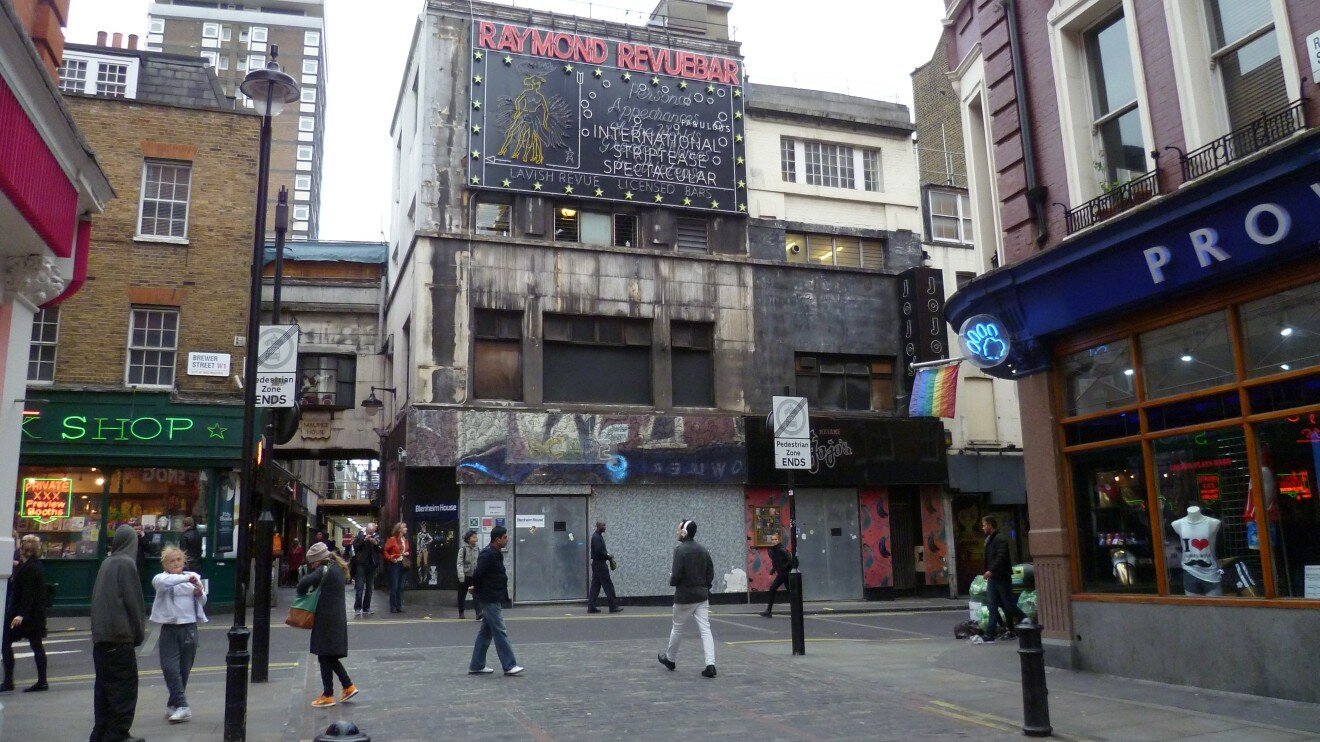
Soho is one of the best-known districts of London’s West End, located in the borough of Westminster. This small district, covering roughly 2.6 square kilometers, has undergone a remarkable transformation over the centuries: from royal hunting grounds to an aristocratic quarter, and later into the capital’s center of entertainment and bohemian life.
Origin of the name and early history
The name «Soho» first appears in documents around 1636 and derives from an old hunting cry. Interestingly, half a century later the same cry was used by James Scott, 1st Duke of Monmouth, as a battle rallying cry for his men at the Battle of Sedgemoor on July 6, 1685.
In the Middle Ages, the land now occupied by Soho was farmland belonging to the abbot and monastery of Abingdon, as well as to the master of the Burton Lazars hospital in Leicestershire. In 1536, King Henry VIII seized these lands and turned them into a royal park for Whitehall Palace.
Formation of the district and its boundaries
Soho has never been an official administrative unit with clearly defined boundaries. It’s traditionally bounded by Shaftesbury Avenue to the south, Oxford Street to the north, Regent Street to the west, and Charing Cross Road to the east. Its nearest neighbors are Mayfair to the west, Fitzrovia to the north, St Giles and Covent Garden to the east, and St James’s to the south.
In the 1660s, ownership of the Soho Fields land passed to Henry Jermyn, 1st Earl of St Albans, who leased 19 of the 22 acres to Joseph Girle. Girle obtained development permission and quickly transferred the lease and development rights to the bricklayer Richard Frith.
The aristocratic period
Building in the district accelerated in the late seventeenth century. Grand mansions went up, including Monmouth House (built for James Scott, 1st Duke of Monmouth, Charles II’s eldest illegitimate son), Leicester House, Fauconberg House, Carlisle House, and Newport House.
Soho Square was first laid out in the 1680s on the site of the former Soho Fields. By 1691, 41 houses had been completed there. The square was originally called King Square, in honor of Charles II, whose statue was placed at its center. Several high-society families moved into the district, including those of Richard Graham, 1st Viscount Preston, and Edward Howard, 2nd Earl of Carlisle.
Although the Earls of Leicester and Portland intended to make Soho an aristocratic estate to rival Bloomsbury, Marylebone, and Mayfair, the district never developed in that direction. From roughly 1680, immigrants began settling there, particularly French Huguenots after 1688, and the district became known as London’s French quarter.
The decline of its aristocratic status
By the mid-eighteenth century, the aristocrats living on Soho Square or Gerrard Street had moved on to more fashionable districts such as Mayfair. By the nineteenth century, the aristocracy had largely abandoned Soho, and prostitutes, music halls, and small theaters took their place. The population grew significantly, reaching 327 residents per acre by 1851, making it one of the most densely populated districts in London.
Houses were subdivided into multi-family tenements plagued by chronic overcrowding and disease. A cholera outbreak in 1854 drove the remaining upper-class families out of the district. That event became a landmark in the history of epidemiology and public health, thanks to John Snow’s investigation, which traced the outbreak to water from a public pump at the corner of Broad Street and Cambridge Street.
The rise of the entertainment industry
Soho’s reputation as London’s premier entertainment district was built on theaters such as the Windmill on Great Windmill Street, and music venues such as the 2i’s coffee bar and the Marquee Club. The Windmill Theatre became famous for its nude tableaux vivants, in which the models had to remain motionless to get around censorship laws.
In 1958 the Raymond Revuebar opened on Walker’s Court, specializing in striptease and nude dance. It was owned by Paul Raymond and advertised as the «World Centre of Erotic Entertainment.»
The music scene
Soho’s music scene traces back to 1948 and the «Club Eleven,» considered the first venue in Britain to feature modern jazz, or bebop. In the early 1950s, Soho became the center of London’s beatnik culture.
The 2i’s coffee bar was one of the first rock clubs in Europe. It originally opened on Gerrard Street in 1956 but soon moved to its better-known location on Old Compton Street. Soho quickly became the hub of London’s nascent rock scene.
The Marquee Club on Wardour Street, opened in 1958, became a legendary venue. In the 1960s it hosted many major rock acts, including the Rolling Stones, The Who, Jimi Hendrix, David Bowie, Led Zeppelin, and Pink Floyd.
Film industry and media
Soho became a hub for the independent film and video industry, as well as for television and film post-production. Trident Studios, on St Anne’s Court, was a major London recording studio, founded by brothers Norman and Barry Sheffield in 1968. It became an immediate success after the Beatles decided to record several tracks there for the «White Album.»
Twentieth Century House was built on Soho Square in 1937 for Twentieth Century Fox. The British Board of Film Classification has been based on Soho Square since 1950.
Restaurants and culinary tradition
Many small, affordable restaurants and cafés were founded in Soho in the nineteenth century, largely as a result of Greek and Italian immigration. Restaurants were initially looked down upon, but their reputation shifted in the early twentieth century.
Kettner’s restaurant on Romilly Street was founded in 1867 by Auguste Kettner, a former chef to Napoleon III. It was frequently visited by the Prince of Wales, Albert, and by Oscar Wilde. The restaurant survived both world wars and was regularly patronized by Agatha Christie and Bing Crosby.
The sex industry
Soho was at the center of London’s sex industry for more than 200 years. After the Street Offences Act of 1959 drove prostitution off the streets, many clubs became fronts for it. By the 1970s, sex shops had multiplied from the handful opened by Karl Slack in the early 1960s.
Between 1976 and 1982, Soho held 54 sex shops, 39 sex cinemas and film clubs, 16 strip shows and peep shows, 11 clubs catering to particular sexual tastes, and 12 licensed massage parlors. By the 1980s, police crackdowns, combined with pressure from the Soho Society and stricter new licensing controls, brought a crackdown on illegal establishments.
Soho today
Since the 1980s the district has undergone significant gentrification. Today it’s primarily a fashionable district of upscale restaurants and media offices, with only a small remnant of the old sex industry left. London’s main gay village is centered on Old Compton Street, in Soho.
The district remains an important cultural and entertainment hub. It’s home to the Soho Theatre, built in 2000 for new plays and comedy. The internet station Soho Radio, on Great Windmill Street, broadcasts live and recorded programming that reflects Soho’s culture.
Streets and landmarks
Berwick Street was built between 1687 and 1703 and named after James FitzJames, 1st Duke of Berwick. A street market has operated there since the early eighteenth century.
Carnaby Street was laid out in the late seventeenth century and became the fashionable heart of London’s «Swinging Sixties,» though it quickly became known for low-quality merchandise as well.
Dean Street was built in the 1680s and originally settled by French immigrants. It’s home to the Soho Theatre and the French House pub.
Frith Street is named after Richard Frith, a local builder. Mozart lived here as a child between 1764 and 1765, and in 1926 John Logie Baird gave the first demonstration of television in Laboratory 22.
Gerrard Street is the center of London’s Chinatown. Built between 1677 and 1685, by 1970 it had become the heart of London’s Chinatown and was pedestrianized, decorated with Chinese gates and lanterns.
Old Compton Street was named after Henry Compton, Bishop of London, and first laid out in the 1670s. Today it is the core of London’s main gay village.
Religious buildings
St Anne’s Church on Wardour Street was built between 1677 and 1686, possibly to a design by Sir Christopher Wren. The church was damaged by a V1 flying bomb during the Second World War, but the tower survived.
London’s French Protestant Church, unique in the city and built in the Flemish Gothic style, has stood on Soho Square since 1893.
Cultural influence
Soho has had a significant influence on British and world culture. The district’s name has been borrowed by other entertainment districts, such as SoHo in Hong Kong and SoHo in Manhattan, New York.
The district is frequently mentioned in literature and music. In Robert Louis Stevenson’s novel «Strange Case of Dr Jekyll and Mr Hyde,» Dr. Jekyll sets Edward Hyde up with a house in Soho. Charles Dickens referenced Soho in several of his works.
Modern Soho remains one of London’s most dynamic and diverse districts, combining a rich history with contemporary culture and entertainment. It’s a place where, for centuries, different cultures, social classes, and creative movements have crossed paths, creating a unique atmosphere that continues to draw people from all over the world.