In 1993 Moscow, the combination of a leather jacket, tracksuit pants with side stripes, pump-style shoes, and white socks formed a stable outfit that let observers identify the wearer as belonging to a particular social group. This combination was regularly seen at city markets, at kooperativy* (private cooperatives), and near commercial storefronts.
The basic rules for pairing socks in classic men's dress
The system for choosing socks in a man's wardrobe rests on the principle of visual continuity. Sock color is set by the color of the trousers or the shoes, whichever is darker. With dark trousers and light shoes, socks should match the trousers. With light trousers and dark shoes, they should match the shoes. The purpose of this rule is to create a smooth transition between shoe and trouser leg, without a jarring color contrast.
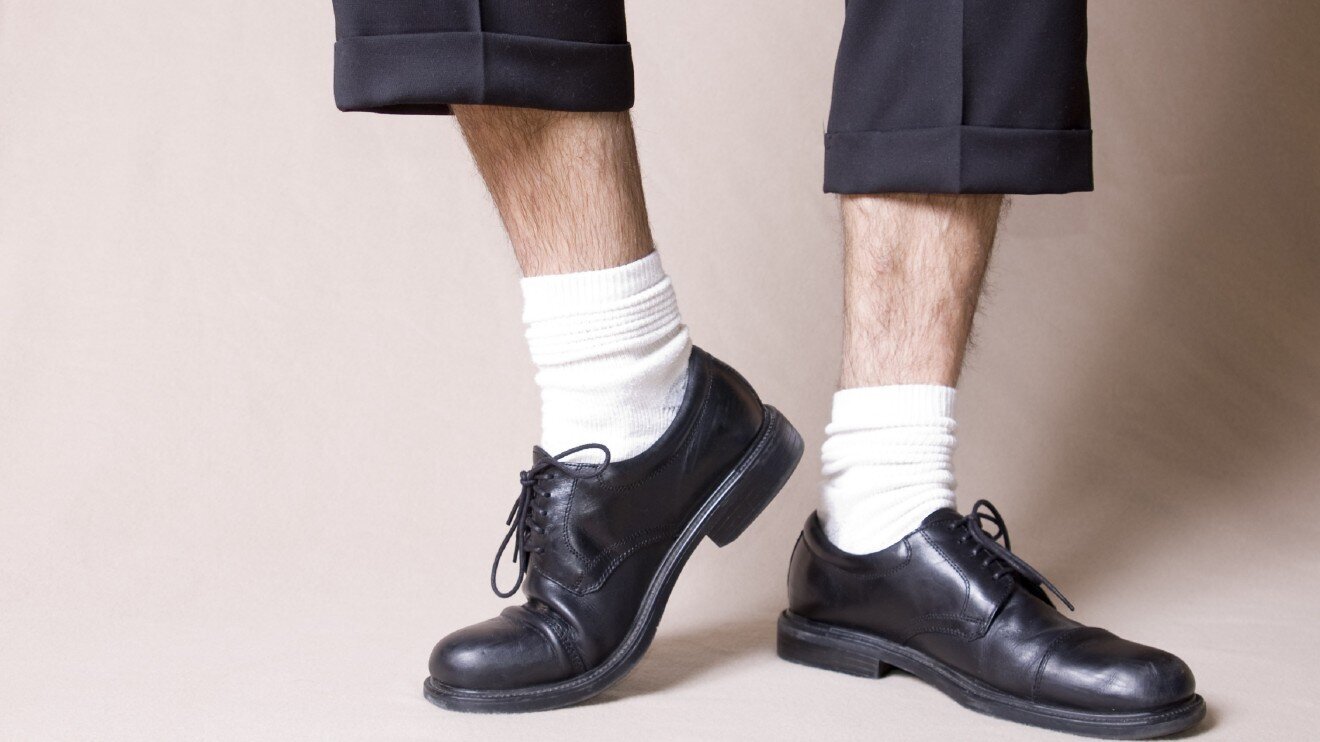
White socks worn with dark shoes and dark or denim trousers break this principle. They create a contrasting white patch between trouser leg and shoe, drawing attention to the ankle area. Instead of an unbroken vertical line to the silhouette, a visual gap appears.
Men's style guides record the rule plainly: white socks are acceptable only with athletic wear — with sneakers for sports. Breaking this rule is treated as a serious error in coordinating an outfit.
White as a "universal" color
Choosing white socks as a universal wardrobe item has several roots. In the popular imagination, white is associated with cleanliness and neatness. A white shirt is the foundation of the business dress code*. White underwear symbolizes hygiene. These associations shaped the idea of white socks as a sign of tidiness.
Dirt shows on white socks, which in theory encourages the wearer to change them more often. There is also a practical reason: white socks are universal to wash. They can be washed with any white laundry, at high temperature, with bleach, without worrying about staining other items. For people with limited means, or only a basic grasp of household management, this is a real advantage.
White athletic socks are the cheapest and most accessible option. They are sold in large, low-cost packs. For someone who doesn't pay attention to the finer points of appearance, they are the optimal choice on both price and practicality.
The rise of a distinctive style in early-1990s Russia
The combination of athletic and formal clothing elements formed at the intersection of several cultural influences. Tracksuit pants and white socks evoked athletic culture, which held special status in the late Soviet era. Athletes formed a privileged group, with access to scarce goods and foreign travel. Athletic clothing, especially imported gear, was a symbol of prestige.
A leather jacket and pump-style shoes symbolized entry into the world of grown men, the ability to earn money and "get things done." It was an attempt to look solid and respectable, made by people with no grasp of the classic canons of men's style.
The result was a hybrid look, combining elements of athletic wear with attempts at a formal dress code. White socks played the role of a universal connecting element, linking mismatched parts of the outfit. Their visibility — a white stripe between shoe and trouser leg — was not an oversight, but a deliberate choice. It was a display of cleanliness and respectability, within a particular system of perception.
For those who wore this style, it represented a way of looking "po ponyatiyam"* ("by the code") — conforming to the norms of one's own social group. Within their circles, a man in a formal suit with dark socks might be seen as a "beloruchka" (a soft-handed person), an intellectual, a "botanik"* (a nerd) — an outsider. White socks were part of a group code, a marker of belonging to a particular milieu.
Typical wearers of the style
In 1993 Moscow, this style of dress was characteristic of the following groups:
- Brigadiry* (crew bosses) at city markets
- Reshaly* ("fixers") within kooperativy
- Security guards at commercial businesses
- People running small- and mid-scale racketeering* operations
- Athletes connected to the criminal world
These groups straddled the line between the legal and criminal economy, between athletic subculture and street life. Their style of dress reflected a social function: they needed to look threatening at once (a leather jacket, a heavy build), athletic (ready for physical action), and yet not entirely criminal — not prison clothing, but something conditionally normal.
The Michael Jackson case
Michael Jackson regularly appeared onstage and in everyday life in black trousers, black shoes, and brilliant white socks, often accented with silver sequins or rhinestones. This case differs radically from the situation with white socks in early-1990s Russia, on several counts.
For Jackson, stage costume was a form of art, not adherence to the rules of everyday dress. His white socks were part of a carefully considered image, an element of choreography: they made his footwork more visible onstage, emphasizing his moonwalk*.
Jackson did not wear ordinary athletic socks, but specially made stage accessories, often decorated and embellished. This was not an attempt to look "correct" or respectable, but a deliberate act of eccentric self-presentation.
Jackson possessed enormous cultural capital* and influence, which let him break any rule — his standing in the world of fashion and entertainment was so secure that details of dress could not shake it. When rules are broken by someone of high status, it can be read as innovation. When they're broken by someone who doesn't understand the rules in the first place, it reads as bad taste.
The Jackson phenomenon led some pop-culture fans in various countries to imitate his style without understanding its context. White socks with dark trousers and shoes came, for some, to be seen as a stylish look.
Exceptions to the rule
Certain situations exist where white socks can be worn with everyday clothing without breaking the rules. These exceptions are specific:
- An entirely white or light-colored ensemble. When wearing white trousers and white shoes, white socks provide visual continuity from shoe to trouser leg. This does not mean athletic socks, but thin, high-quality cotton or linen socks from well-known brands.
- Two-tone shoes in light colors. Classic brogues* or oxfords*, made in a white-and-brown combination, allow for light-colored socks worn with light summer trousers.
- Summer linen ensembles. In hot climates, with light linen suits in cream, beige, or white, light off-white* socks can be appropriate. This means expensive, thin socks, not thick athletic ones.
The key distinction in these exceptions: light-colored socks are appropriate only in harmony with the outfit's overall light palette, not when creating a sharp contrast. It is always a matter of quality socks in a fine material, not thick athletic ones with logos.
White socks as a social code
Clothing is a system of communication. Every detail of an outfit tells those around a person information about them: their social status, education, values, self-identity. White socks with dark clothing are a glaring error within this system — an error someone with a certain level of cultural capital would not make.
Observing this error prompts a conclusion: the person either doesn't know the rules (low cultural capital), or knows them but ignores them (a demonstrative disregard for social norms). Either way, it signals membership in a particular social group.
White socks with dark shoes are not merely an error, but a maximally conspicuous one. A bright white patch at the border of trouser leg and shoe draws the eye. It shapes the impression of the entire outfit, regardless of the quality of its other elements.
The context of 1993 Moscow
The early 1990s was an era of rapid social transformation. Old Soviet norms were collapsing, and new ones had not yet formed. People searched for new identities, new ways of marking their place in society.
For some, the marker of success became the crimson blazer* and the jeep*. For others, it was a suit and tie with a briefcase, symbolizing membership in the new business class. For still others, deliberately careless dress, displaying disdain for material values.
White socks with shoes and tracksuit pants formed the uniform of a particular social group. Their style of dress reflected their social function and value system. In this context, white socks were an attempt to add an element of cleanliness and respectability to the image — though the result was the opposite: this detail immediately gave away the wearer's social affiliation.
Its function as a social marker
In 1993 Moscow, the ability to read social codes through clothing had real practical value. For people working at markets or within commercial structures, identifying visitors by appearance was a matter of survival and safety.
The combination of a leather jacket, tracksuit pants with side stripes, pump-style shoes, and white socks was not a random assortment of clothing items. It was a coherent statement, a sign of belonging to a specific social group and a specific value system. A visitor's clothing immediately conveyed information about who one was dealing with, what to expect, how to behave.
White socks, in this context, were a serious social indicator — an element of the language various groups in early-1990s Moscow used to communicate with one another.
Details of dress carry significant social weight. Style is a language through which people convey information about their identity to those around them. A pair of socks can communicate more than verbal speech.