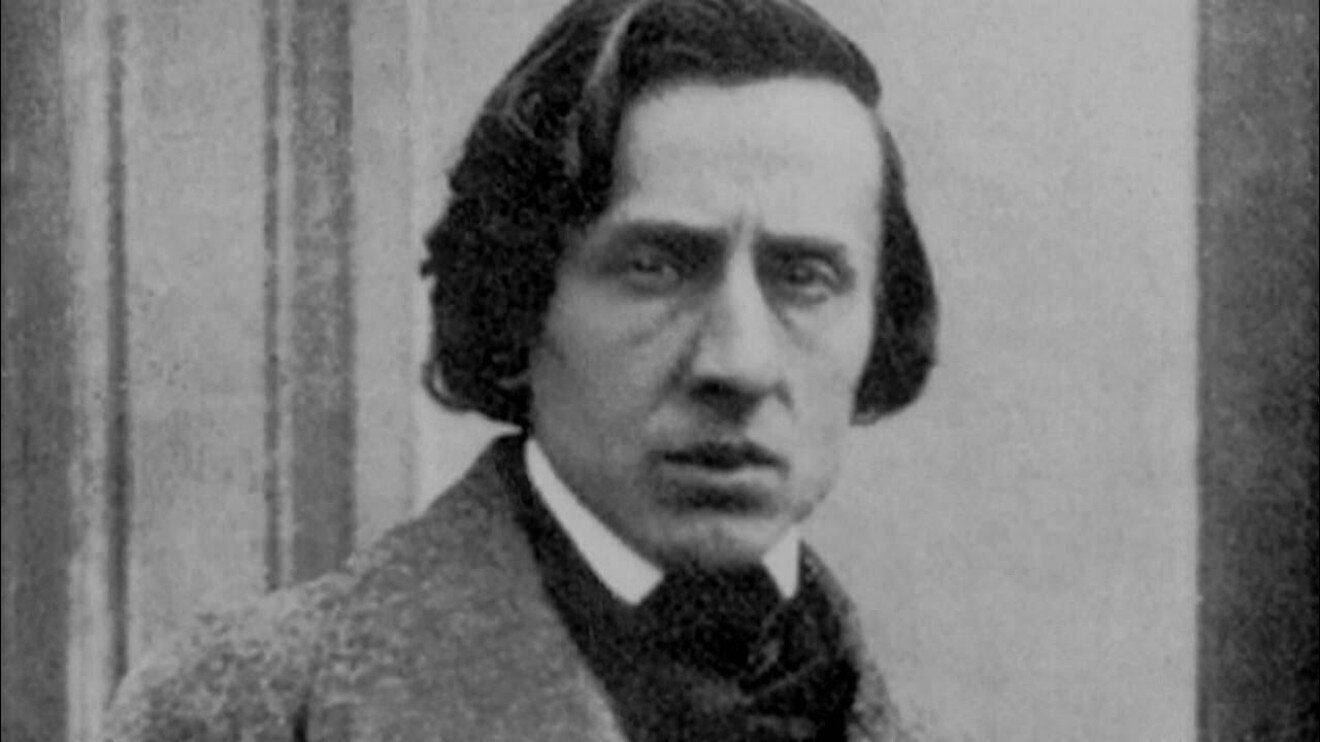
The novel mentions "Chopin's Opus Thirty-Five, movement number three" — a veiled threat that the main character, Vadim, uses to intimidate street toughs in early-1990s Moscow. Behind this cultural reference lies one of the darkest and most recognizable works in world musical literature — the Funeral March from Frédéric Chopin's Second Sonata.
Opus 35: the Sonata in B-flat minor
Piano Sonata No. 2 in B-flat minor, designated Opus 35, was completed by the Polish composer Frédéric Chopin in 1839, and published a year later. This work became one of the three piano sonatas Chopin wrote in his lifetime, and, without question, the most famous of them.
A distinctive feature of this sonata is that its third movement — the famous Funeral March — was written considerably earlier than the other movements, back in 1837, when the twenty-seven-year-old composer first felt the onset of the lung disease that would eventually cause his early death. This melody has become so deeply etched into humanity's cultural memory that it has become a universal symbol of death, grief, and farewell.
The sonata's structure
The sonata consists of four movements, each its own distinct musical world:
First movement: Grave. Doppio movimento
It opens with a brief four-bar introduction, in which the tonic center immediately shifts. The main theme runs in B-flat minor, and is marked by turbulence, with constant shifts in volume, from forte to piano. Robert Schumann, the great German Romantic composer and Chopin's contemporary, wrote of this theme: "Only Chopin could begin this way, and only he could end it this way: from dissonances, through dissonances, to dissonances."
The secondary theme contrasts with the main theme in its lyricism at first glance, but in fact complements and balances its pathos. The development is based mainly on the main theme, which sounds in the lower register, taking on an extremely somber cast. The two themes develop a picture of dramatic struggle — the central image of the entire sonata. In the recapitulation, as is often the case with Chopin, the main theme is omitted, and the recapitulation itself is written in the parallel major, B-flat major. In the coda, phrases from the main theme reappear in the bass, while powerful chords in the right hand surge toward the upper register.
Second movement: Scherzo
The scherzo is titled as such by Chopin himself, and ranks among the most dramatic works of this genre he ever wrote. Traditionally, a scherzo implies lightness, playfulness, a jesting character (the word "scherzo" itself means "joke" in Italian), but Chopin turns this genre into something entirely different — a tense, dramatic, almost sinister statement.
Third movement: Marche funèbre. Lento
This is the movement at the very center of the entire sonata — both compositionally and in terms of its significance. The Polish musicologist Józef Chomiński wrote: "After the heroic struggle, the funeral march is, evidently, already the drama's final act…"
Fourth movement: Finale. Presto
The finale lasts just a minute and a half — the shortest finale in the history of large-scale piano form. Both voices sound in unison, creating a sense of emptiness and hopelessness. The great Russian pianist Anton Rubinstein called this movement "the night wind sweeping over graves in a cemetery." Robert Schumann was stunned by this finale, writing that this movement is "devoid of melody and joy," even that it is "not music" — while nonetheless acknowledging the presence, within it, of some kind of "horrifying spirit." The sonata ends with a powerful fortissimo chord — first in the bass, then, almost immediately, in the upper voice.
Schumann himself called the entire sonata "the four maddest of Chopin's offspring" — a remark reflecting his contemporaries' bewilderment before this unusual, somber work, revolutionary for its time.
The third movement: the Funeral March
When, in the novel, Vadim mentions "Chopin's Opus Thirty-Five, movement number three," he means precisely the Funeral March — the Marche funèbre. Lento. This is not merely a piece of music — it is a cultural code that, in 1990s Russia, was understood by practically every educated person.
The march's musical structure
The march is written in three-part form. In the first section, steady bass chords play a special role, underscored by the dotted rhythm of the upper voice. Musicologists believe this imitates the tolling of a bell — a slow, heavy funeral knell. The tonal structure of the third movement mirrors that of the first: B-flat minor gives way to D-flat major.
The middle episode of the march can be called elegiac, songlike — a moment of light amid the darkness, a ray of hope breaking through the mourning clouds. The Soviet People's Commissar for Enlightenment, writer, and literary critic Anatoly Lunacharsky left a moving description of this march:
"The procession unfolds, gigantic and black, long files of people with bowed heads… And suddenly the black shroud tears open. A ray of sun falls through the clouds. Something ignites in the black depths of the heart, something is still believed in, a certain tenderness grips the throat, and almost sweet tears well up in the eyes. Someone sings, sadly and simply — the song promises nothing, it is mysterious, this song, but somehow it consoles. Yet the roiling masses of black clouds once again hide the fleeting ray of sun. And again, straining, the somber, funereal music sounds…"
This description conveys the march's emotional architecture with striking precision: darkness — illumination — the return of darkness. This structure reflects the path of human grief: from the first shock of loss, through an attempt to find consolation, to the final acceptance of an irrecoverable loss.
The Funeral March in history
Chopin's Funeral March has accompanied the burial of many famous people around the world. Among them: US President John F. Kennedy, CPSU Central Committee General Secretary Leonid Brezhnev, and Queen Elizabeth II of the United Kingdom. In the Soviet Union, this march was performed at most state funerals — if not during the funeral procession itself, then at least at the moment of burial.
A striking irony of fate: Chopin himself was buried at the Père Lachaise Cemetery in Paris to the sound of his own Funeral March, orchestrated by the French composer Napoléon Henri Reber. This took place on October 30, 1849, nearly two weeks after the composer's death. So many people wished to bid farewell to the great musician that entry was by ticket only — more than three thousand people, who had come from London, Berlin, and Vienna, were unable to attend the farewell.
Another orchestration of the Funeral March was made in 1933 by the English composer Edward Elgar, and a year later, this version was performed for the first time — at Elgar's own funeral — yet another tragic example of how funeral music becomes autobiographical for those who come into contact with it.
Frédéric Chopin: a brief biography
To understand the depth and significance of the Funeral March, one must know something of its creator — a man whose life was filled with suffering, longing for his homeland, and a premonition of early death.
Origins and childhood
Frédéric François Chopin was born on March 1, 1810, in the village of Żelazowa Wola, near Warsaw. His father, Nicolas Chopin, was a Frenchman from a modest family, who had moved to Poland in 1787 and worked as a teacher of French and German. His mother, Tekla Justyna Krzyżanowska, came from Polish gentry stock, and was highly musical — she played the piano well, and had a beautiful voice.
From the age of three, little Frédéric showed remarkable musical ability. A family anecdote survives: the child was found at night at the piano, picking out a dance tune his mother had played during the day for the boarders at his father's school. Asked what he was doing, the boy replied that he wanted to be able to take his mother's place, in case she grew tired.
Chopin's first teacher was his older sister Ludwika; then, when the boy was seven, the pianist Wojciech Żywny, a Czech by origin who considered himself a representative of the Bach school, began teaching him. This is how Chopin, from the earliest age, became acquainted with the great Johann Sebastian Bach, and carried a reverence for the Leipzig cantor throughout his entire life.
At eight, Chopin performed in public for the first time, and was compared to Mozart. By age twelve, his performing talent had developed to such a degree that Żywny gave up further lessons, declaring he could teach the young virtuoso nothing more.
Education and youth
From age twelve, Chopin began theoretical studies under the composer Józef Elsner, who characterized his student as a "musical genius," and did not confine him to any strict rules or methods. In 1826, Chopin entered the Warsaw Conservatory of Music, under Elsner, where his gift for composition fully blossomed.
Trips to Berlin, Dresden, and Prague, and visits to concerts by outstanding musicians, opera houses, and art galleries, helped shape the young composer's broad cultural outlook.
Parting with his homeland
Chopin's public career began in 1829. He undertook a concert tour of Austria, where the press wrote of him as a "new northern star" and "a bright meteor on the musical horizon." But on November 5, 1830, Chopin left Warsaw forever. This separation from his homeland became the source of a constant, hidden grief that runs through all his work.
In 1830, an uprising for independence from the Russian Empire broke out in Poland. Chopin dreamed of returning home and taking part in the fighting, but on the road he was overtaken by terrible news: the uprising had been crushed, and its leaders taken prisoner. In Stuttgart, Chopin wrote a diary reflecting his state of mind — despair, anger, hope. "Poland will be brilliant, mighty, independent!" he wrote. It was during this period that his famous "Revolutionary Etude" appeared — a musical embodiment of a defeated nation's fury and grief.
The Paris years
Traveling through Dresden, Vienna, Munich, and Stuttgart, Chopin arrived in Paris in 1831. He spent the rest of his short life here. He gave his first Paris concert at age twenty-two; it was a complete success. Chopin rarely performed in concerts, but his fame grew extraordinarily fast in the salons of the Polish colony and the French aristocracy.
In Paris, Chopin surrounded himself with outstanding musicians and figures of the arts. He kept up acquaintance with the leading European composers of his time: Franz Liszt, Felix Mendelssohn, Vincenzo Bellini, Hector Berlioz, and Robert Schumann. Among his friends were the painter Eugène Delacroix, the poet Adam Mickiewicz, and the writer Heinrich Heine.
Over time, Chopin took up teaching. A love of teaching piano was a distinguishing trait of the composer — he was one of the few great artists who devoted so much time and effort to it.
Illness and love
In 1837, Chopin felt the first attack of his lung disease — most likely, tuberculosis. This was a fatal disease in the 19th century, slow and agonizing. It was in this very year that the twenty-seven-year-old composer wrote his Funeral March — perhaps sensing his own fate.
That same year, 1837, Chopin met the writer George Sand (real name Aurore Dudevant), with whom he began an affair. Though she had many admirers, she broke off all her other ties, and devoted herself entirely to Chopin. On doctors' advice, they spent most of their time in a subtropical climate, though Chopin found the rainy seasons hard to bear, as they worsened his tuberculosis.
While staying at a monastery on the island of Mallorca, Chopin fell into a melancholic state, marked by longing and thoughts of death, along with auditory hallucinations. Sand cared for him, carefully following every doctor's instruction. Many works, including the famous 24 Preludes, were composed on Mallorca. After returning to France, he settled at Sand's estate in Nohant, where his health temporarily improved. There he composed his famous B-flat minor sonata (the one with the Funeral March), along with numerous nocturnes and mazurkas.
Ten years of life with George Sand, full of emotional trials, badly undermined Chopin's health. Their breakup in 1847 caused him considerable stress, and cost him the chance to rest in Nohant's favorable climate. Wishing to leave Paris and change his surroundings, Chopin traveled to London in April 1848 to give concerts and lessons. This proved to be his last journey. Chopin's final public concert took place on November 16, 1848, in London.
Death
In late November 1848, Chopin returned to Paris. His health continued to decline. In June 1849, his sister Ludwika, with her husband and daughter, came from Poland to be by his side. From September 1849, Chopin lived in a hotel on the Place Vendôme. On October 17, after midnight, a doctor leaned over him and asked if he was suffering greatly. Chopin answered: "No longer." The composer died that same day, a few minutes before two in the morning, at the age of thirty-nine.
At Chopin's request, his sister Ludwika took his heart (which had been removed and placed in a jar of spirits) back to Poland. The urn containing the composer's heart was placed in one of the pillars of the Holy Cross Church in Warsaw, where it remains to this day. Chopin is thus physically divided between his two homelands: his body rests in Paris, and his heart in Warsaw.
Chopin's body of work
Frédéric Chopin is the author of numerous works, almost exclusively for piano. He wrote only two concertos for symphony orchestra and a handful of songs — everything else was devoted to his beloved instrument.
Chopin transformed many musical genres: he revived the prelude on a Romantic footing, created the piano ballade, and poeticized and dramatized dance forms — the mazurka, the polonaise, the waltz — turning the scherzo into an independent work in its own right. He enriched harmony and piano texture, combining classical form with melodic richness and Romantic imagination.
Among Chopin's works are: 2 concertos, 3 sonatas, a fantasy, 4 ballades, 4 scherzos, impromptus, nocturnes, etudes, waltzes, mazurkas, polonaises, and preludes. Characteristic features of his music include exceptional nobility and spirituality, and a striving for perfection in the smallest details.
In his works, Chopin actively drew on Polish genres and folklore. He turned the mazurka, a Polish folk dance, into a professional concert work, for example, while preserving its national character and spirit.
The musicologist Nikolai Solovyov wrote, in the Brockhaus and Efron Encyclopedic Dictionary: "Chopin's music is full of boldness and imagery, and never suffers from mere whimsy. If, after Beethoven, an era of stylistic novelty arrived, then Chopin was, of course, one of the chief representatives of that novelty. In everything Chopin wrote, in his wondrous musical contours, one sees a great musician-poet."
Unlike Franz Liszt, who treated the piano as an instrument capable of reproducing an orchestra's grandiose sound, Chopin explored the possibilities peculiar to the piano's own timbre. According to his contemporaries' accounts, Chopin could not play forte — the upper limit of his dynamic range was roughly mezzo-forte. This was not a weakness, but a feature of his artistic vision: Chopin's music addresses the listener's inner world; it does not overwhelm through loudness, but penetrates the soul through subtlety and depth.
A cultural code: why Vadim mentions Chopin
Returning to the novel: when Vadim, in an early-1990s office, mentions "Chopin's Opus Thirty-Five, movement number three," he is deploying a sophisticated cultural threat. The Funeral March is a universal symbol of death and burial, understood by any educated person in Russia at the time.
Vadim's line, "There's an orchestra too, ready to perform Chopin's Opus Thirty-Five, movement number three," means: there are people ready to arrange your funeral. And this threat is delivered not crudely, not head-on, but in a cultured manner, with a touch of irony. It is a kind of password of the educated person, separating "us" from "them."
In the context of 1993, when crime was infiltrating every sphere of life, when bandits in tracksuits were "settling accounts" with businessmen, such a cultural reference served as a marker of social status. Vadim demonstrates that he is not dealing with street hooligans, but with serious people who have both education and connections, and the means to organize anything — up to and including a funeral with an orchestra.
Interestingly, Vadim does not say directly "we'll kill you" or "our people will deal with it." Instead, he suggests the toughs go down to the first floor, to meet "the crew, open to business proposals," hinting that serious people wait there, capable of "performing" the Funeral March. This is a typical structure of power in the 1990s: at the top, cultured "businessmen," doing business; below, "the crew," settling matters by force.
The phrase itself is constructed cleverly: first, an offer of business negotiations ("the crew, open to business proposals"), then a veiled threat ("There's an orchestra too"), then a demonstrative distancing ("But our job is a small one. We're just businessmen at heart. We've no time for Chopin"). Vadim shows that he is above all this, that violence is not his element, but that it is available should the need arise.
The symbolism of the Funeral March in Russian culture
In the Soviet Union, and later in Russia, Chopin's Funeral March held special significance. It was performed at state funerals, and broadcast on radio and television during days of national mourning. For several generations of Soviet people, this melody was inseparably tied to death, grief, and farewell.
When CPSU Central Committee general secretaries died, when heroes were buried, when mourning was declared for those killed in disasters — Chopin sounded. This music became part of the collective memory, a cultural code that needed no decoding. It was enough to say "Chopin's Funeral March," and everyone understood what was meant.
In this context, the mention of "Opus Thirty-Five, movement number three" in a novel set in 1993 is especially expressive. This was a time of the destruction of old Soviet codes, and the creation of new, post-Soviet ones. But some symbols continued to function — and Chopin's Funeral March was one of them.
Music as the intellectual's weapon
The novel's characters — Pavlik, who whistles Modern Talking, and Vadim, who deploys references to Chopin — represent a type of "New Russian" with cultural baggage. They are not gangsters; they are "businessmen." But they have learned to speak the language of power, while preserving their cultural identity.
Mentioning Chopin in a conversation with street toughs is not just a nice turn of phrase. It is a demonstration of power through cultural capital. In a world ruled by brute force, Vadim shows that he has access to a different kind of power — the power of education, connections, organization. He can afford to threaten elegantly, through cultural references, because behind those references stands real power.
Chopin's Funeral March, in this context, becomes a metaphor for death — but organized, "civilized" death, with an orchestra. It is not a street brawl, not a domestic massacre — it is death with ritual, with form observed. And it is precisely this form that makes the threat more frightening: it signals that behind Vadim stands not just gangsters, but a structure, an organization, capable of carrying out an "event" on a high level.
Conclusion: the eternal music of grief
The Sonata in B-flat minor, Opus 35, and especially its third movement, the Funeral March, became one of Frédéric Chopin's most significant works, and one of the most recognizable melodies in the history of music. From its creation in 1837 to the present day, this music has accompanied humanity through its most tragic moments.
Chopin, who himself died young of tuberculosis, created a universal expression of human grief — music that speaks a language understood by every nation and culture. His Funeral March has sounded at the funerals of kings and presidents, general secretaries and ordinary people; it has been performed during national tragedies and personal losses alike.
In a novel about Russia in 1993, the mention of "Chopin's Opus Thirty-Five, movement number three" is not merely a cultural reference. It is a reminder that even in the darkest, cruelest times, culture continues to function as a coordinate system, a way of understanding and communicating. Chopin's music, written in 19th-century Paris by a tubercular Pole, turns out to remain relevant in 1990s Moscow, in the world of "New Russians," street toughs, and turf wars over spheres of influence.
Chopin and Romanticism: music as a confession of the soul
To understand more deeply the significance of the Funeral March, and Chopin's work as a whole, one must place him within the context of the Romantic era — the artistic movement that dominated European culture in the first half of the 19th century.
The Romantics set the cult of feeling, individuality, and national spirit against the rationalism of the Enlightenment. Music became, for them, the highest art, capable of expressing what words could not. And Chopin was one of the most brilliant representatives of musical Romanticism, though a rather distinctive one.
Unlike Berlioz, with his grandiose programmatic symphonies, or Liszt, with his virtuosic transcriptions and large-scale concert performances, Chopin was an introvert, a chamber musician. He rarely gave public concerts, preferring to play in salons for small audiences of connoisseurs. His music did not aim to astonish the masses — it addressed itself to the individual soul, to the listener's inner world.
Chopin was reserved and withdrawn by nature, and his personality reveals itself only to those who know his music well. Many famous artists and men of letters of the time revered him: Franz Liszt, Robert Schumann, Felix Mendelssohn, Giacomo Meyerbeer, Ignaz Moscheles, Hector Berlioz, Heinrich Heine, Adam Mickiewicz, Eugène Delacroix, and many others. They saw in him not merely a virtuoso, but a poet of the piano, capable of expressing the subtlest movements of the human soul.
A Polish soul in European music
A special place in Chopin's work belongs to the Polish theme. He was a deeply national composer, though he spent most of his life far from his homeland. His separation from Poland, after the crushing of the 1830-1831 uprising, became a source of constant, hidden grief that runs through all his work.
Chopin actively drew on Polish folk genres — the mazurka and the polonaise — not as exotic material, but as the foundation of his musical language. He wrote sixty mazurkas and sixteen polonaises, turning these folk dances into high art while preserving their national spirit.
In Chopin's hands, the mazurka ceased to be merely a dance — it became a lyrical sketch, a memory of homeland, a longing for what was lost. The polonaise, traditionally a stately dance of the Polish aristocracy, took on, under Chopin's pen, an epic, heroic character. His polonaises are musical monuments to the greatness of the Polish people, to their striving for freedom.
For the Russian reader of the 1990s, for whom this novel is written, this theme held special relevance. The collapse of the Soviet Union, the newly gained independence of the former republics, ethnic conflicts — all of this created a context in which the story of Chopin, an emigré composer longing for an enslaved homeland, resonated as very contemporary.
Chopin's piano: instrument and composer
Chopin's relationship with the piano was unique. He was the first major composer to write almost exclusively for this instrument. Before him, the great composers — Bach, Mozart, Beethoven — wrote music for the most varied ensembles: orchestra, chorus, chamber groups, keyboard instruments. Chopin deliberately confined himself to the piano — and within that limitation found an endless wealth of possibility.
During his years in Warsaw, the young Frédéric played on a grand piano made by the Polish craftsman Buchholtz. Later, in Paris, he acquired an instrument from the Pleyel firm, of which he spoke enthusiastically: "Nothing is better!" Camille Pleyel, the firm's founder, became one of Chopin's close friends, and was among those who carried his coffin at his funeral.
Franz Liszt, having become friends with Chopin in Paris, described the sound of his Pleyel grand piano as "a union of crystal and water" — a metaphor that captures the character of Chopin's music with striking precision: transparent, pure, flowing, yet fragile and precious.
In his London home, Chopin kept three instruments from different makers — Pleyel, Broadwood, and Érard. Each had its own tonal character, and Chopin chose an instrument depending on the mood and character of the music he wished to perform.
The 19th-century piano differed significantly from modern concert grand pianos. Its sound was lighter, its timbre softer, with a less powerful bass and more singing upper registers. It was an instrument for salons, not for large concert halls. And Chopin wrote music precisely for such an instrument — intimate, chamber-like, demanding attention and concentration from the listener.
Modern pianists performing Chopin on powerful concert grand pianos in enormous halls often distort the character of his music, making it too loud, too dramatic. Authentic Chopin is a matter of half-tones, hints, understatement, fine nuance. It is music for those who know how to listen to silence.
The Etudes: a revolution in piano technique
Among Chopin's works, his twenty-seven etudes occupy a special place — technical exercises that he transformed into high art. Before Chopin, etudes were written solely to develop a pianist's technique — they were mechanical exercises, devoid of artistic value.
Chopin was the first to show that an etude could be not merely a technical exercise, but a full-fledged artistic work. His etudes breathe now with a youthful, impetuous freshness, now with dramatic expression. Melodic and harmonic beauties of the first order are present within them.
Nikolai Solovyov wrote: "The crown of this wondrous group is the C-sharp minor etude, which, in its profound content, reaches Beethovenian heights." This is the highest possible praise — a comparison with Beethoven, the greatest composer of the preceding era.
Among Chopin's etudes is also the famous "Revolutionary Etude" in C minor, written in 1831 upon news of the crushing of the Polish uprising. Turbulent passages in the left hand, imitating the roar of cannon and the tramp of troops, powerful chords in the right hand — this is a musical embodiment of the fury, despair, and unconquered spirit of a people.
The Nocturnes: night music of the soul
Another important genre in Chopin's work is the nocturne (from the French for "nocturnal"). This genre existed before Chopin as well — it was created by the Irish composer John Field. But it was Chopin who brought the nocturne to perfection, making it one of the most poetic genres of piano music.
Chopin's nocturnes are music of dreams, memories, quiet sadness. How much dreaminess, grace, and wondrous music they contain! They are meant to be performed at twilight, or by candlelight, when the outside world recedes and a person is left alone with their thoughts and feelings.
In his nocturnes, Chopin developed a distinctive texture: a singing melody in the right hand is accompanied by steady, lulling chords in the left. This seemingly simple formula creates an effect of floating, weightlessness, immersion in a world of reverie.
The Ballades: poems without words
The piano ballade is a genre that can be credited to Chopin's invention. He wrote four ballades, and all of them are large-scale, single-movement works of a narrative character — musical poems without words.
Chopin's ballades are believed to have been inspired by the poetry of Adam Mickiewicz, the great Polish Romantic poet. The composer himself never offered a programmatic explanation for his ballades, but their dramatic structure, contrasting imagery, and epic scope suggest the presence of some sort of plot, some narrative.
The First Ballade, in G minor, is especially famous, and many consider it Chopin's greatest work. It begins, as it were, out of silence, with a recitative-like introduction, then unfolds into a large-scale drama, with contrasting themes, a turbulent development, and a tragic conclusion. It is a genuine musical poem about heroic struggle and defeat — perhaps an allegory for the fate of Poland itself.
The Waltzes: a lyrical diary
The most intimate, "autobiographical" genre in Chopin's work is his seventeen waltzes. According to the Russian musicologist Isabella Khitrik, the connection between Chopin's real life and his waltzes is exceptionally close, and the body of the composer's waltzes can be seen as a kind of "lyrical diary."
Chopin's waltzes are not meant for dancing — they are too technically demanding, and too individual in character. These are waltzes for listening, for reflection. They capture fleeting moods, memories of meetings and partings, portraits of loved ones.
Among the waltzes are brilliant, virtuosic works of a salon character, lyrical miniatures of touching beauty, and even tragic, almost sinister creations. The famous "Minute Waltz" (which in fact lasts not one minute, but about a minute and a half to two) is a musical joke, depicting, in one version, a dog chasing its own tail, and in another, the flickering light feet of a dancing woman.
The Preludes: a microcosm of Chopin
The Twenty-Four Preludes, Opus 28, written mostly on Mallorca in the winter of 1838-1839, form a complete cycle in every major and minor key. This was a deliberate bow to Johann Sebastian Bach, who wrote two volumes of "The Well-Tempered Clavier" — twenty-four preludes and fugues in every key.
But where Bach's preludes served as introductions to fugues, Chopin's preludes are independent miniatures, each a complete statement in itself. They are remarkably varied in character and length: from twenty seconds to five minutes, from bright lyricism to somber drama.
Among them is the famous Prelude No. 4 in E minor, which was performed at Chopin's own funeral. This brief piece, only a few dozen bars long, has a wondrous, mournful beauty. The steady chords of the accompaniment, like the tolling of a funeral bell, support a slowly descending melody — a procession into eternity.
Prelude No. 15, in D-flat major, is known as the "Raindrop" Prelude — according to legend, Chopin wrote it while listening to raindrops falling on the roof of the monastery on Mallorca. The steady, repeated note A-flat really does create the effect of falling drops, against which a musical picture unfolds, at first tranquil, then increasingly anxious.
The Concertos: Chopin and the orchestra
Chopin's two piano concertos — Concerto No. 1 in E minor and Concerto No. 2 in F minor (numbered in reverse order of their composition) — belong to the composer's early work. They were written in 1829-1830, when Chopin still lived in Warsaw.
Modern criticism often notes the weakness of the orchestral writing in these concertos. Indeed, Chopin's orchestra plays a largely accompanying role, not entering into an equal dialogue with the soloist. But this reflects not an inability on Chopin's part to write for orchestra, but his artistic conception: the center of attention always remains the piano, and the orchestra merely creates a backdrop against which the soloist's monologue unfolds.
The slow movements of both concertos are especially beautiful — romances suffused with deep lyricism. In the Second Concerto, the adagio reaches, in Solovyov's words, "first-rate" beauty. These slow movements are true nocturnes for piano and orchestra, islands of calm and reverie amid the virtuosic, brilliant music of the outer movements.
The Polonaises: heroic Poland
Chopin's sixteen polonaises form a gallery of musical portraits of Poland — from its majestic past to its tragic present. The polonaise was the traditional dance of the Polish aristocracy, a solemn procession, a display of dignity and nobility.
Chopin transformed the polonaise from a courtly dance into a musical monument to the Polish national spirit. His polonaises are heroic frescoes, battle scenes, portraits of warriors and rulers. Within them sounds pride in a great past, and pain for an enslaved present.
The "heroic" polonaises are especially famous — Polonaise No. 6 in A-flat major (known as the "Heroic") and Polonaise No. 3 in A major (known as the "Military," or the "Polonaise-Fantasy"). Powerful chords, marching rhythms, and fanfare-like motifs create the image of an unconquered, struggling nation.
But there are other polonaises too — somber, tragic ones, like Polonaise No. 13 in A-flat major, where bitterness and despair lie hidden behind outward brilliance. This is a portrait of a defeated but unbroken Poland, retaining its dignity even in defeat.
The Mazurkas: the heart of Poland
If the polonaises represent heroic, aristocratic Poland, the mazurkas represent the Poland of the people, the peasantry, the heartfelt Poland. Chopin wrote sixty mazurkas — more than in any other genre. They accompanied him his whole life, from earliest youth to his final days.
The mazurka is a Polish folk dance, existing in several variants (the mazurka proper, the oberek, the kujawiak). It is characterized by a triple meter with an accent on the second or third beat — a feature that creates a distinctively "Polish" rhythmic figure.
Chopin transformed a simple folk dance into a refined work of art, while preserving its national character. His mazurkas are extraordinarily varied: some are light, dance-like, almost naive; some are virtuosic and concert-worthy; some are deeply lyrical and melancholic; some are dramatic, almost tragic.
In his mazurkas, Chopin drew on the particulars of Polish folk music: specific modes, characteristic intonations, rhythmic formulas. For Polish listeners, his mazurkas were charged with deep national meaning — they heard in them the voice of their native land, an echo of folk songs, memories of village festivities.
For Western European listeners, Chopin's mazurkas were exotic, a window onto an unfamiliar Slavic world. But what drew them was not so much their exoticism as the music's universal humanity — its ability to express the subtlest shades of feeling using the material of a folk dance.
The Scherzos: a joke turned drama
Chopin's four scherzos represent a unique phenomenon in the history of music. Traditionally, a scherzo (Italian for "joke") was a light, playful movement of a symphony or sonata. Beethoven was the first to begin turning the scherzo into something more serious and dramatic, but it was Chopin who brought this process to its logical conclusion.
Chopin's scherzos are large-scale, single-movement works of a dramatic, at times tragic character. Of the "joke," only the name remains, along with the swift tempo. In essence, these are dramatic poems, comparable in scale and significance to the ballades.
The Second Scherzo, in B-flat minor (the very one that forms part of Sonata No. 2, Opus 35, alongside the Funeral March), ranks among the most dramatic works of this genre the composer ever wrote. It is full of contrasts, abrupt shifts of mood, and turbulent bursts of emotion.
Impromptus and fantasies: spontaneity within form
Chopin's four impromptus represent an attempt to capture, in written notation, the art of improvisation — the spontaneous creation of music. The Impromptu (