Definition and Purpose
An armored personnel carrier (APC, Russian БТР) is an armored transport-and-combat vehicle designed to carry troops and their equipment to the site of a mission, and to evacuate the wounded from the battlefield.
An APC’s main functions include:
- Protected transport of infantry
- Fire support from onboard weapons
- Evacuating the wounded from the battlefield
- Delivering supplies
Historical Development
World War I
The first APCs appeared in Britain as "troop-carrying tanks." The famous Mark IX, built on the Mk I tank chassis, could carry up to 30 infantrymen. At the time, such vehicles were classified as "tank-transports."
The Interwar Period
Leadership passed to Germany, which developed the famous SdKfz 250 and SdKfz 251, with half-track drivetrains and bullet-resistant armor set at efficient sloped angles.
World War II
By the start of the war, the American M3 had become the most widely produced APC of its time. Under Lend-Lease, the USSR received 413 M9-variant vehicles, along with M2 and M5 artillery tractors on the same chassis.
Important: Soviet manufacturing capacity was concentrated on tanks and self-propelled guns, so the USSR produced almost no APCs of its own.
Postwar Development in the USSR
The Soviet APC Program
After World War II, the absence of a proper APC in the USSR was recognized as a serious gap. Between 1947 and 1949, the first modern Soviet armored personnel carriers were developed.
This led to an entire family of vehicles:
- BTR-40 — the first mass-produced Soviet APC
- BTR-152 — a further development of the concept
- BTR-60 — a groundbreaking amphibious vehicle
- BTR-70 — an upgrade of the BTR-60
- BTR-80 — the modern vehicle, adopted in 1985
Classification and Drivetrain Types
Wheeled APCs
Advantages
- Longer service life
- High mechanical reliability
- Better road speed
- Lower operating cost
Modern wheeled APCs have significantly improved off-road capability and now approach tracked vehicles in combat performance.
Tracked APCs
Advantages
- Better cross-country mobility
- Room for heavier weapons
- Better protection (in modern examples)
Recently, tracked APCs built on tank chassis with shell-resistant armor have been developed.
How It Differs From Related Vehicles
| Vehicle Type | Primary Purpose | Armament | Protection | Notable Traits |
|---|---|---|---|---|
| APC (BTR) | Transporting infantry | Machine gun (usually unstabilized) | Bullet-resistant | High speed, low cost |
| IFV (BMP) | Supporting infantry in combat | Cannon/missile-cannon (≥20mm) | Reinforced | Stabilized weaponry |
| Airborne IFV (BMD) | Supporting paratroopers | Cannon/missile-cannon | Reinforced | Can be air-dropped |
The BTR-80: The Russian Army’s Standard APC
General Specifications
- Adopted: 1985
- Replaced: the BTR-60 and BTR-70
- Crew: 3
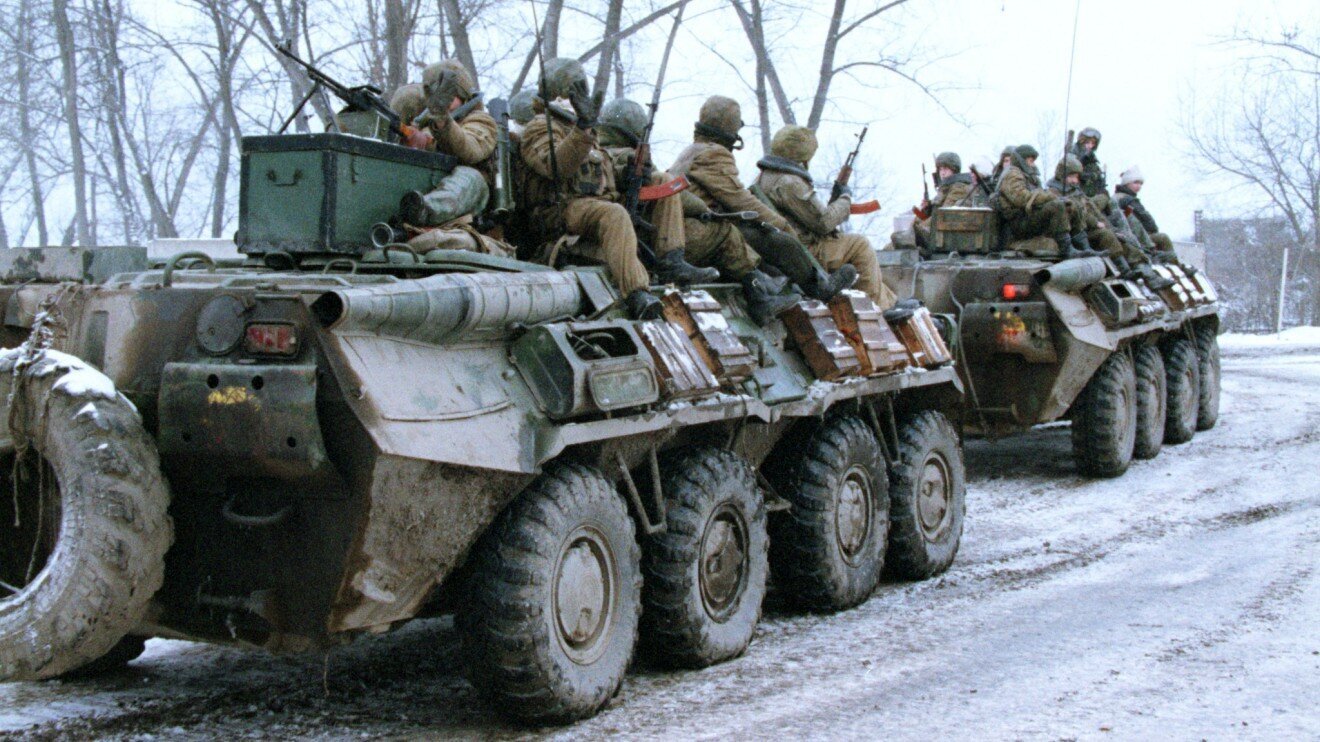
- Troop capacity: 7 inside + 7 riding on top
- Weight: 13.6 tonnes
- Engine: Diesel (replacing the paired carburetor engines)
- Wheel configuration: 8×8
- Status: In production through 2012 and beyond
Why It Was Developed
The BTR-80 was developed in the early 1980s as an evolution of the BTR-70, addressing shortcomings exposed during the war in Afghanistan:
Problems With the BTR-70
- An unreliable paired carburetor-engine setup
- High fuel consumption
- Poor troop-disembarkation design
- Inadequate protection
- Problems with the water-jet propulsion system
How the BTR-80 Fixed Them
- A single, more powerful diesel engine
- Two-piece side doors
- Ability to disembark on the move
- Reinforced armor
- Ball mounts instead of firing ports
BTR-80 Design
Layout
Front Section
Driving compartment
Driver and commander
Middle Section
Troop/fighting compartment
7 troops plus turret armament
Rear Section
Engine-transmission compartment
Diesel engine
Armor Protection
Protection level: Bullet-resistant (weakly differentiated)
Material: Homogeneous armor steel, 5–9mm thick
Design notes: Most plates are set at significant sloped angles
BTR-80 Vulnerabilities
- Rocket-propelled grenades (RPGs)
- Anti-tank guided missiles
- Small-caliber autocannons (ZU-23, 2A42)
- Heavy machine guns (12.7mm and 14.5mm)
- 120mm mortar rounds
- Cannon fire of almost any caliber
Additional Design Elements
- Streamlined hull shape
- Folding wave deflector
- Improved amphibious performance
- Efficiently sloped armor
Crew and Troop Layout
Crew (3 people)
- Driver (left side of the driving compartment)
- Vehicle commander (right side of the driving compartment)
- Gunner (in the turret)
Troops (7 inside)
- 6 seated in the rear on longitudinal benches (facing the sides)
- 1 seated up front on the right (facing forward)
- 1 acting as turret gunner, seated on the left (back to the side wall)
Additionally: Up to 7 more can ride outside, on the armor
Armament and Firepower
Turret Armament
Standard: a 14.5mm KPVT heavy machine gun plus a 7.62mm PKT machine gun
Notes: Unstabilized, with simplified sights
Role: Primarily self-defense
Small-Arms Firing Ports
Ball mounts: 8, set into the hull sides
Traverse: from ±15° to ±25°
Orientation: Angled toward the forward hemisphere
Blind spots: The rear hemisphere, and a small zone forward on the left
Main BTR-80 Variants
- Retains the standard armament
- Three additional workstations for officers
- Extra communications equipment
- Deployable remote communications gear
- Externally, nearly indistinguishable from the base model
- Armament: a 30mm 2A72 autocannon plus a 7.62mm PKT machine gun
- Turret: a new gun-mount-style turret
- Classification: Many specialists consider it a wheeled IFV
- Protection: Somewhat better against anti-tank guided missiles, but still vulnerable
- Armament: a 14.5mm KPVT plus a 7.62mm PKT
- Turret: gun-mount-style
- Purpose: Built specifically for Russia’s National Guard forces
- Engine: a 240-horsepower YaMZ-238
- Tires: KI-126, with improved bullet resistance
- Hull: Lengthened
- Distinguishing feature: Noticeably larger than earlier models
Entry and Exit Points
Main Entrances
Side doors: The main difference from earlier models
- Large two-piece doors behind the turret
- The upper panel swings forward
- The lower panel drops down as a step
- Key feature: They allow troops to disembark while the vehicle is moving!
Additional Hatches
For the crew
- Two individual, half-round hatches over the driver’s and commander’s seats
For the troops
- Two rectangular hatches in the roof
- Access hatches for onboard equipment
Combat Use and Exports
Combat Use
- The war in Afghanistan: Soviet forces
- Since the 1990s: The Russian military’s standard APC
- Post-Soviet conflicts: Nearly every major one
- Former Soviet republics: Their standard APC as well
Exports
Status: Actively exported
Reach: As of 2011, in service with at least 26 countries
Popularity: One of the most widely fielded APCs in the world
Technical Specifications
| Weight | 13.6 tonnes (18% heavier than the BTR-70) |
| Crew | 3 |
| Troop capacity | 7 inside + 7 riding on top |
| Engine | Diesel (replacing the paired carburetor engines) |