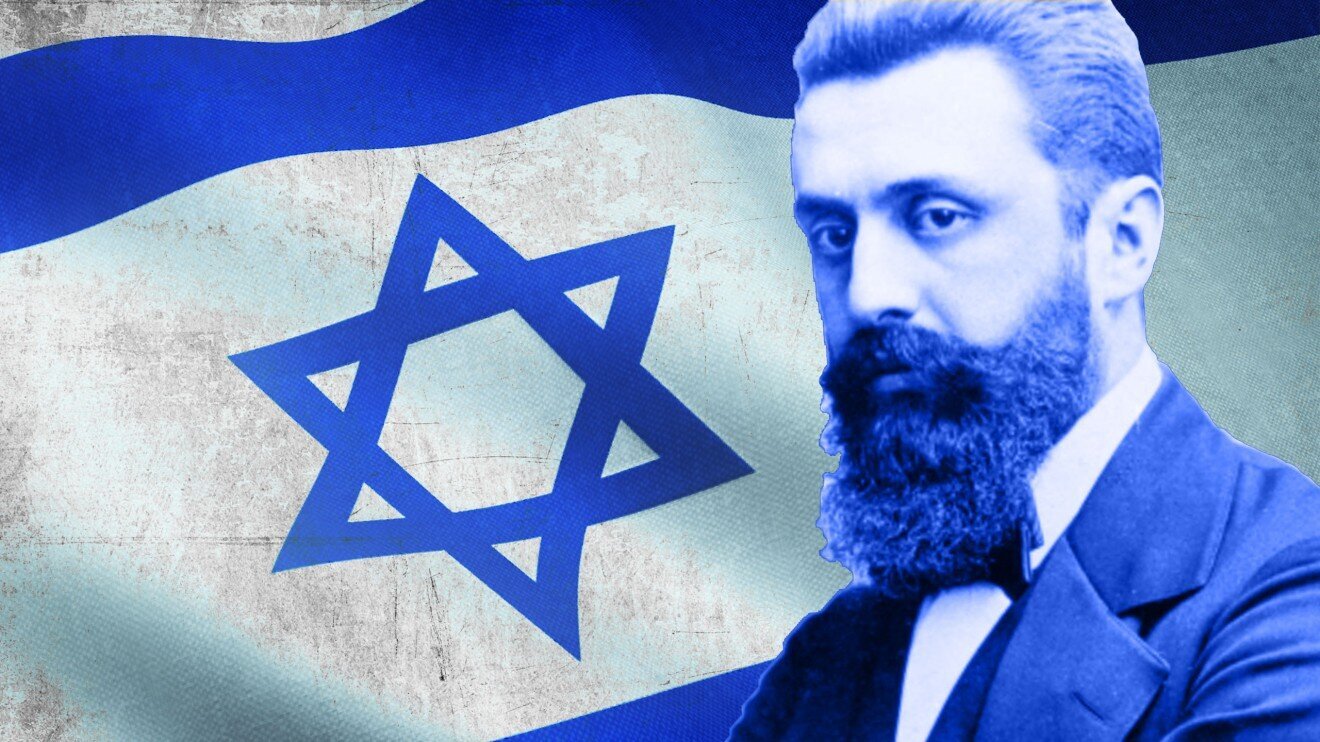
Zionism (from Mount Zion in Jerusalem) is a political national movement whose goal is the reunification and revival of the Jewish people in their historic homeland, the Land of Israel (Eretz Yisrael), and the ideological framework underlying that movement.
Origin and Meaning of the Term
The word "Zionism" derives from the place name Zion (Tzion in Hebrew); the Land of Israel was often called "the daughter of Zion," and the Jewish people "the sons of Zion." Since the Babylonian exile, Zion has served the Jewish diaspora as a symbol of a lost homeland, reflected in biblical poetry: "By the rivers of Babylon, there we sat down and wept, when we remembered Zion."
The term "Zionism" itself was coined by one of the movement’s early theorists, Nathan Birnbaum, in 1890, in the pages of the journal Selbstemancipation. Originally the term denoted a political program that, unlike purely practical settlement efforts, sought to secure the Jewish people’s return to Eretz Yisrael through political means.
An Important Distinction
Zionism should be distinguished from territorialism — the aspiration of some Jews to have their own state regardless of its specific location. Zionism is the aspiration to revive a Jewish state specifically in the ancient homeland, the Land of Israel.
Historical Background
According to biblical tradition, the Land of Israel was promised by God to the patriarch Abraham and his descendants. For nearly two millennia of galut (exile from the historic homeland), Jewish religion and culture preserved the idea of an eventual liberation from foreign rule and a return to the homeland.
It was in the Land of Israel that the Jews formed as a people; a sovereign Jewish state existed there, the spiritual and religious character of the Jewish people took shape there, the values of its national culture were forged there, and the Bible itself was composed there. After the Jewish state lost its independence, the Land of Israel became a province of successive empires — Roman, Byzantine, the Arab Caliphate, the Ottoman Empire.
The connection to the Land of Israel persisted throughout Jewish history. Messianic movements arose repeatedly, seeking a return to the historic homeland. Individual groups of Jews periodically resettled in the Land of Israel: 300 rabbis arrived from France in 1211; exiles from Spain and Portugal came at the turn of the 15th–16th centuries; refugees from Ukraine arrived in 1648; Hasidim and Mitnagdim from Russia and Poland came in 1774–1777.
Political Preconditions for Its Emergence
Zionism arose amid the broader wave of national emancipation sweeping 19th-century Europe — a process of national self-determination and national-liberation struggle. Despite widespread Jewish assimilation in Western Europe, nationalist and antisemitic sentiment intensified in many European countries during the 19th century.
The emergence of racial antisemitism in the second half of the 19th century played an especially important role, since it denied the possibility of assimilation and focused instead on ethnic origin. A stark illustration of this trend was the Dreyfus Affair — the false accusation of espionage leveled against a Jewish officer in the French army. In Russia, pogroms against Jews began in 1821.
The social base of Zionism was the middle and petty bourgeoisie, who, alongside working-class Jews, faced the greatest discrimination and suffered most from antisemitism.
The Founding of Political Zionism
Theodor Herzl (1860–1904) is regarded as the founder of political Zionism. In 1896, he published the book The Jewish State, laying out his vision for a future Jewish state. In 1897, Herzl chaired the First World Zionist Congress in Basel, where the World Zionist Organization was founded.
The movement gained powerful momentum after the 1903 Kishinev pogrom, which set off the Second Aliyah (1904–1914). Its most significant political achievement was the 1917 Balfour Declaration, in which the British government expressed favor toward establishing a national home for the Jewish people in Palestine.
Thirteen Theses on Zionism
Historian Walter Laqueur identified 13 core theses of Zionism:
- Zionism is a reaction to antisemitism.
- Antisemitism, in its deadliest form, culminated in Central Europe, where relatively small Jewish communities had assimilated most fully.
- Zionism has always regarded Jewish assimilation as its chief adversary.
- Zionists got their real chance for success only after the First World War.
- Zionism arose much later than other national movements, leaving extremely little time and few resources to achieve its goals.
- Zionism had no money, no military strength, no political influence — Zionists had mainly moral arguments at their disposal.
- A Jewish state came into being only once it was already too late to save the Jews perishing in Europe.
- Until the 1930s, Zionist leaders had no clear understanding of the movement’s ultimate goal.
- The Arab-Jewish conflict was inevitable, since Arabs could not accept the creation of a Jewish state.
- From the Arab point of view, Zionism represented aggression, and Jewish immigration an invasion.
- Zionism has also drawn criticism from Jewish ultra-Orthodox circles, assimilationists, and the far left.
- The chief source of Zionism’s weakness was the fact that conditions for realizing the Zionist dream were never favorable.
- Zionism’s core goal was twofold: to restore Jewish self-respect and dignity in the eyes of non-Jews, and to re-establish a Jewish national home so that Jews could "live as free people in their own land, and die peacefully in their own homes."
Attitudes Toward Zionism in the USSR
The Soviet Interpretation of Zionism
In the USSR, during the era of "stagnation," Zionism was equated with Jewishness itself and declared a form of "new fascism" and racism. From 1963–1964 onward, Soviet discourse relied on a dual equation — "Zionism = racism" and "Zionism = fascism/Nazism" — which served as additional grounds for treating Zionism as a crime.
Soviet discourse constructed an antisemitic conspiracy theory positing the existence of a secret alliance of imperialist forces uniting "reactionary Judaic clerics," Zionist organizations, and "fascist" regimes. Zionism was portrayed as the leading contender for world domination.
This distorted understanding of Zionism as "Jewish fascism and racism," an ally of Western imperialism, still has present-day adherents among various political groups around the world.
Ideological Currents Within Zionism
In the first half of the 20th century, several major currents emerged within Zionist ideology:
Socialist Zionism
The socialist Zionist movement dominated the movement from its inception until the late 1970s. Its adherents believed the Jewish state’s economy should be built on socialist principles.
Nachman Syrkin is regarded as the founder of this ideological current; in his essay "The Jewish Question and the Jewish Socialist State" (1898), he argued that the Zionist movement could succeed only if the Jewish state were "founded on justice, rational planning, and social solidarity."
Adherents of socialist Zionism made up the core of the Second and Third Aliyahs, and nearly all the leaders of the Yishuv in the 1920s–1940s, along with many founders of the State of Israel and its first leaders, including David Ben-Gurion, came from their ranks.
The Mapai party (later "Avoda"/Labor), the chief vehicle for this ideology, gradually lost popularity over time and drifted away from socialist ideology. Even so, the legacy of socialist ideas — kibbutzim, state control over the economy, a significant role for trade unions — remains visible in Israel to this day.
Revisionist Zionism
The ideological current known as "Revisionism" was founded and led by Vladimir (Ze’ev) Jabotinsky (1880–1940). The name comes from the fact that its adherents "revised" the socialist Zionist ideology that had dominated the movement in the early 20th century.
According to Revisionist Zionists, the Jewish state’s economy should be built exclusively on free-market principles. This current remained secondary until the mid-20th century, after which Revisionist influence grew substantially.
The party representing this current, Herut (later "Likud"), was for a long time one of Israel’s ruling parties, reflecting Israeli society’s broader evolution from socialist toward liberal-conservative values.
Religious Zionism
Religious Zionism was articulated by Rabbi Abraham Isaac Kook (1865–1935), the foremost religious authority of the early 20th century, who served as Chief Rabbi of the Land of Israel from 1921 to 1935.
He believed that Zionism not only did not contradict Orthodox Judaism (as many ultra-Orthodox rabbis maintained) but, on the contrary, should become the foundation for Judaism’s revival. This position reconciled the religious and secular elements within the Zionist movement.
For many years, this ideology’s chief political vehicle was the National Religious Party ("Mafdal"), later absorbed into the "Ichud Leumi" ("National Union") bloc.
Post-Zionism
Post-Zionist ideas developed after the founding of the State of Israel in 1948. Adherents of this current among Israeli intellectuals hold that Zionism has fulfilled its core ideological mission — the creation of a Jewish state.
Under post-Zionist ideology, Israelis, like any nation living securely within its own state, should now pursue "normal" goals: raising living standards and the population’s social and cultural well-being.
Post-Zionist politics envisions words instead of force, negotiation instead of confrontation, human rights instead of the rights of the Jewish people specifically. The ongoing Arab-Israeli conflict, however, has stood in the way of realizing these ideas.
The Achievements of Zionism
The Zionist movement’s principal achievement was the founding of the State of Israel on May 14, 1948. The state’s early years saw mass immigration by Holocaust survivors and Jews expelled from Arab countries. Between 1948 and 1958, Israel’s population grew from 800,000 to 2,000,000.
In this way, after nearly two thousand years of exile, the Jewish people returned to their historic homeland and restored their statehood. Israel quickly became home to the largest Jewish population in the world, becoming a center of Jewish life and culture.
Conclusion
As a political movement and ideology, Zionism played a decisive role in the Jewish people’s return to their historic homeland and the creation of the modern State of Israel. The various currents within Zionism reflect the diversity of approaches to the Jewish question and to building a Jewish state.