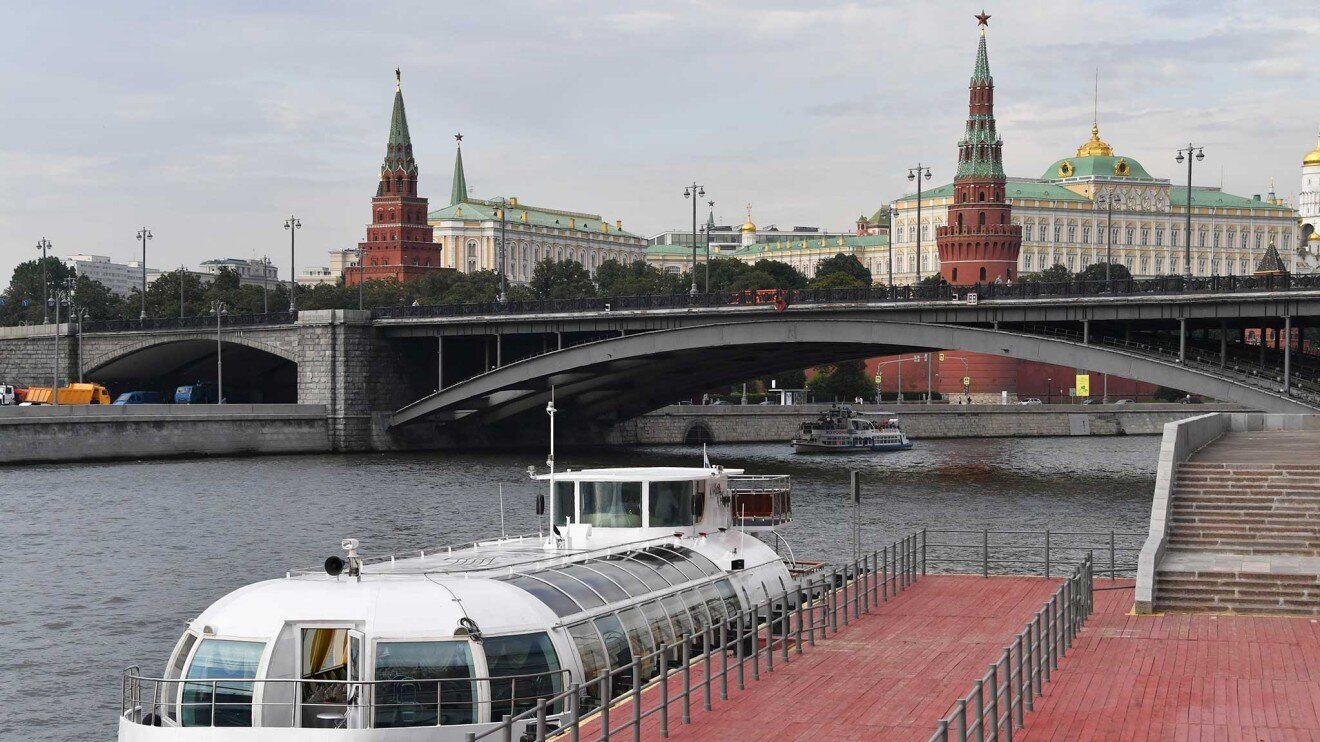
The novel mentions footage shot from a camera beyond the Bolshoy Kamenny Bridge, on the Moskva River embankment. Judging by the description of the pan, the filming was clearly done from the stretch of embankment between the Krymsky Bridge and the Bolshoy Kamenny Bridge, which offers a distinctive view of central Moscow.
The Bridge’s Historical Significance
The Bolshoy Kamenny («Great Stone») Bridge is one of the oldest and most significant bridges across the Moskva River, connecting Borovitskaya Square, Mokhovaya Street, and Znamenka Street near the Kremlin’s Borovitskaya Tower with Bolshaya Polyanka Street on Bolotny Island. The bridge crosses the Vodootvodny Canal via the Maly Kamenny Bridge, making it an important transport link in the city center.
Since the very founding of Moscow, the site of the modern bridge held a ford, through which passed the road from Ryazan to Novgorod via Volokolamsk, known as the Volotskaya road. This ancient route held strategic importance for trade and military campaigns.
The First Stone Bridge (17th Century)
Originally, a floating («living») bridge stood on this site, which could be opened to let ships pass. In the late 16th century, the Vsekhsvyatskiye (Water) Gates of the White City were built opposite the bridge, named for the nearby Church of All Saints.
In 1643, by decree of Tsar Mikhail Fyodorovich, a master builder from Strasbourg named Anton Christler began construction of the first permanent stone bridge across the Moskva River at the Vsekhsvyatskiye Gates. But after the deaths of both the tsar and the master builder, construction stopped, as the plan was deemed too bold and too costly.
Construction resumed and was completed between 1682 and 1687, on the initiative of Tsarevna Sophia and Vasily Golitsyn. The work followed Christler’s old design, of which he’d left behind a wooden model. Construction was overseen by the «master of stone bridge-building,» the monk-elder Filaret. Once completed in 1692, the bridge was named the Vsekhsvyatsky Bridge, though it was also called the Bersenevsky, or the New Stone Bridge.
Architectural Features of the First Stone Bridge
The bridge measured 170 meters long and 22 meters wide. It had 8 arches, the central ones used for passing rafts and boats, with spans up to 15 meters. On the Zamoskvorechye side, a gate tower stood before the bridge — the Shestivratnaya («Six-Gated») Tower, with six gate openings, several pyramidal tiers, and two crowning tent roofs topped with double-headed eagles.
Since the bridge was 3 to 4 times wider than the largest Moscow streets of the time, it was built up with structures on both sides. In the era of Peter the Great, the bridge held: a chamber belonging to the Monastery of St. John the Forerunner, four stone chambers belonging to Prince Menshikov, a tobacco customs house, and a beer yard. At the end of the bridge stood a tavern called «Zavernyaika.»
Popular Memory of the Bridge
The funds spent on building the bridge so astonished contemporaries that a saying arose, current in Moscow for more than a century and a half: «More expensive than the Stone Bridge!» According to Moscow historian I. M. Snegiryov, the bridge was «regarded as one of the capital’s wonders, on par with Ivan the Great, the Sukharev Tower, the Tsar Bell, and the Tsar Cannon.»
Beneath the bridge gathered all manner of «thieves» and «lawless men,» and one span on the left bank in particular had a notoriously bad reputation — the «ninth cell.» Come evening, Muscovites tried to avoid walking past it.
Destruction and Reconstructions
In 1783, during a spring flood, the bridge suffered severe damage: three arches and 11 shops collapsed. One man standing on the bridge fell and was killed, and a fisherman and two women beneath the bridge were crushed by the debris. In 1786, the bridge was again damaged by flooding.
Because of this, by order of commander-in-chief Count Bryus, the bridge was repaired and rebuilt. The reconstruction continued until 1792 and cost 213,000 rubles. During the work, the bridge was reinforced, the shops demolished, the Shestivratnaya Tower dismantled, and railings installed along the sides.
In the mid-1850s, the by-then dilapidated bridge was slated for demolition. The demolition proved difficult, given the strength of the masonry, which had to be blown up. I. M. Snegiryov, who witnessed the destruction, wrote: «What effort and expense it took to tear down this two-century-old monument! Moscow residents gathered with curiosity and regret to watch the destruction of this bridge.»
The 19th-Century Metal Bridge
In 1859, on the site of the dismantled bridge, engineer N. N. Voskoboynikov, following a design by engineer-colonel N. B. Tannenberg, built a new bridge — Moscow’s first metal, three-span bridge. The river span was covered with arches, and gun-carriage planking was used for the roadway.
An interesting historical fact: in September 1877, according to Moscow Conservatory professor N. D. Kashkin, Pyotr Ilyich Tchaikovsky attempted to take his own life near the Bolshoy Kamenny Bridge.
The Modern Bridge
In 1930, a decision was made to build a new bridge, but it wasn’t until 1938 that the modern bridge was built, somewhat further downstream, closer to the Kremlin. The project was carried out by engineer N. Ya. Kalmykov and architects V. A. Shchuko, V. G. Gelfreikh, and M. A. Minkus.
The bridge was relocated to Borovitskaya Square, since the narrow Lenivka Street made access difficult. With its approaches, the bridge measures 487 meters long, including a river span of 105 meters and shore spans of 42.5 meters each, with a width of 40 meters.
The 2020–2021 Reconstruction
On July 11, 2020, a major reconstruction of the bridge began. The work was prompted by the observation, during Victory Parade rehearsals, that the bridge vibrated and swayed under the weight of heavy military equipment. The first phase of work was completed on December 19, 2020, with the work fully finished by August 16, 2021.
The bridge was essentially reassembled from scratch, and its utilities, decorative elements, and lighting were updated as well. The work took 14 months, and neither vehicle nor pedestrian traffic was ever halted.
The Krymsky Bridge: A Neighboring Architectural Landmark
Given that the novel mentions filming the embankment between the two bridges, the Krymsky Bridge — the only suspension bridge across the Moskva River, located near the Bolshoy Kamenny Bridge — deserves mention as well.
The History of the Krymsky Bridge
Since ancient times, a ford across the Moskva River existed on the site of the modern Krymsky Bridge, known as the Krymsky («Crimean») ford, since it was used by Crimean Tatars during raids on Moscow. The name stuck in the 16th and 17th centuries, from a nearby courtyard where envoys, couriers, and merchants from the Crimean Khanate would stay.
In the 16th century, a commercial ferry crossing, the Krymsky Perevoz, arose at this stretch of the river and operated until 1836. In 1789, a floating bridge, the Nikolsky Bridge, was built on the site of the ford, consisting of a series of rafts tied together with hemp ropes and secured to 39 piles driven into the riverbed.
In the early 19th century, a permanent wooden bridge on piles, named the Krymsky Bridge, replaced the floating one. In 1873, it was replaced by a metal bridge, designed by engineers Amand Struve and Vladimir Konstantinovich Shpeyer. Muscovites nicknamed this bridge the «mousetrap» for its distinctive appearance.
The Modern Krymsky Bridge
The modern Krymsky Bridge was built in 1938, as part of the General Plan for the Reconstruction of Moscow, designed by architect Alexander Vlasov and engineer Boris Petrovich Konstantinov. In 2007, the Moscow city government added the bridge to the register of the capital’s protected cultural heritage sites.
The total length of the bridge crossing is 668 meters, of which the bridge itself accounts for 262.5 meters. Its width is 38.4 meters. The bridge’s structure consists of two pairs of pylons, 27 meters tall, suspended on chains 297 meters long.
The chain material is «DS» steel («Dvorets Sovetov,» or «Palace of the Soviets» grade), somewhat stronger than ordinary structural steel. The chain is made of edge-set plate elements, four centimeters thick and 0.93 meters tall. Notably, the pylons aren’t connected to each other at the top — an unusual design, rarely seen in world engineering practice.
The Embankment Between the Bridges
The stretch of embankment between the Krymsky and Bolshoy Kamenny bridges is one of the most picturesque parts of central Moscow. From here, a panoramic view opens onto the Kremlin, the Cathedral of Christ the Saviour, the House on the Embankment, and the Bersenevskaya, Prechistenskaya, and Sofiyskaya embankments.
It was apparently from this stretch of embankment that the filming in the novel took place. The camera may have been set up on the Bersenevskaya Embankment or near Bolotny Island, offering the distinctive view of both bridges and the central part of the city.
This part of Moscow has always drawn artists, photographers, and filmmakers with its views. Architectural landmarks from different eras converge here: from the ancient Kremlin walls to the Stalinist high-rises, from historic bridges to modern buildings.
The Significance of the Bridges in the Urban Landscape
Both bridges — the Bolshoy Kamenny and the Krymsky — are not just important transport arteries but significant architectural landmarks of Moscow. Together, they help form the city’s recognizable silhouette, especially alongside the panorama of the Kremlin and the Cathedral of Christ the Saviour.
The Bolshoy Kamenny Bridge, being one of the capital’s oldest, carries centuries of Moscow history within it. Its modern form, created in the 1930s, reflects the architectural trends of the Stalinist reconstruction of the city.
The Krymsky Bridge, in turn, is a unique feat of engineering — the only suspension bridge across the Moskva River. Its elegant structure, with its distinctive pylons, has become one of the symbols of 20th-century Moscow.
Conclusion
The Bolshoy Kamenny Bridge and its neighboring embankment form a unique historical and architectural complex that has served, for centuries, as an important part of Moscow’s urban infrastructure. From an ancient ford to a modern bridge, this site holds the memory of many different eras in the history of the Russian capital.
The filming location on the embankment between the Krymsky and Bolshoy Kamenny bridges, mentioned in the novel, was no accident — it’s precisely from here that one of Moscow’s most characteristic and recognizable views opens up, combining historical heritage with the capital’s architectural grandeur.