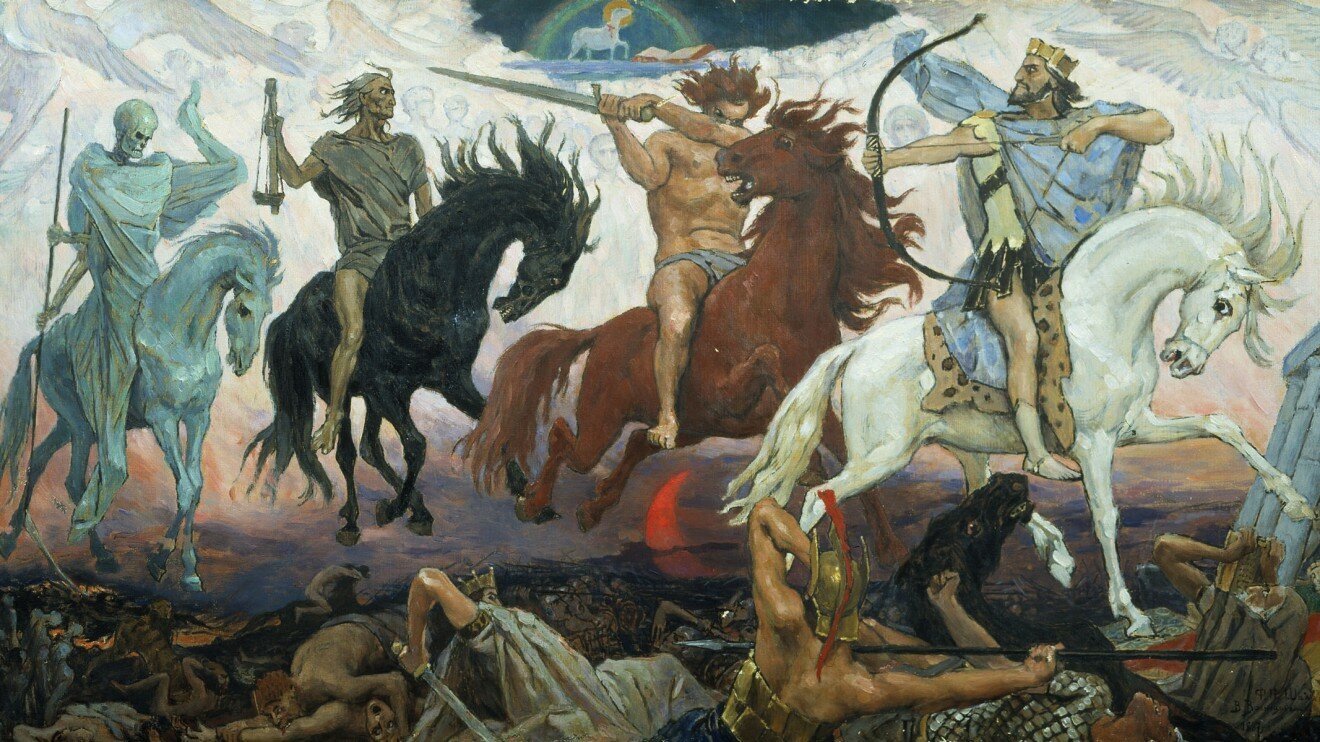
The Four Horsemen of the Apocalypse are among the most enigmatic and symbolically dense figures in Christian eschatology, described in the sixth chapter of the Revelation of St. John. For two thousand years, these mysterious figures have inspired theologians, artists, and writers, becoming a symbol of the end of the world and divine judgment.
Biblical Origins
The vision of the four horsemen is described in the Revelation of St. John (the Apocalypse) in the context of the opening of the first four seals of a mysterious scroll that only the Lamb — a symbol of Jesus Christ — can open. Each horseman is preceded by a cry from one of the four mysterious living creatures (the tetramorphs): «Come and see.» This creates a dramatic picture of the step-by-step unveiling of the divine plan for the fate of the world.
The text of Revelation offers no direct explanation of exactly what each horseman symbolizes, which has given rise to countless interpretations over the centuries. Traditionally, though, they’re identified with humanity’s central calamities: conquest (or righteousness), war, famine, and death.
The First Horseman: The White Horse
«And I saw when the Lamb opened one of the seals, and I heard, as it were the noise of thunder, one of the four beasts saying, Come and see. And I saw, and behold a white horse: and he that sat on him had a bow; and a crown was given unto him: and he went forth conquering, and to conquer.» (Rev. 6:1–2)
The first horseman is one of the most disputed figures in Christian exegesis. The white color of his horse has produced two main interpretations, diametrically opposed to one another.
The Reading as Righteousness
Irenaeus of Lyon, in the second century, was the first to suggest that the rider on the white horse is Christ himself. This interpretation rests on the fact that, in biblical symbolism, white is traditionally associated with righteousness and purity. Supporters of this view point to the parallel with Revelation 19:11, where Christ also appears on a white horse as «Faithful and True.»
The bow in the rider’s hand symbolizes the spread of the Gospel, and the crown, Christianity’s victory over paganism. Under this reading, the first horseman embodies the triumphant march of Christian teaching across the world, which precedes and prepares the way for the eschatological events to come.
Andrew of Caesarea developed this idea, interpreting the opening of the first seal as «the embassy, in the world, of the holy Apostles, who, like a bow, aiming the Gospel preaching against the demons, struck the wounded with saving arrows and brought them to Christ, and received a crown for having conquered the ruler of darkness through truth.»
The Reading as False Righteousness
An alternative interpretation views the first horseman as an embodiment of evil disguised as good. Given the context, where the other three horsemen clearly represent destructive forces, many theologians conclude that the first horseman must also symbolize something negative.
Billy Graham interpreted the rider on the white horse as the Antichrist — an embodiment of false prophecy and deception. This view rests on the differences between the rider in chapter six and Jesus in chapter nineteen of Revelation: Christ wears many crowns, the rider only one; their weapons and attributes differ as well.
The German exegetical tradition sometimes interprets the first horseman as a symbol of civil war and internal discord, which logically rounds out the picture of universal destruction created by the other horsemen.
The Second Horseman: The Red Horse
«And when he had opened the second seal, I heard the second beast say, Come and see. And there went out another horse that was red: and power was given to him that sat thereon to take peace from the earth, and that they should kill one another: and there was given unto him a great sword.» (Rev. 6:3–4)
The second horseman is traditionally called War, or Strife. The red (in some translations, «fiery red») color of his horse symbolizes blood shed in battle. The great sword in the rider’s hand confirms his martial nature and his power to bring death and destruction.
What distinguishes the second horseman is that he’s «given to take peace from the earth.» This means not merely military action, but the total destruction of peace as a condition of human society. The rider doesn’t bring isolated conflicts, but universal war, in which people «kill one another.»
Andrew of Caesarea offered a spiritual interpretation: the red horse symbolizes «the apostolic teaching, preached by martyrs and teachers,» which divides the world, since Christ said: «I came not to send peace, but a sword» (Matt. 10:34). In this reading, the red color represents either the blood shed by martyrs, or «the fervor of heart» of those who suffered for Christ.
Historical interpretation ties the second horseman to specific first-century military conflicts, including the Boudican revolt in Britain (61 CE) or the wars in Germania and Palestine during the same period.
The Third Horseman: The Black Horse
«And when he had opened the third seal, I heard the third beast say, Come and see. And I beheld, and lo a black horse; and he that sat on him had a pair of balances in his hand. And I heard a voice in the midst of the four beasts say, A measure of wheat for a penny, and three measures of barley for a penny; and see thou hurt not the oil and the wine.» (Rev. 6:5–6)
The third horseman, on the black horse, embodies Famine. Black is traditionally associated with death and mourning, fitting the destructive nature of famine. The scales (a measure) in the rider’s hand symbolize the scrupulous rationing of scarce food supplies.
The Economic Details of the Vision
The vision contains specific economic details that help convey the scale of the predicted calamity. A choenix (roughly 1.08–1.14 liters) of wheat was considered the minimum daily ration for one person — exactly what a slave was allotted. A denarius was an ordinary day’s wage for an unskilled laborer.
So the prophecy describes a situation in which an entire day’s wages would barely cover the minimum food for a single day. Barley, being a cheaper staple, could feed three people, but was food of lower quality.
The line about not harming the oil and the wine remains puzzling. It may mean that luxury goods would remain available while basic foodstuffs became inaccessible to most people. An alternative interpretation ties the oil and wine to Christian sacraments, suggesting that spiritual sustenance would remain available even amid physical hunger.
Agricultural Symbolism
From a practical standpoint, the survival of grapevines and olive trees while grain crops are destroyed can be explained by the fact that vines and olive trees have deeper roots and withstand drought better. This lends the prophecy a grounding in realism and points to a specific type of natural disaster.
Andrew of Caesarea offered an allegorical reading: the black horse symbolizes «lamentation over those who fell away from faith in Christ because of the severity of torments.» The scales represent «the comparison of those who fell away from the faith,» and the measure of wheat for a denarius, «all those who struggled lawfully and preserved the image of God given to them.»
The Fourth Horseman: The Pale Horse
«And when he had opened the fourth seal, I heard the voice of the fourth beast say, Come and see. And I looked, and behold a pale horse: and his name that sat on him was Death, and Hell followed with him. And power was given unto them over the fourth part of the earth, to kill with sword, and with hunger, and with death, and with the beasts of the earth.» (Rev. 6:7–8)
The fourth horseman is the only one directly named in the text: Death. This makes him the clearest of the figures and, at the same time, the most sinister. Hell (Hades) follows behind him, creating an image not merely of physical death, but of spiritual perdition.
The Color Symbolism
The horse’s color is described by the Greek word «chloros» (χλωρóς), which can be translated as «pale,» «ashen,» «pale green,» or «yellowish-green.» This color is traditionally associated with the pallor of a corpse, making the symbolism unmistakably clear.
Unlike the other horsemen, the fourth isn’t described as carrying any particular object, though artistic depictions often show him with a scythe — the traditional symbol of death.
The Scale of Destruction
The fourth horseman is given power «over the fourth part of the earth,» indicating the limited scope of his influence compared to the final judgment. The methods by which he exercises his power include «sword, and hunger, and death, and the beasts of the earth» — the full spectrum of violent death.
Interestingly, this combines the actions of all the previous horsemen: the sword recalls war (the second horseman), hunger recalls the third horseman, and pestilence is a new element entirely. Wild beasts add an archaic touch, recalling times when nature had not yet been fully subdued by man.
Historical Interpretation (Preterism)
The preterist school of interpretation views the horsemen as symbols of specific first-century historical events. According to this view, the prophecies of Revelation were already fulfilled in the early centuries of Christianity.
The first horseman (the white horse) is identified with the Parthian king Vologases I, who in 62 CE forced a Roman army to capitulate. The Parthians were indeed famous for their mounted archers, and their riders were often depicted on white horses.
The second horseman is linked to the Boudican revolt in Britain (61 CE), in which up to 150,000 people died, or to the concurrent wars in Germania and unrest in Palestine.
The third horseman corresponds to the famine of 62 CE in Armenia and Palestine. Interestingly, the policy of Roman Emperor Domitian in 92 CE, restricting viticulture in favor of grain crops (a policy he later abandoned due to protests), may explain the strange instruction to spare the wine and oil.
The fourth horseman is linked to the epidemics of 61 CE in Asia and Ephesus, as well as to Nero’s persecution of Christians.
Modern Interpretations
Christian theologians in every era have found, in the images of the horsemen, reflections of the events and challenges of their own time. In the 20th century, the red horseman was often associated with communism, the black one with capitalism, and the fourth horseman’s greenish color with Islam.
Some modern interpreters link the horsemen to contemporary global threats: nuclear war, ecological crisis, pandemics, and economic upheaval.
The Mormon Interpretation
The Church of Jesus Christ of Latter-day Saints (the Mormons) offers a unique chronological interpretation. According to their teaching, each seal symbolizes a thousand-year period of history. The first horseman corresponds to the period 4000–3000 BCE and embodies the prophecy of Enoch, who founded the righteous city of Zion.
In this reading, the white horseman represents good, and his «conquest» is a victory of morality, not of war. The remaining horsemen correspond to the eras of Noah (3000–2000 BCE), Abraham (2000–1000 BCE), and the period from 1000 BCE to the birth of Christ.
The Jehovah’s Witnesses’ Interpretation
Jehovah’s Witnesses believe the vision of the four horsemen has been unfolding since 1914, leading up to the destruction of «this system of things.» For them, the first horseman is Jesus Christ, who began to reign in heaven as King. The remaining three horsemen symbolize the wars, famine, and disease of the modern era.
Symbolic Parallels
The vision of the four horsemen has parallels elsewhere in the Bible. The prophet Zechariah likewise saw four horses, which he called «the four spirits of heaven.» But Zechariah’s horses played more the role of guardians than of destructive forces.
Some scholars draw parallels between the horsemen and the archangels of the four cardinal directions (Michael, Gabriel, Raphael, and Uriel), adding a cosmic dimension to their symbolism.
Artistic Depictions
The Four Horsemen of the Apocalypse became one of the most popular subjects in Christian art. Albrecht Dürer’s famous woodcut (1497–1498) established an iconographic standard that shaped depictions of the horsemen for centuries.
In literature, the image of the horsemen has been used to create an apocalyptic atmosphere and symbolize global catastrophe. Their imagery has permeated popular culture, where it’s often used as a metaphor for inevitable ruin or radical change.
Theological Significance
The Four Horsemen of the Apocalypse represent a complex theological concept that goes beyond a simple prediction of catastrophe. They embody the idea that history remains under divine control, even when chaos and destruction seem to rule the world.
Each horseman receives his authority from God («power was given unto him»), underscoring the problem of theodicy: how to reconcile the existence of evil with faith in a good and all-powerful God. The horsemen show that even destructive forces serve the divine plan of salvation.
The sequence in which the horsemen appear also carries symbolic weight. It may reflect a logical chain of destruction: conquest leads to war, war to famine, and famine to death. Or it may represent a spiritual decline: from outward prosperity (the white horse) to inner conflict (the red), then to spiritual hunger (the black), and finally to spiritual death (the pale).
Conclusion
The Four Horsemen of the Apocalypse remain one of the most powerful and multilayered symbols in the Christian tradition. Their images are at once specific and universal, historically grounded and timeless. They embody humanity’s fears of war, famine, disease, and death, but also point toward hope for the final triumph of good over evil.
The sheer variety of interpretations of the horsemen reflects the richness of biblical symbolism and its capacity to speak to every generation in its own language. From the early Christians, who saw in them a reflection of Roman persecution, to modern believers who find in them a warning about the global threats of the 21st century, the horsemen continue to serve as a reminder of the fragility of human existence and the need for spiritual readiness for the last times.
In a literary context, the imagery of the horsemen offers rich material for creating an atmosphere of eschatological unease and reflection on humanity’s fate. Their archetypal power lets writers explore deep questions about the meaning of history, the nature of evil, and humanity’s hope for salvation.