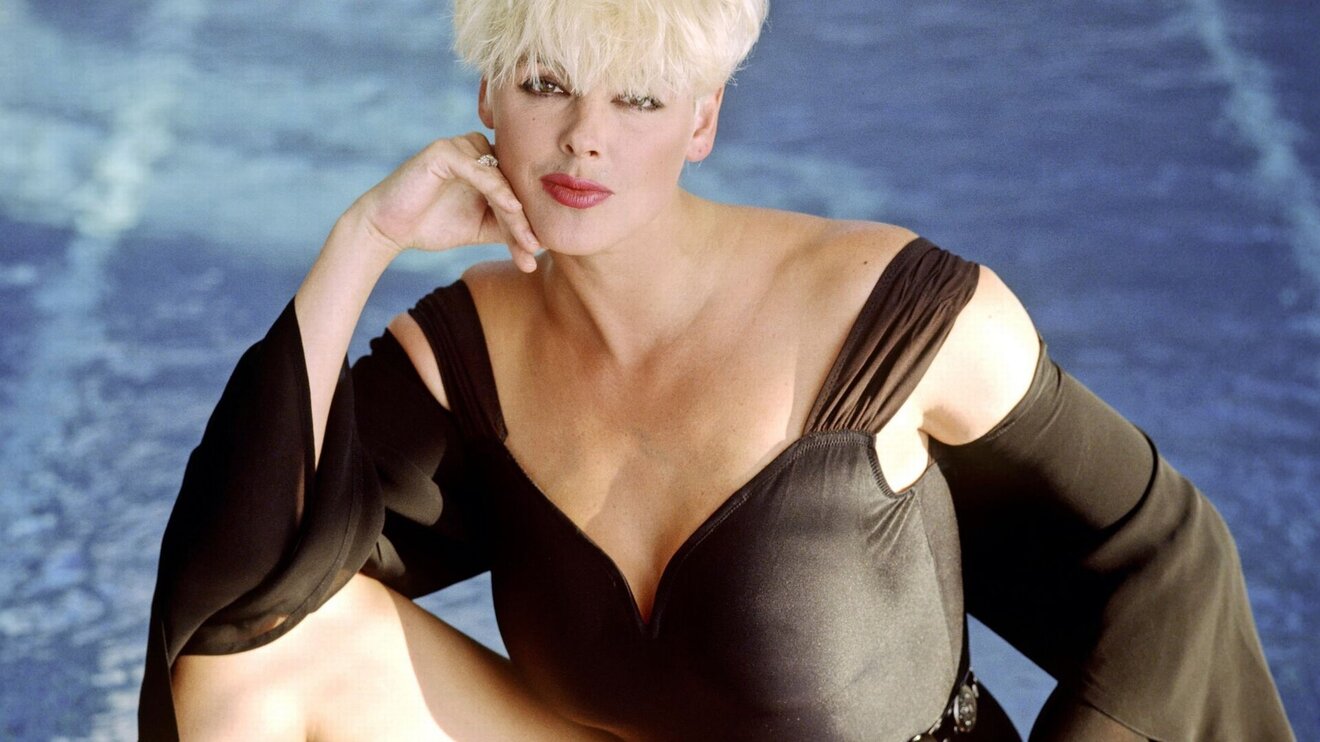
Brigitte Nielsen (née Gitte Nielsen, born July 15, 1963) is a Danish actress, model, and singer who became one of the most recognizable faces of 1980s pop culture. By 1996, when the novel’s events take place, she was already known worldwide as the screen’s Amazon, a scandal-prone star, and a symbol of the era.
Early years and the start of her career
Born in the Copenhagen suburb of Rødovre, Brigitte was the daughter of librarian Hanne and engineer Svend Nielsen. Her striking height of 183 centimeters (6 feet) set her apart from her peers from an early age and shaped her future modeling career.
In the early 1980s Nielsen began working as a model, collaborating with photographers as celebrated as Greg Gorman and Helmut Newton. Her work with Newton, a master of erotic photography, helped forge the image of the femme fatale that later became her calling card. Tall, statuesque, blonde, with sharp features and a piercing gaze, she quickly caught the attention not just of modeling agencies but of Hollywood.
Her Hollywood breakthrough
1985 proved a turning point in Nielsen’s career. She made her film debut in two significant projects at once: the fantasy action film «Red Sonja» opposite Arnold Schwarzenegger, and the iconic «Rocky IV» with Sylvester Stallone. In «Rocky IV» she played Ludmilla Drago, wife of Soviet boxer Ivan Drago, embodying a cold, calculating Soviet beauty.
The work on «Rocky IV» changed not just the actress’s career but her personal life as well. Her romance with the film’s director and lead star, Sylvester Stallone, became one of Hollywood’s most talked-about stories of the mid-1980s. The couple married on December 15, 1985, in Beverly Hills, at the home of producer Irwin Winkler.
The «Amazon» era
Thanks to her impressive height and athletic build, Nielsen earned the nickname «the Amazon,» which stuck with her firmly in the world press. She successfully leaned into this image in her films. In 1986 came the action movie «Cobra,» in which she again appeared opposite Stallone, this time as a fashion model who witnesses a crime.
Her marriage to Stallone, however, proved short-lived – the couple divorced in 1987. The divorce came with loud tabloid scandals, which only heightened public interest in the controversial actress.
That same year, 1987, Nielsen appeared in the comedy-action film «Beverly Hills Cop II» as Karla Fry, an elegant criminal. Her performance opposite Eddie Murphy showed that the actress was capable of comedy as well as drama.
Music career
In 1987 Nielsen decided to try her hand at music, releasing her debut album «Every Body Tells a Story.» Her most successful outing was the duet with Austrian pop artist Falco, «Body Next to Body,» written by the legendary Giorgio Moroder. The song reached number 22 in Germany and number 6 in Austria, proving the actress could find success in music too.
A second album, «I’m the One... Nobody Else,» followed in 1992. Interestingly, Nielsen recorded some songs under the pseudonym «Gitta,» wanting to test whether she could succeed as a singer without relying on her famous name. The song «No More Turning Back» did in fact chart commercially, reaching number 54 on the UK charts.
Her European career
By the early 1990s Nielsen had increasingly turned her focus to the European market. She became a star of Italian television, appearing in the popular fantasy series «Fantaghirò» (1992–1996), where she played the Black Witch. Her character was originally meant to die in the first film of the series, but thanks to her popularity with viewers the Black Witch was «resurrected» for the sequels.
Her work on Italian television brought Nielsen a fresh wave of fame in Europe. She hosted various shows, including the prestigious Sanremo Music Festival in 1992. Her command of several languages – Danish, English, German, and Italian – let her work across a range of European markets.
Scandals and personal life
Nielsen’s personal life was always a subject of close tabloid attention. After her divorce from Stallone she dated American football player Mark Gastineau (1988–1990), with whom she had a son, Killian. In 1990–1992 she was married to director and photographer Sebastian Copeland.
In her later interviews, Nielsen spoke candidly about her affairs with famous men. In particular, she admitted to a relationship with Arnold Schwarzenegger during the filming of «Red Sonja» in 1985, at a time when the actor was just beginning his relationship with Maria Shriver. Schwarzenegger himself confirmed the relationship only in 2020.
Cultural influence by the mid-1990s
By 1996 Brigitte Nielsen had already become firmly embedded in popular culture as a symbol of a particular type of female beauty – tall, athletic, commanding. Her «Amazon» image had become so recognizable that a mention of her name instantly summoned certain associations.
In the popular imagination she was associated with the 1980s – an era of big hair, bold colors, muscle-bound action heroes, and glamorous villainesses. Her look – a tall blonde with sharp features – became something of a benchmark for the era’s cinema.
Photo shoots and media image
Nielsen posed repeatedly for Playboy, gracing the cover of the December 1987 issue. These photo shoots only reinforced her reputation as a sex symbol. In the late 1980s Marvel Comics even asked her to pose as the superheroine She-Hulk, a telling sign of how closely her physique was associated with the image of a powerful woman.
Renowned photographer Helmut Newton’s work with Nielsen became a classic of the genre. Newton, known for his provocative, stylish images, managed to capture the actress’s full power and sensuality on film, creating a visual image that defined her public persona for years to come.
Cinematic legacy
Though most of Nielsen’s films never became masterpieces of cinema, they carved out their own place in culture as examples of 1980s and early-1990s genre filmmaking. «Rocky IV» remains one of the most popular entries in its franchise, and Ludmilla Drago is one of its most memorable female characters.
By the mid-1990s Nielsen was increasingly appearing in B-grade projects – low-budget action films and thrillers made for the video-rental market. Among them: «976-Evil II,» «The Double 0 Kid» (1992), «Chained Heat II» (1993), and «Galaxis» (1995). These films, though not commercially significant, kept her status alive among certain circles of genre-film fans.
International recognition
By the mid-1990s Nielsen was better known in Europe than in the US. Her work on Italian television, her participation in European projects, and her command of languages made her a genuine international star, though of a somewhat different caliber than at the height of her Hollywood career.
In 1996 she hosted the Italian TV show «Retromarch!,» demonstrating her ability to adapt to different formats and audiences. Her charisma and name recognition kept her in demand in the entertainment industry, even as offers for major Hollywood roles grew rarer.
A symbol of the era
In the context of 1996, a mention of Brigitte Nielsen in a work of fiction instantly conjured particular images and associations for readers. She had become a kind of cultural marker – a reference to a particular type of beauty, a particular era, a particular lifestyle.
The comparison to Nielsen in the novel’s description of the women on the yacht creates a vivid visual image – tall, statuesque, imposing beauties with a somewhat cold, detached air. It was a recognizable type, associated with luxury, power, and unattainability.
Influence on fashion and style
Nielsen’s style – big hair, bold makeup, images that were pointedly feminine and powerful at once – was characteristic of 1980s aesthetics. By the mid-1990s that aesthetic was already starting to read as retro, but it still retained its appeal and recognizability.
Her looks in films and photo shoots often included elements that emphasized her physical strength and independence – leather clothing, militarized costume elements, bold cuts and silhouettes. This «strong woman» style was an important part of 1980s culture and influenced the fashion trends of the era.
Legacy in popular culture
By 1996 Brigitte Nielsen had already become part of the collective memory of a generation raised on 1980s films. Her name belonged on the list of cultural touchstones alongside stars of the era such as Madonna, Cindy Crawford, or Grace Jones (also mentioned in the novel).
It’s worth noting that in the novel’s context, Nielsen is invoked specifically in connection with the description of luxurious life aboard a yacht – a fit with her image in the popular imagination as a symbol of glamour and wealth. Her career was always associated with the world of show business, expensive cars, lavish parties, and the international jet set.
Conclusion
In the context of 1996, Brigitte Nielsen was a living legend of the era of big Hollywood action films, a glamorous lifestyle, and international fame. Invoking her in the novel instantly conjures for the reader the image of a particular type of woman – tall, beautiful, commanding, and somewhat unattainable.
That image was especially resonant for Russia in the 1990s, when Western pop culture was flooding into the post-Soviet space, and stars like Nielsen were perceived as symbols of the successful, beautiful life so many dreamed of. Her «Amazon» image was perfectly suited to describing the mysterious companions of wealthy men on luxury yachts – a world that seemed unattainable to most readers, but one they could glimpse in films and magazines.
The mention of Brigitte Nielsen in the novel, then, serves not merely as a descriptive device but as a cultural marker, pointing the reader toward a particular era, lifestyle, and set of values characteristic of the 1990s.