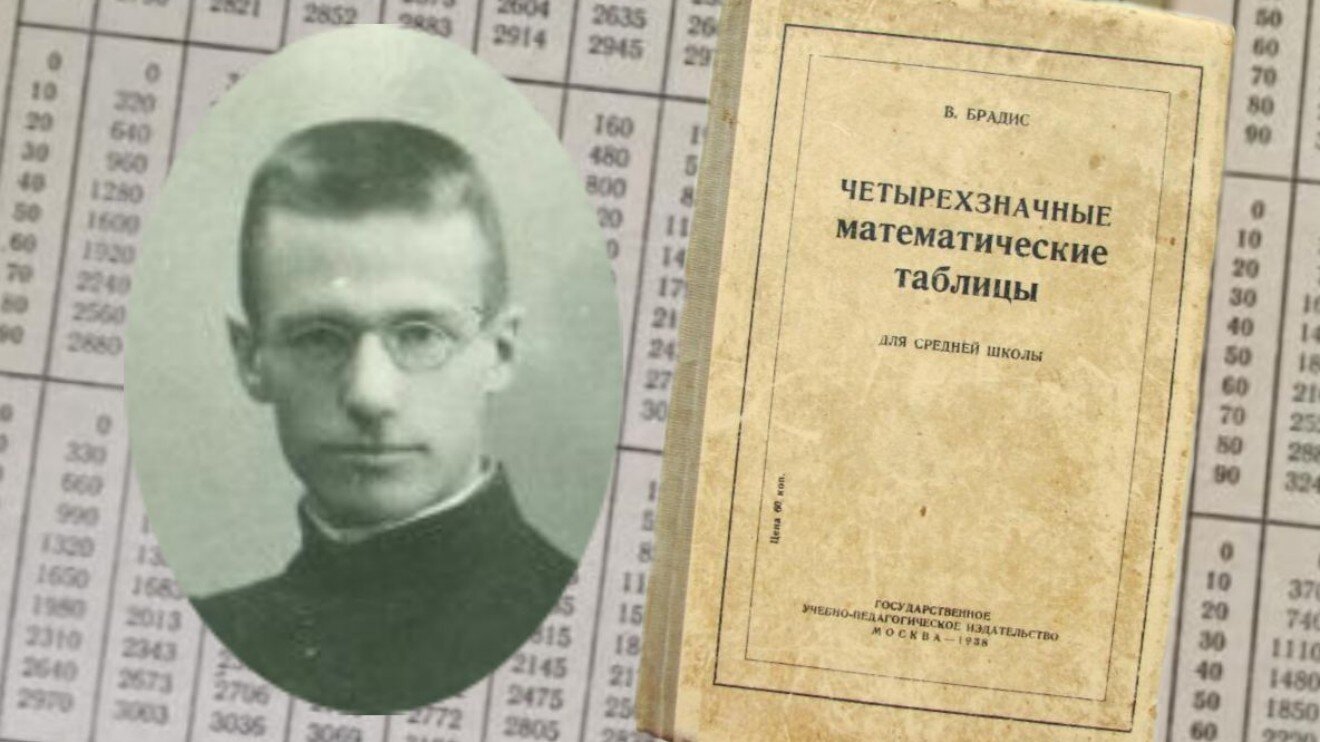
The novel mentions the Bradis tables — a legendary mathematical reference book that, for decades, was an indispensable tool for millions of Soviet schoolchildren and students.
What the Bradis Tables Are
The Bradis tables are a mathematical reference containing precomputed values of various mathematical functions, calculated to four decimal places. In the era before calculators and computers, these tables were the only way to quickly obtain precise values for complex mathematical expressions.
The tables listed values for:
- squares and cubes of numbers
- square roots
- logarithms
- trigonometric functions (sine, cosine, tangent, cotangent), in degrees and radians
- inverse trigonometric functions
Calculations were accurate to four decimal places, and to one arc-minute when determining angles. That provided sufficient precision for most practical calculations of the time.
Vladimir Modestovich Bradis
Vladimir Modestovich Bradis (1890–1975) was an outstanding Soviet mathematics educator, a corresponding member of the USSR Academy of Pedagogical Sciences. His life story was typical of the early-twentieth-century intelligentsia, reflecting all the twists of Russian history.
Born into a family of village teachers in Pskov. As a young man, he was expelled from gymnasium for distributing illegal literature, and in 1909 was exiled to Siberia for three years for belonging to the Socialist Revolutionaries. During his exile he pursued self-education, studying advanced mathematics and foreign languages.
After returning from exile, he enrolled in the mathematics department at St. Petersburg University, graduating in 1915. He devoted the rest of his life to teaching mathematics, working at the Kalinin Pedagogical Institute from 1920 to 1959.
How the Tables Came to Be
The first edition of the Bradis tables was published in 1921 in Tver under the title «Tables of Four-Digit Logarithms and Natural Trigonometric Values.» Part of the calculations were done by students of the Tver Institute of Public Education under Bradis’s supervision.
Later editions appeared under the title «Four-Digit Mathematical Tables» and went through more than 60 reprintings in Soviet times. After 1991, roughly 30 more editions were published — the tables are still in use today, despite the rise of electronic computing tools.
Significance in the Context of the Novel
Mentioning the Bradis tables in the novel carries a deep symbolic weight. The protagonist compares human life to a mathematical table, where every «input value» has a strictly determined result.
This metaphor captures a sense of predetermination, of mechanistic existence, characteristic of the transitional 1990s. The Bradis tables, with their precision «to the tenth decimal place,» symbolize a person’s attempt to bring order to a chaotic world, to find patterns and predictability within it.
For a generation raised in the USSR, the Bradis tables were more than a textbook — they were a symbol of a rational, scientific approach to understanding the world. Their mention amid reflections on a person’s fate underscores a nostalgia for an era when it seemed everything in the world could be calculated and predicted.
Interesting Facts
Vladimir Bradis was one of the pioneers of interval computation in the USSR, developing, from the 1920s on, a «method of bounds» — a way of obtaining reliable two-sided bounds for a computed result.
Bradis’s works were translated into the languages of the peoples of the USSR and into foreign languages, including Bulgarian, Czech, Romanian, German, and Chinese — a testament to the international recognition of the quality and practical value of his mathematical tables.
The Bradis tables became an inseparable part of the Soviet education system and culture, leaving a deep imprint on the memory of several generations.