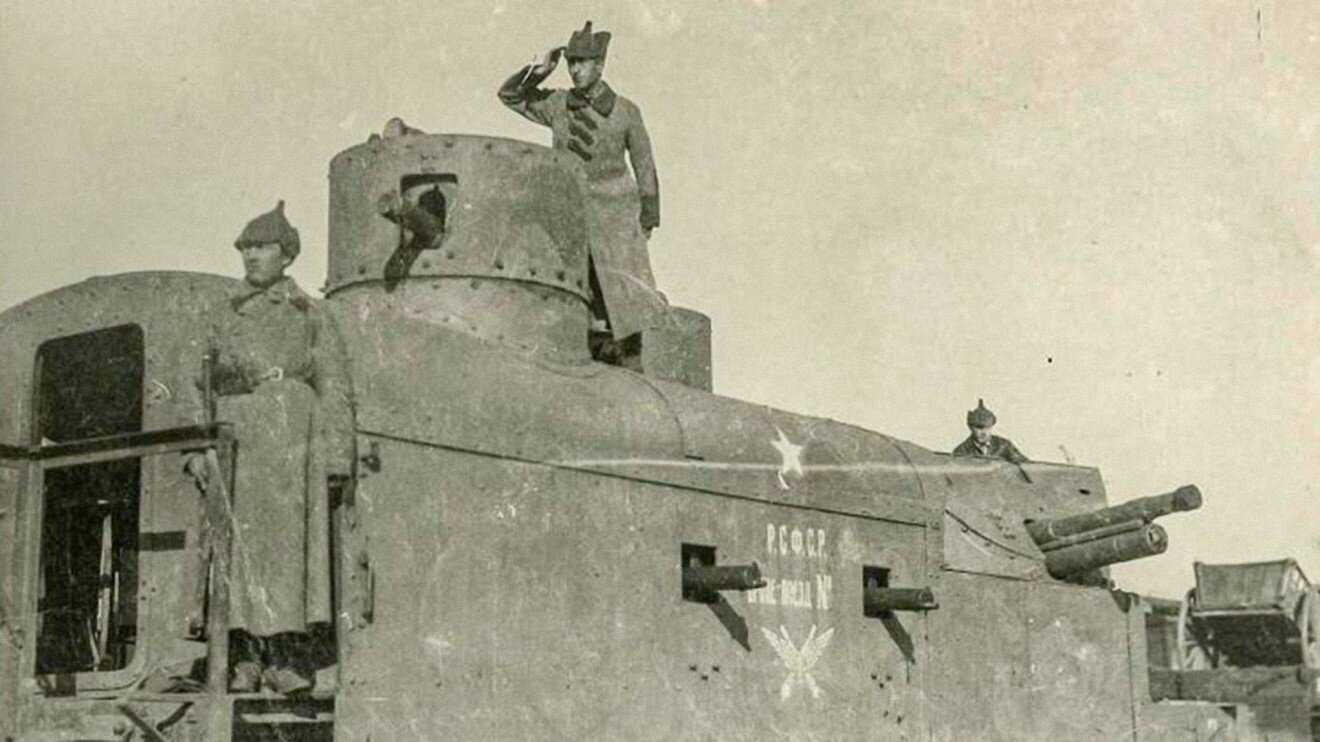
This famous line from the “Song of Kakhovka” became one of the most recognizable poetic formulas of the Soviet era. Created in 1935 by the poet Mikhail Svetlov and the composer Isaak Dunaevsky, it turned into a catchphrase symbolizing a peaceful people’s readiness to defend the homeland.
The Origin of the Phrase
The phrase “an armored train stands ready on a side track” first appeared in the “Song of Kakhovka,” written for the 1935 film “Three Comrades.” The song’s creation began with a simple conversation between the film director Semyon Timoshenko and the poet Mikhail Svetlov.
As Svetlov himself recalled: “One day the Leningrad film director Semyon Timoshenko showed up at my place out of the blue. He said to me: — Misha! I’m making a film called ‘Three Comrades.’ And it needs a song, one with Kakhovka and a girl in it. I’m worn out from the trip, I’ll sleep at your place; when you’ve written it, wake me up…”
Remarkably, the song’s lyrics were written in just forty minutes. When the director expressed his surprise, Svetlov replied: “You’re counting wrong. It took forty minutes plus my whole life.” The song’s images and motifs had long been living in the poet’s creative mind, waiting for their moment.
The Historical Roots of the Image
Armored trains played a significant role in the Civil War of 1918-1920. These mobile fortresses, armed with artillery and machine guns and protected by armor plating, became a symbol of the revolutionary struggle and the technical progress of the young Soviet state.
The Kakhovka bridgehead, mentioned in the song, really existed. In the autumn of 1920, near the Ukrainian town of Kakhovka, ran the famous defensive line of the Red Army’s forces. Wrangel’s White Guard units never managed to break through this bridgehead, despite using the newest English tanks and armored cars.
It was from here that on October 20, 1920, the forces of the Southern Front, under the command of M.V. Frunze, launched a decisive offensive that led to the liberation of the Dnieper region and Crimea — Wrangel’s last stronghold.
The Image in Svetlov’s Earlier Work
Interestingly, the image of the armored train had appeared in Svetlov’s work before. In the poem “To the Old Folks,” published in Komsomolskaya Pravda on July 10, 1933, the poet wrote:
“We took our youth
By storm,
Our songs
Have yet to bloom!
Our glory —
Our armored train
Stands ready
On a side track…”
So by the time “Kakhovka” was written, this image had already been well developed in Svetlov’s poetic imagination.
Symbolic Meaning
The refrain “We are peaceful people, but our armored train stands ready on a side track” became, in the words of the poet Yaroslav Smelyakov, “a famous political and poetic formula.” This line expressed the Soviet people’s readiness to defend peaceful labor and the gains of socialism.
The image of the armored train on a side track symbolized:
- Peaceful intentions — the main activity is directed toward building, not war
- Readiness to defend — in the event of a threat, the people are ready to rise to defend the Motherland
- Technical progress — the armored train as a symbol of the country’s industrial development
- Continuity between generations — the link between a heroic past and the present
Its Musical Realization
Isaak Dunaevsky wrote a melody for Svetlov’s lyrics that perfectly conveyed the text’s heroic, romantic spirit. The composer worked right on the Lenfilm set where “Three Comrades” was being filmed.
People’s Artist of the USSR M.I. Zharov, who played one of the lead roles in the film, recalled: “Dunaevsky, swaying quietly to the beat of the song, looked around, evidently searching for Svetlov, while Svetlov, suddenly looking young again, sat modestly in a corner behind the set, listening to the song with his eyes closed, as if everything he had told people about in the song was passing before him.”
Influence on Soviet Culture
The “Song of Kakhovka” launched an entire series of heroic-epic songs about the army’s and the people’s combat past. It was followed by:
- “Partisan Zheleznyak” by M. Blanter and M. Golodny
- “Orlyonok” by V. Bely and Ya. Shvedov
- “The Cavalry Song” by the Pokrass brothers and A. Surkov
All these works used a similar rhythmic pattern and heroic theme, laid down by “Kakhovka.”
Attempts at Revision
Several attempts were made to create new versions of the song. Svetlov himself twice tried to rework the text: during the Great Patriotic War, at the request of soldiers at the front, and in the 1950s, in connection with the construction of the Kakhovka hydroelectric station. But none of the variants could eclipse the original — the song proved impervious to revision.
Monuments and Memorials
The song’s popularity led to the creation of several monuments tied to its imagery:
The Tachanka Monument in Kakhovka
In 1967, on the site of the Kakhovka bridgehead, the monument “The Legendary Tachanka” was erected (sculptors Yu. Lokhovinin, L. Rodionov, L. Mikhailyonok; architect E. Poltoratsky). Lines from Svetlov’s song are engraved on the monument.
The Girl of Kakhovka
In Kakhovka itself, a sculpture was created of the girl from Kakhovka, the song’s heroine. The monument portrays a girl in a soldier’s greatcoat, “walking through burning Kakhovka.”
The Armored Train in Dnipro
In Mikhail Svetlov’s home city, Dnipropetrovsk (now Dnipro), a real armored railcar from the Civil War era stands in a small park next to the Metallurgists’ Palace of Culture. On a granite slab beside it are carved the famous lines: “We are peaceful people, but our armored train stands ready on a side track!”
Its Social Resonance
The expression “an armored train on a side track” quickly moved beyond the song and became part of everyday speech. It was used to denote:
- Hidden reserves and capabilities
- Readiness to act at a critical moment
- A peaceful but resolute stance
- The link between a heroic past and the present
Its Creative Legacy
Svetlov created not just a song but a poetic formula that had an enormous influence on the development of the Soviet song tradition. The image of the girl in the greatcoat from “Kakhovka” stepped into immortality and found echoes in the work of many other poets and composers.
Interestingly, three famous songs of the period — Svetlov’s “Kakhovka,” Golodny’s “Partisan Zheleznyak,” and Shvedov’s “Orlyonok” — are all written in the same verse meter, evidence of “Kakhovka’s” deep influence on the songwriting that followed it.
Its Role in Building Soviet Identity
The composer and musicologist Yuri Biryukov noted the song’s special role in practical affairs. During the construction of the Kakhovka hydroelectric station in the 1950s, the song provided real support to the project. As one of the dam builders recalled: “The song’s charm helped us all along the way as the project moved forward, and later too, once construction began. Times weren’t exactly prosperous — it was nineteen fifty. But building materials made it to Kakhovka, as they say, on a green light.”
Its Literary Significance
The “Song of Kakhovka” became a model for combining personal, lyrical feeling with historical material. Svetlov managed to create a work in which an individual fate is organically woven into the fabric of great history.
It was no accident that the poet placed the little-known Kakhovka alongside Irkutsk, Warsaw, and Oryol — cities with rich revolutionary histories. For him it was a native, familiar place, tied to his youth and the shaping of his worldview.
Conclusion
The expression “an armored train stands ready on a side track” became one of the most vivid poetic metaphors of the Soviet era. It successfully combined images of a heroic past, a peaceful present, and readiness for future trials.
Created in forty minutes, but drawing on the poet’s entire life experience, this formula proved so precise and so full of meaning that it outlived its era and continues to be used in modern language as a symbol of hidden strength and readiness to act.
The phenomenon of “Kakhovka” shows how genuine art can transform a specific historical episode into an eternal symbol, and an author’s personal experience into the property of an entire people.