The expression “the swish of a lamb in the guillotine” in the novel refers to one of the most famous mechanisms in the history of capital punishment. To understand the metaphor of inevitability and swift decision, it helps to understand how the guillotine worked and where the slang name for its main part came from.
What the Guillotine Is
The guillotine (French: guillotine) is a device for carrying out capital punishment by beheading. The name comes from French physician and politician Joseph-Ignace Guillotin (1738-1814), who proposed using the device as a humane method of execution during the French Revolution.
It’s worth noting that Dr. Guillotin did not invent the machine. Similar devices existed long before the French Revolution. Scotland and Ireland had used a similar tool called the “Scottish Maiden” since the 14th century. The Italian equivalent was called the “mannaia.” But the French version, with its angled blade, became the standard model and spread widely.
How the Guillotine Worked: What the "Little Sheep" Was
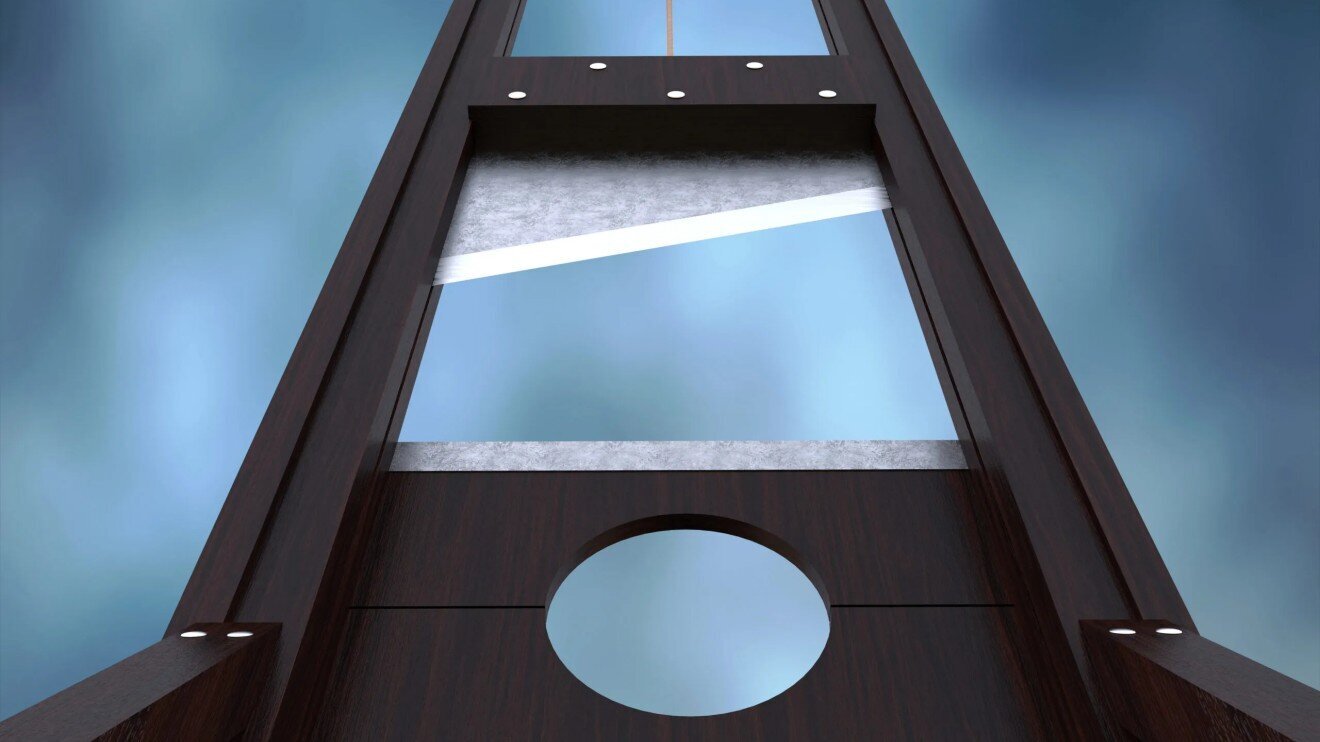
The guillotine’s main component was a heavy angled blade weighing between 40 and 100 kilograms, called the “mouton” (“little sheep” or “ram”) in the professional jargon of executioners and jailers. This slang name arose from the blade’s distinctive triangular shape, vaguely resembling the profile of a ram’s head, and from the way the blade slid obediently along its rails, like a sheep in a flock.
The blade moved freely along vertical rails and was hoisted to a height of 2-3 meters by rope, where it was held by a special catch. When the catch was released via a lever mechanism, the “mouton” fell at tremendous speed under its own weight and gravity.
Dr. Antoine Louis, who developed the device’s technical side on the commission’s orders, originally recommended the triangular blade shape. This recommendation was adopted, and the triangular blade became a distinguishing feature of the French guillotine, unlike the straight blades of other national variants.
History of Its Creation and Use
The French Revolution and the First Executions
Dr. Joseph-Ignace Guillotin submitted his proposal to the National Constituent Assembly in December 1789. His goal was to make capital punishment equal for all social classes — until then, nobles were executed by sword (considered an honorable death), while commoners were hanged or subjected to more agonizing methods.
On March 20, 1792, a decree was adopted specifying that “all those condemned to death shall be beheaded by a method adopted following consultation with the learned secretary of the Surgical Society.” After successful tests on corpses, the new machine’s first execution took place on April 25, 1792, on the Place de Grève in Paris. The victim was an ordinary thief, Nicolas Pelletier.
Interestingly, the device was initially called the “Louisette” or “little Louison” (la petite Louison), after Dr. Antoine Louis. But the name “guillotine” soon stuck.
The Reign of Terror
The guillotine gained the greatest notoriety during the Jacobin Terror of 1793-1794. On January 21, 1793, King Louis XVI was executed on the Place de la Révolution (now Place de la Concorde). Over the course of the Terror, more than a thousand people were executed on this square, including Queen Marie Antoinette and Robespierre himself.
The crowd of onlookers was initially disappointed by the speed of the execution — medieval “refined” executions had lasted hours, while the “mouton” did its work in seconds. But it was precisely this speed and painlessness that were the new device’s chief virtues.
Technical Improvements
From the 1870s, France used an improved guillotine of the Berger system. It was collapsible for ease of transport and was set up directly on the ground, usually in front of the prison gates — a scaffold was no longer required. The execution itself took mere seconds — after the “mouton” fell, the beheaded body immediately dropped into a prepared deep box with a lid.
During this period the post of regional executioner was abolished. The chief executioner, his assistants, and the guillotine itself were based in Paris and traveled to carry out executions throughout the country.
The Guillotine in Other Countries
Germany
In Germany the guillotine (German: Fallbeil, “falling axe”) had been used since the 17th-18th centuries. Unlike the French models, the German guillotine was lower, with metal vertical posts and a winch to lift the heavier blade.
In Nazi Germany, guillotining was applied to criminal offenders and Resistance fighters. Historians estimate that between 1933 and 1945, roughly 40,000 people were beheaded in Germany and Austria. Beheading was considered a “less noble” form of death compared to shooting.
Italy
The guillotine was introduced in the Papal States in 1819. The Roman guillotine differed from the French one with a straight blade and angular “vices” that clamped the condemned’s body. Executions took place at the Piazza del Popolo and near the Castel Sant’Angelo. The last execution took place on July 9, 1870.
The Last Executions and Abolition
The last public execution in France took place on June 17, 1939, in Versailles — the German murderer Eugen Weidmann was executed. Due to the crowd’s indecent behavior and press scandals, it was decided to carry out future executions within prison walls, behind closed doors.
The last-ever execution by guillotine in France took place on September 10, 1977, in Marseille — Hamida Djandoubi, a French citizen of Tunisian origin, was executed. This was also the last execution in Western Europe.
Capital punishment was abolished in France in 1981 under President François Mitterrand.
The "Little Sheep" in Popular Language
The slang name “mouton” for the guillotine’s blade entered popular speech and became a symbol of inevitability, speed, and finality in decision-making. In Russian, the expression “like the swish of the guillotine’s lamb” is used to describe something instantaneous, unappealable, and irreversible.
This comparison captures the nature of a firing decision especially well — just as the fall of the “mouton” in the guillotine left its victim no chance, a decision to dismiss someone is often made quickly and finally, with no possibility of appeal or reconsideration.
The Guillotine in Culture
The image of the guillotine has become firmly entrenched in world culture as a symbol of revolutionary terror, the relentlessness of fate, and mechanized death. It was described by Victor Hugo in “The Last Day of a Condemned Man,” by Alexandre Dumas in “The Count of Monte Cristo,” and it’s mentioned in Charles Dickens’s “A Tale of Two Cities.”
Ivan Turgenev, in his essay “The Execution of Tropmann” (1870), described the “sinister” grace of the guillotine with revulsion, comparing it to a swan’s neck. Russian poet Georgy Shengeli dedicated a dramatic poem, “Doctor Guillotin” (1922), to the device.
In cinema the guillotine has appeared in numerous films about the French Revolution, as well as in pictures about the Nazi regime, depicting the execution of Resistance fighters.
Myths and Misconceptions
There’s a widespread myth that Dr. Guillotin himself was executed by the machine he invented. This is false — Joseph-Ignace Guillotin survived the revolution and died a natural death in 1814. Moreover, he did not invent the guillotine, but merely proposed it as a humane alternative to the cruel execution methods that already existed.
Another myth holds that a severed head supposedly retains consciousness for several seconds after execution. Modern medicine refutes this theory — brain death occurs almost instantly due to the sharp drop in blood pressure.
The "Dry Guillotine"
Interestingly, the term “dry guillotine” referred to the Saint-Laurent-du-Maroni penal colony in French Guiana (Cayenne). Due to the tropical climate and harsh conditions, the survival rate of exiles was extremely low — by some estimates, no more than 3%. Exile to Cayenne was thus tantamount to a death sentence, only carried out not mechanically, but slowly, through disease and deprivation.
Conclusion
The expression “the swish of the guillotine’s lamb,” used in the context of the novel hero’s dismissal, precisely captures the nature of the decision made — swift, final, and unappealable. The “mouton,” the slang name for the guillotine’s blade, became a symbol in popular speech of the relentlessness of fate.
The history of the guillotine demonstrates the paradox of progress: invented as a humane alternative to cruel executions, it became a symbol of mass terror. The mechanization of death embodied in this device reflects industrial society’s general tendency toward rationalizing and mechanizing every sphere of life, including its most dramatic moments.
Today, with capital punishment abolished in most developed countries, the guillotine remains a historical monument to an era when the state claimed the right to take its citizens’ lives, and technical perfection served as an instrument of justice — whether fair or not is another question entirely.