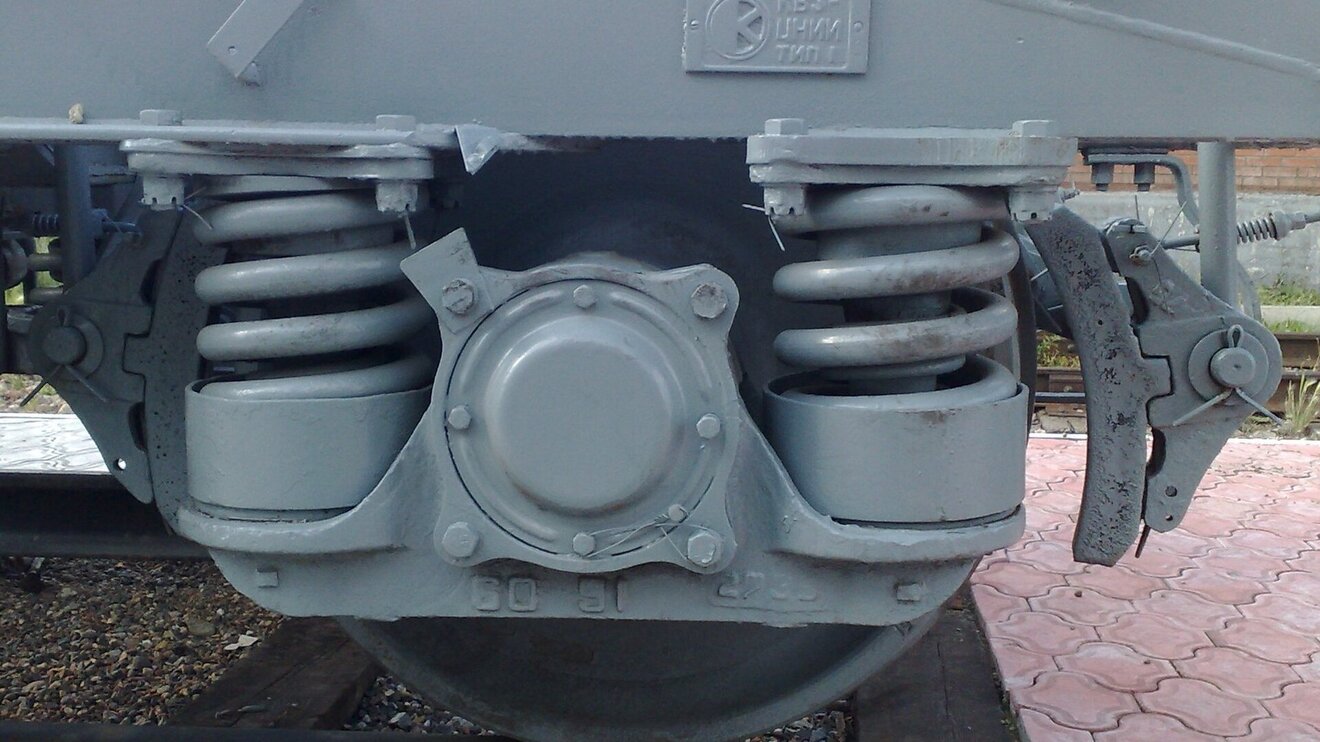
The axle box (journal box) is an important structural component of a railcar or locomotive, providing the connection between the frame (or bogie) and the wheelset. The term comes from the German Büchse, meaning «box.» Boxes were originally made of boxwood, but in railway technology the axle box is typically a cast or welded metal (steel or cast-iron) box housing the bearings, lubricant, and the fittings that service the rotating part of the axle.
Functions of the Axle Box
- Transferring the car’s weight onto the wheelset axle.
- Allowing the wheelset to rotate with minimal friction.
- Fixing the wheelset’s position relative to the frame or bogie.
- Protecting against dirt, dust, moisture, sand, and other abrasives getting into the bearing.
- Lubricating the friction surface of the axle journal.
Design of the Axle Box
The main elements of a classic axle box include:
- Housing — a steel or cast-iron box containing the whole mechanism.
- Bearing — the element the axle journal rests on. This can be a plain (sliding) or rolling bearing.
- Lubricant — a liquid or thick mixture needed to reduce friction between surfaces.
- Waste-packing pad and brush — a device that feeds lubricant to the axle journal.
- Seals — protect the inside of the box from contaminants.
- Lid — opens for inspection, giving access to the bearing and lubricant.
Types of Axle Boxes
There are several ways to classify axle boxes, but the most important divisions are by bearing type and by the way the box attaches to the bogie frame.
1. By Bearing Type
- Plain (sliding): the traditional type. The axle journal rests on a babbitt-metal or other anti-friction liner. Lubricant is fed through a waste pad and brush. This type was widespread until the late 20th century.
- Rolling: the modern type, using roller bearings. The lubricant is a thick grease (e.g., «ZhRO,» «Buksol»). This type needs less maintenance and offers less rolling resistance.
2. By Method of Attachment to the Bogie Frame
- Jaw-type: fitted into a cutout in the frame, held relatively loosely. More prone to wear and require precise adjustment.
- Jawless: connected to the frame by hinged links. More reliable, don’t require sliding in guides, and last longer without maintenance.
Servicing Axle Boxes
Standard practice at a station has a car inspector check every axle box. The procedure includes:
- Opening the axle-box lid with a special hammer.
- Visually checking the bearing’s condition and the lubricant level.
- Topping up oil from an oiler if needed.
- Checking for overheating, unusual noises, or contamination.
The inspector also uses a long-handled hammer for percussion diagnostics of the wheelsets: the sound of the strike can reveal cracks in the wheel tire or other defects.
Dangers and Failures
Any contamination of an axle box, especially sand or abrasive getting in, increases friction and causes overheating. In plain-bearing boxes, this can cause:
- Melting of the babbitt — the bearing-liner material.
- Oil catching fire due to high temperature.
- Wheelset seizure and, as a result, a possible derailment.
Railway history records cases of sabotage in which sand was deliberately poured into an axle box. This method has been used both in wartime and peacetime.
Language and Symbolism
The phrase «sand in the axle box» became an idiom in Russian, meaning destructive activity meant to sabotage a well-functioning mechanism or process. In literature and film, the axle box is often mentioned as a weak point in a railcar’s construction — an accessible target for sabotage.
Modern Practice
Modern freight and passenger cars generally use roller-bearing axle boxes. They’re more reliable, sealed, and require far less maintenance. The whole assembly is made non-serviceable for regular staff: it can only be opened at a depot using specialized equipment.
Even so, when cars derail, catch fire, or are hit by an explosion, the axle box can be damaged or destroyed. In extreme situations — such as the post-apocalyptic landscape described in the novel — the remains of an axle box may be the only recognizable fragment left of the car’s structure.
Conclusion
The axle box is not just a technical component but a key part of a railcar, one whose condition directly affects the safety of train movement. Though it looks from the outside like a simple metal box, inside it hides a carefully engineered system for transferring load, rotation, and lubrication. Understanding how an axle box works lets you sink deeper into the atmosphere of the railway, feel the realism of the scene, and even grasp, symbolically, the moments in which it appears.