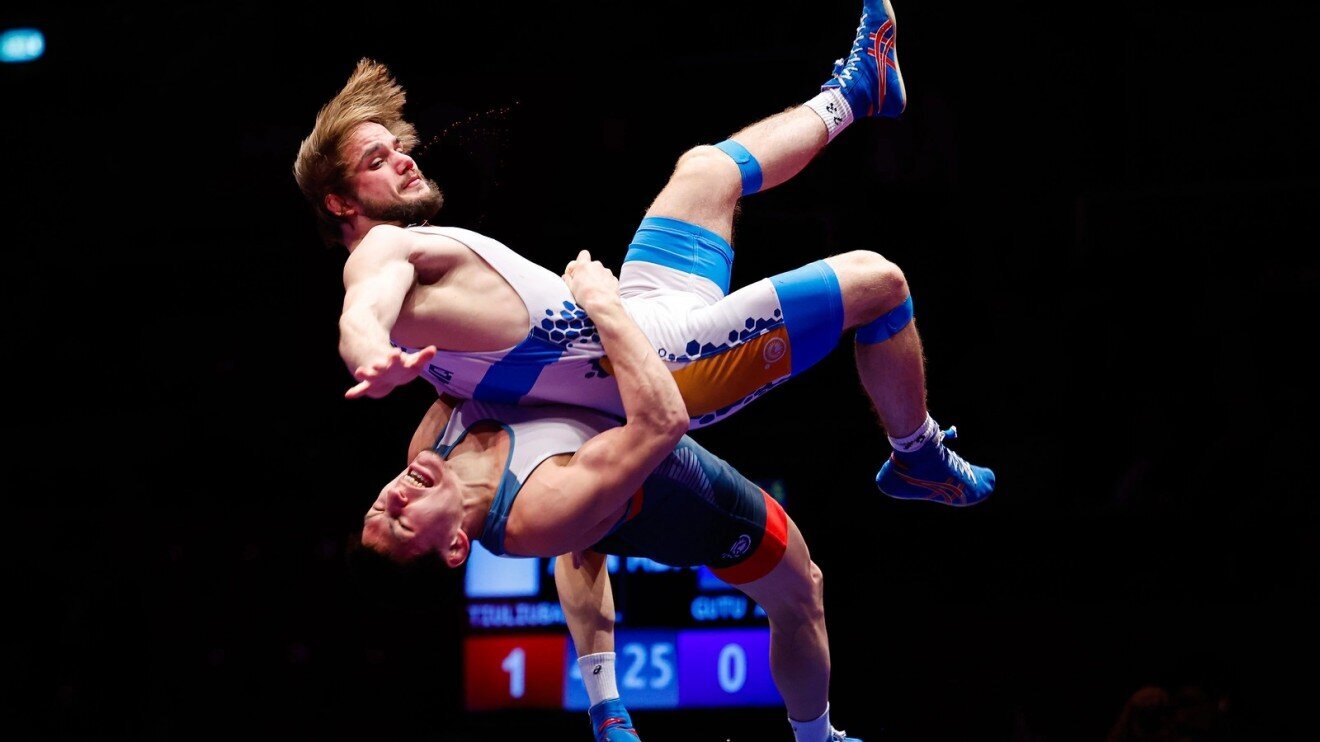
Greco-Roman wrestling (classical wrestling) is a European style of wrestling in which an athlete uses a specific arsenal of technical moves to throw an opponent off balance and pin their shoulders to the mat. The style’s defining feature is a ban on using the legs as an attacking tool, and on grabbing an opponent’s legs with the hands.
Origins and development
Greco-Roman wrestling’s roots reach deep into antiquity. Classical wrestling was born in ancient Greece and further developed in the Roman Empire, where it was an integral part of physical education and military training. The modern, revived form of Greco-Roman wrestling, however, took shape in France in the first half of the nineteenth century.
Until the second half of the 1940s, this style of wrestling was known in Russia as «French wrestling,» reflecting its modern French origin. After the Great Patriotic War it was renamed «classical wrestling,» and later «Greco-Roman-style competitive wrestling.» The renaming was tied to a Soviet campaign against «kowtowing to the West.»
Olympic history
Wrestling was included in the modern Olympic program from the very first Games, in Athens in 1896, underscoring its historical significance and popularity. Wrestling wasn’t contested at the next Olympics, in 1900, but from 1904 onward it has featured in the program of every single Summer Games without exception.
Regular international competitions began in the late nineteenth century: European championships have been held since 1898, and world championships since 1904. In 1912 the International Wrestling Federation, FILA, was founded, and by 1997 it counted more than 120 member countries.
Rules and features
Core principles
Greco-Roman wrestling pits two athletes against each other using various techniques applied strictly above the waist. The main goal of a bout is to pin the opponent’s back to the mat (a fall, or «touch»). This is what fundamentally sets Greco-Roman wrestling apart from freestyle, where leg techniques and leg grabs with the hands are permitted.
Greco-Roman wrestlers are strictly forbidden from:
- Using trips, hooks, or leg sweeps in their techniques
- Attacking the opponent’s legs
- Applying technical actions against joints
- Executing submission holds
- Holding the neck with both hands for more than 5 seconds
Scoring and how bouts are conducted
A wrestler can win in several ways:
- By pinning the opponent’s back to the mat (a fall) – an outright win
- By winning 1 or 2 periods on points
- By building an 8-point lead – the bout ends early
A bout consists of 2 periods of 3 minutes each (2 minutes for cadets and younger age groups), with a 30-second break between them. Wrestlers earn a set number of points for each throw, hold, or technique. The mat referee awards points, but the head judge must confirm the call.
If the score is tied, the winner is determined by the following criteria:
- Quality of technical actions
- Fewer cautions
- The most recent technical action
Wrestling technique
Stances and movement
In classical wrestling, a stance may be high, medium, or low, and, relative to the opponent, right-sided, left-sided, or frontal. A wrestler usually leads with their stronger leg. A high or medium stance favors mobility and attack, while a low stance favors defense.
Movement must be quick but stable. One foot is placed forward first, and the other is drawn up to it. Crossing the legs is discouraged, since it can cost a wrestler their balance.
The role of the legs in wrestling
Though the legs don’t «take part in the contest» as an attacking tool, their strength and speed play a huge role. In most throws that lift an opponent, the legs move from a bent, knee-flexed position to a straightened one, overcoming the weight of the person being thrown. Standing techniques are marked by explosive force and range of motion.
Core technical actions
Greco-Roman wrestling includes both scored and unscored techniques:
Standing
- Throws – the main attacking actions used to take an opponent down to the mat
- Takedowns – actions meant to disrupt an opponent’s balance
- Drags – techniques used to force an opponent down
On the mat
- Escapes – actions used to break free of a hold
- Rolls-through – carrying an opponent over one’s own body
- Rolls – rotational movements together with an opponent
- Turns – changing the position of the person being attacked
Ground work
- Holds – pinning an opponent in a disadvantageous position
- Pressing – forcing an opponent into a fall
- Turnovers – changing position to gain an advantage
Classic throws
Throws are categorized by rotation, bend, or arch. Historically, many technique names came from French terminology, laid out by Jean Esbroyer in 1848:
- Bras roulé («the mill»)
- Souplesse avant («forward belt»)
- Souplesse arrière («reverse belt»)
- Arrache – a classic snatch throw
- Tour de tete – a throw over the head
- Tour de hanche – a hip throw
In the USSR, French terminology was purged from the sporting vocabulary starting in 1948, and techniques were given Russian-language names. The international name «Greco-Roman wrestling» came back into official use in 1991.
Physical demands and training
Flexibility as the foundation of skill
Greco-Roman wrestling’s calling card is the arched throw with a waist grip – extremely dangerous for both wrestlers, and demanding exceptional flexibility and strength. Classical wrestling is a unique combination of flexibility and power.
Training places special emphasis on the «bridge» – a position in which only the athlete’s feet, forehead (sometimes chin), and arched back touch the mat. This position is critical both for defending against a fall and for executing many technical elements.
Acrobatic training
Flexibility is developed through a set of acrobatic exercises:
- Rolls of varying difficulty
- Cartwheels and round-offs
- Handstands
- Bridging up from a supine position
- Run-throughs
- Various types of bridges
Without strong, elastic joints and a well-developed circulatory and lymphatic system, a wrestler has no chance of success, which is why falling and self-protection technique are drilled extensively.
Strength training
Strength is built comprehensively:
- On apparatus: the bar, parallel bars
- With weights: squats, deadlifts, bench and standing presses, exercises drawn from powerlifting, bodybuilding, and weightlifting
- Without weights: push-ups, neck-strengthening exercises
- Specialized drills: resistance-band work at the gymnastics wall, hip-turn drills
Building endurance
The respiratory system and general endurance are built through running and games of movement, rugby-ball games being especially popular. Techniques are drilled on a dummy and with a training partner. Practice bouts sharpen technique and build the specific endurance that plays a decisive role in competition.
Gear and codes of conduct
Uniform
A wrestler’s gear includes:
- A singlet – the specialized wrestling uniform
- Socks – for hygiene and comfort
- Wrestling shoes – soft wrestling footwear
- A handkerchief – permitted, but largely symbolic today
Historically the handkerchief was used to wipe away blood and sweat, but today modern tissues serve that purpose, and the handkerchief remains mostly a nod to tradition. Beginning wrestlers can wear a T-shirt and shorts, and ordinary sneakers or gymnastic slippers instead of wrestling shoes.
Appearance and conduct requirements
Wrestlers are strictly forbidden from stepping onto the mat:
- With any substance smeared on their body
- With long fingernails
- Without a handkerchief on their person
Wrestlers are not permitted to:
- Argue with the referee (punishable by automatic loss)
- Talk to each other during a bout
- Leave the mat without the referee’s permission
Weight and age categories
International Greco-Roman wrestling is divided into five main age categories, each with its own weight divisions:
Younger cadets
Age: 12–13 (or 11, with medical clearance and parental permission)
Weight classes: 10 classes, from 29 to 85 kg
Cadets (younger)
Age: 14–15 (or 13, with medical clearance and parental permission)
Weight classes: 10 classes, from 32 to 120 kg
Cadets
Age: 16–17 (or 15, with medical clearance and parental permission)
Weight classes: 10 classes, from 55 to 130 kg
Juniors
Age: 18–20 (or 17, with medical clearance and parental permission)
Weight classes: 8 classes, from 55 to 130 kg
Seniors
Age: 20 and up
Weight classes: 7 classes, from 55 to 130 kg
Veterans
Age: 35 and up
Weight classes: same as seniors
After weigh-in, wrestlers may only compete in their own weight class. Older-category wrestlers may compete in a higher weight class, except for the heavyweight division.
Outstanding wrestlers
Legends of the sport
Alexander Karelin is recognized by the International Wrestling Federation as the greatest Greco-Roman wrestler of the twentieth century. His record is staggering: a three-time Olympic champion, nine-time world champion, twelve-time European champion, and thirteen-time champion of the USSR and Russia.
Mijain Lopez Nunez, a Cuban wrestler, is the only five-time Olympic gold medalist in the sport’s history – a singular achievement in world sport.
Other outstanding athletes
Among three-time Olympic champions, Swedish wrestler Carl Westergren, who also became a world champion, stands out.
Many outstanding wrestlers have won two Olympic titles:
- Valery Rezantsev – a five-time world champion
- István Kozma – a three-time world champion
- Petar Kirov – a three-time world champion
- Hamza Yerlikaya – a three-time world champion
- Armen Nazaryan – a three-time world champion
- Roman Vlasov – a three-time world champion
Circus wrestlers
Circus wrestlers, who helped popularize the sport among the general public, occupy a special place in its history:
- Ivan Maximovich Poddubny – the legendary Russian wrestler
- Khadzhimukan Munaitpasov – a Kazakh wrestler who found fame in the early twentieth century
Grips and technical specifics
Grip rules
Unlike judo and sambo, grips in classical wrestling are applied strictly to the body, demanding considerably more physical strength. Grabbing the following is strictly forbidden:
- Clothing
- Ears or nose
- Fingers
- Genitals
Permitted grips include:
- Hands and forearms
- Shoulders
- Neck (with restrictions)
- Torso
Wrestling in different positions
A bout is contested both standing and on the ground (in par terre). While standing, the main goal is to throw the opponent off balance and bring them to the ground, using various throws and takedowns.
Characteristic standing techniques include:
- The «spin» – a rotational throw
- The arched throw – executed by arching the back
- The turning throw – changing the direction of attack
- The «loop» – a neck-and-shoulder grip used to force an opponent down
On the ground, the goal is to turn the opponent so their shoulders are pinned to the mat, and to hold them there for several seconds. Wrestlers use rolls and rotations, and the «press» is used to force an opponent from a «bridge» position into a fall.
Greco-Roman wrestling in culture
Its cinematic legacy
Greco-Roman wrestling has been depicted in Soviet cinema in several notable films:
- «World Champion» (1954) – about a village boy who becomes world champion
- «The Wrestler and the Clown» (1957) – about the friendship between wrestler Ivan Poddubny and animal-trainer clown Anatoly Durov
- «The Balloonist» (1975) – a biographical drama about Russian wrestler Ivan Zaikin
- «In the Arena: Lurich» (1984) – about episodes in the life of wrestler Georg Lurich
- «Know Our People!» (1985) – about the Kazakh wrestler Khadzhimukan Munaitpasov
- «Arena of the Furious» (1986) – a historical sports drama
Philosophy and significance
Greco-Roman wrestling is more than a sport – it’s an entire philosophy of combat, blending ancient tradition with modern sporting principles. The style builds not just physical qualities but character, teaching wrestlers to overcome hardship and achieve their goals through relentless work.
Its restrictions on technique (the ban on using the legs as an attacking tool) make Greco-Roman wrestling especially dramatic to watch, demanding exceptional development of the upper body, flexibility, and technical mastery from its athletes. That creates a unique style of contest, where every movement has to be precise and effective.
Comparing Greco-Roman wrestling to chaotic movement «on a trampoline,» as literature has vividly described it, captures the dynamism and unpredictability of the sport – where wrestlers, like acrobats, must keep control of their bodies in the most complex and unstable positions.