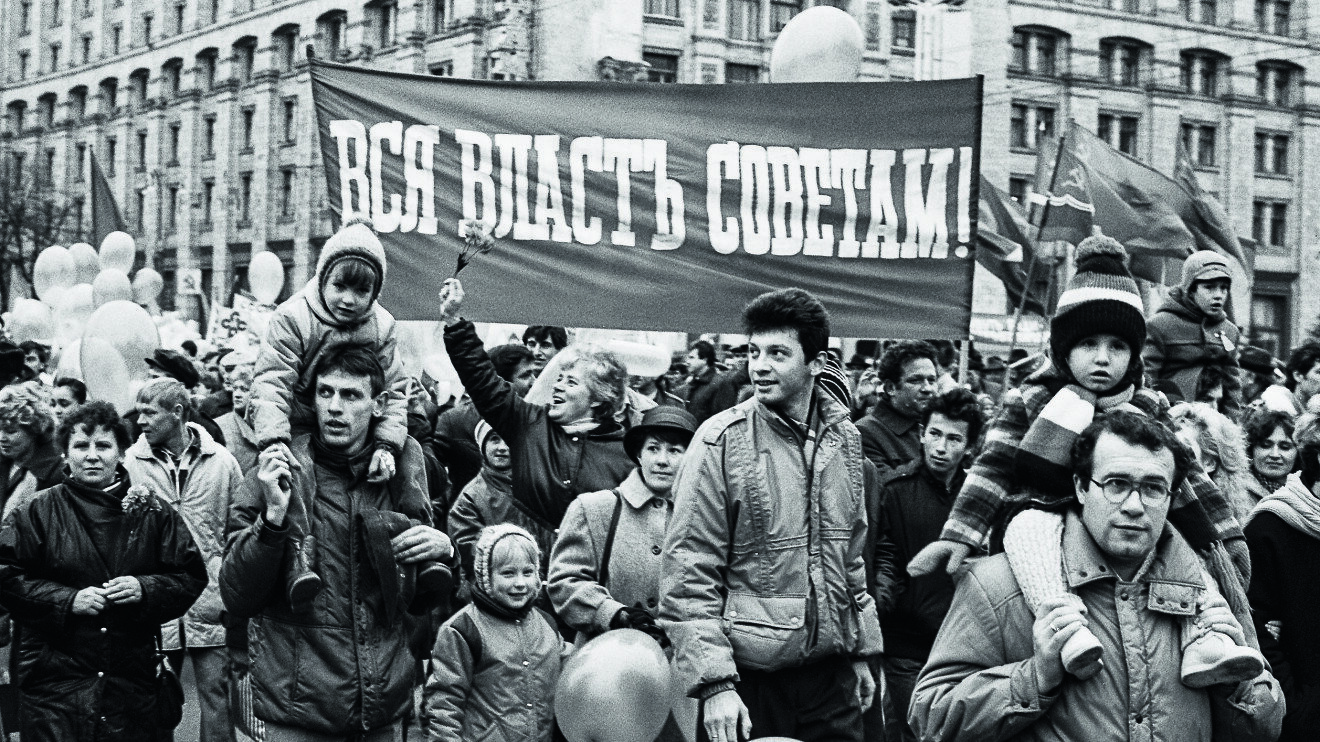
The events mentioned in this chapter — the voucher falling from 9 dollars to 7.5, the dollar jumping from 1,100 to 1,500 rubles, and the remark that «the White House is seething with counter-revolutionary ideas» — took place against the backdrop of the fiercest political confrontation between the executive and legislative branches in Russia, which by September 1993 had reached its critical point.
Roots of the conflict
The constitutional crisis grew out of fundamental disagreements between two political camps over the country’s path forward. On one side stood President Boris Yeltsin, supported by Viktor Chernomyrdin’s government, Moscow mayor Yuri Luzhkov, and part of the regional leadership. They pressed for the swift adoption of a new Constitution, stronger presidential power, and radical market reforms. On the other side stood the leadership of the Supreme Soviet under Ruslan Khasbulatov, Vice President Alexander Rutskoy, and the majority of people’s deputies, who insisted that full authority remain with the Congress of People’s Deputies and objected to the haste of the economic transformation.
Legally, the two sides rested on different readings of the Constitution then in force. Under Article 104, the supreme organ of state power was the Congress of People’s Deputies, which gave parliamentarians a formal right to control the president’s actions. Yeltsin, for his part, regarded this as a «constitutional ambiguity» in which the president swears to uphold the Constitution while being restricted in his powers by it.
Economic reform as catalyst
On November 1, 1991, the Fifth Congress of People’s Deputies granted Yeltsin extraordinary powers for slightly more than a year — until December 1, 1992 — to carry out economic reform. Having won the right to make economic decisions single-handedly, the Yeltsin–Gaidar government launched radical changes, including price liberalization and privatization.
Especially sharp parliamentary reaction was provoked by the decree of August 14, 1992, introducing voucher privatization with anonymous privatization checks, which annulled the law on registered privatization accounts passed by the Supreme Soviet. The decree was signed during the parliamentary recess, when most deputies had scattered from Moscow, which precluded any prompt challenge to it. Methods of that kind seriously sharpened relations between the branches of power.
By the end of 1992 the economic situation had become catastrophic: prices had risen twenty-sixfold over the year, and the purchasing power of household deposits in Sberbank had fallen by 94 percent. Results like those gave the opposition weighty arguments against the government’s policy.
Escalation
The Seventh Congress of People’s Deputies in December 1992 refused to confirm Yegor Gaidar as chairman of the government. A compromise brokered by Valery Zorkin, chairman of the Constitutional Court, produced the appointment of Viktor Chernomyrdin as prime minister, along with a referendum scheduled for April 1993 on the basic provisions of a new Constitution.
The compromise proved fragile. The Eighth Congress in March 1993 effectively cancelled the December agreements. By that point a stable anti-Yeltsin majority had formed in parliament, including the «Russian Unity» bloc (agrarians, communists, nationalists), «Constructive Forces» (industrialists and trade unions), and part of the centrists. Only 99 deputies from the «Reform Coalition» bloc and the «Consensus for Progress» faction remained pro-Yeltsin.
On March 20 Yeltsin announced on television the introduction of a «special order of government» for the country, which was taken as an attempt to suspend the Constitution. On March 23 the Constitutional Court found the president’s actions unconstitutional and identified grounds for impeachment. On March 28 the Ninth Extraordinary Congress voted on removing Yeltsin from office but failed to reach the required two-thirds majority: 617 deputies voted in favor, with 689 needed.
The referendum and the Constitutional Conference
On April 25 an all-Russian referendum was held on four questions. The results were contradictory: citizens expressed confidence in the president (58.7 percent) and approved the government’s social and economic policy (53 percent), but came out against early presidential elections (49.5 percent in favor) and in favor of early parliamentary elections (67.2 percent in favor). By the Constitutional Court’s ruling, however, no decision had been taken on the last two questions, since fewer than half of all registered voters had voted for them.
An attempt to find a compromise through the Constitutional Conference, which began work on June 5, also failed. After the president’s supporters shouted down Khasbulatov’s speech, he walked out of the conference along with part of the delegates. On June 12 the conference approved the «presidential» draft Constitution, but it had become clear that the Congress would never adopt it.
Preparing for the decisive fight
Over the summer of 1993 both sides prepared for the final showdown. On August 12 Yeltsin declared that «the real political fight will come in September,» and that if parliament would not take a decision on early elections, then «the President will take it for them.» On August 31 the president, together with Defense Minister Pavel Grachev, inspected military units outside Moscow — the Kantemirovskaya and Tamanskaya divisions, and an airborne regiment.
On September 1 Yeltsin issued a decree temporarily suspending Vice President Rutskoy from office «in connection with an ongoing investigation» into corruption allegations, which later turned out to be based on forged documents. The Constitution in force made no provision for such a step, and on September 3 the Supreme Soviet petitioned the Constitutional Court to review the decree’s legality.
On September 16 the president inspected the Dzerzhinsky Special Purpose Division of the Interior Ministry’s internal troops and announced the appointment of Yegor Gaidar as first deputy prime minister — an open challenge to parliament. On September 18, at the first session of the Federation Council, the question of early elections was raised for the first time, and Yeltsin agreed to them on condition that the presidential and parliamentary elections be held at different times.
The fateful decision
On September 21, 1993, Boris Yeltsin signed Decree No. 1400 «On Step-by-Step Constitutional Reform in the Russian Federation,» which ordered the Congress of People’s Deputies and the Supreme Soviet to cease their activity and set elections to a new parliament — the State Duma — for December 11–12. The decree flagrantly violated the Constitution then in force.
Under Article 121.6 of the Constitution, the president was automatically deemed removed from office from the moment the decree was issued. The Presidium of the Supreme Soviet recorded that fact, and the Constitutional Court issued a finding that the president’s actions were unconstitutional. On September 22 the Supreme Soviet adopted a resolution terminating Yeltsin’s powers and transferring them to Vice President Rutskoy, announcing the convocation of the Tenth Extraordinary Congress.
On September 23, in an attempt to turn the situation around, Yeltsin announced early presidential elections for June 1994, although by law only the Supreme Soviet could call them. That same day came an attack on the headquarters of the CIS Joint Armed Forces, in which two people were killed.
On September 24 the Tenth Congress of People’s Deputies confirmed the decision terminating Yeltsin’s presidential powers and transferring them to Rutskoy, qualifying the president’s actions as a coup d’état. The Congress resolved to hold simultaneous early presidential and parliamentary elections no later than March 1994.
On September 25, 1993 — the days in which this chapter is set — the country was in a state of dual power. Formally, under the Constitution, the president was Alexander Rutskoy; in fact, Boris Yeltsin continued to exercise the powers of the office. The financial markets mirrored that uncertainty: the dollar rate leapt about, vouchers cheapened, the economy froze waiting for the political crisis to resolve. Ahead lay the tragic events of early October, which would finally settle the outcome of the confrontation.