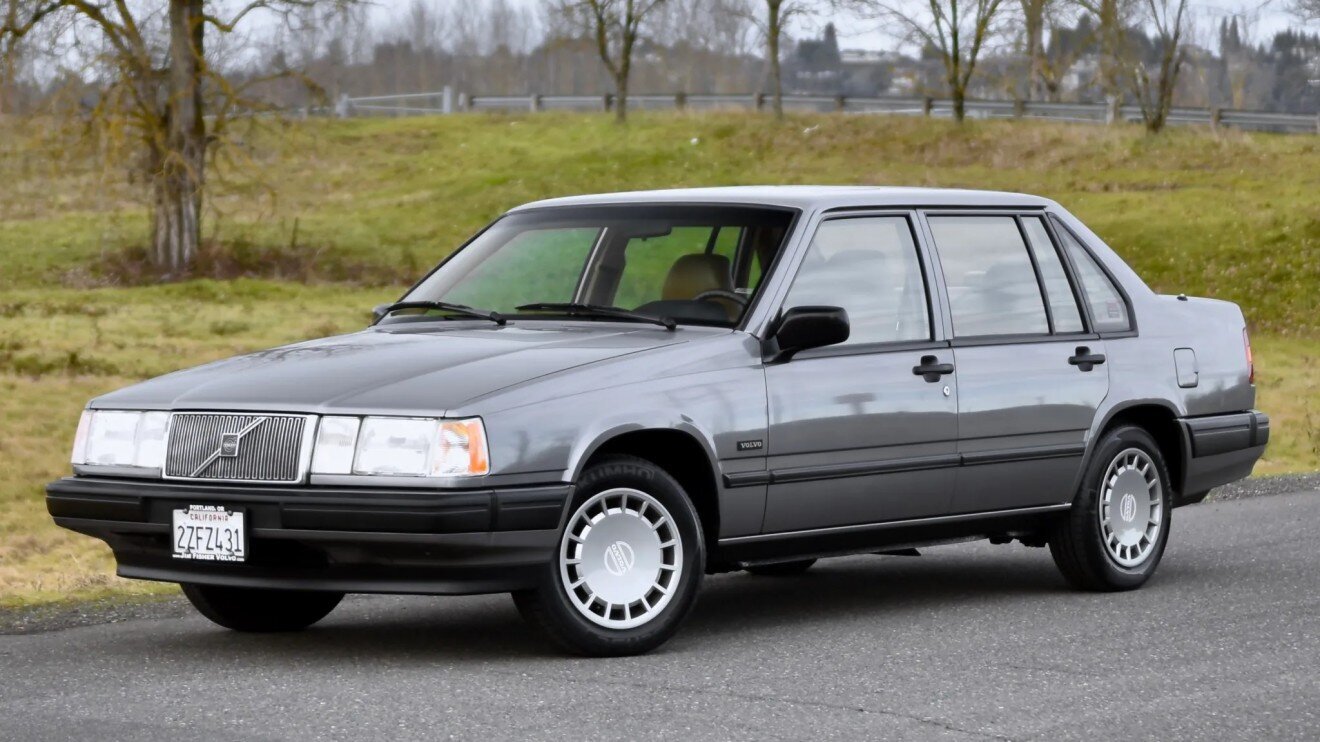
The Volvo 940 was a saloon and estate from the Swedish company Volvo, produced from 1990 to 1998. This model was one of Volvo’s last rear-wheel-drive cars and a symbol of prosperity for successful entrepreneurs of the early 1990s.
The Model’s History
The Volvo 940 was introduced in September 1990 as a direct replacement for the popular 740 series. In essence, the 940 was a cosmetic update of its predecessor, keeping nearly all the same technical solutions but with an updated exterior and improved interior.
The saloon’s main visual difference was a fully reworked rear end from the C-pillar back — the new, taller boot not only changed the car’s silhouette but significantly increased cargo volume compared to the 700 series. That said, this solution somewhat worsened the driver’s rearward visibility.
The Volvo 940 estate, which appeared in May 1991, was outwardly almost indistinguishable from its predecessor, the 740 Estate, keeping the recognizable “brick-like” silhouette that became the calling card of Swedish estates.
Technical Specifications
Engines
The Volvo 940’s engine lineup was inherited from the 740 almost unchanged. At its core were the tried-and-tested four-cylinder “Redblock” engines:
Gasoline engines
- B200 — a 2.0-liter 8-valve engine
- B230FB — a 2.3-liter 8-valve naturally aspirated engine producing 131 hp (the most common variant)
- B230FD — a 2.3-liter engine producing 115 hp (mainly for the US market)
- B230FT — a 2.3-liter turbocharged engine producing 165 hp
In 1991-1992, 16-valve versions of the B204 and B234 engines were also offered, fitted to select variants for certain markets.
Especially notable is the B230FK engine, which appeared in 1994 — a low-pressure turbocharged version with a small turbocharger. At just 135 hp (against 131 hp for the naturally aspirated version), this engine delivered noticeably more torque across the entire rev range and almost no turbo lag.
Diesel engines
A proven 2.4-liter turbocharged Volkswagen D24TIC diesel producing 116 hp was offered, though the share of diesel sales in the 900 series was significantly lower than in previous models.
Transmissions
The Volvo 940 came with various types of gearboxes:
- Manual: a 5-speed M47 or a 4-speed with overdrive M46 (until 1995), then a full 5-speed M90
- Automatic: a 3-speed with overdrive Aisin-Warner AW70/71/72, or a 4-speed ZF 4HP22 (for certain engines)
Trim Levels and Regional Variations
One quirk of the Volvo 940 was that the designation SE meant completely different trim levels depending on the country of sale:
- In Sweden the 940 SE was the base naturally aspirated version with some extra options
- In the UK SE denoted a high trim level, available with any engine type
- In Australia the 940 SE came exclusively with the turbocharged B230FT engine and expanded equipment
- In the US the SE version used the body of the 960 model (with a different dashboard, hood, and recessed wipers) but with a four-cylinder turbo engine
In Italy, from 1993 all 940 estates carried the names “Polar” (with the B200F engine) or “Super Polar” (with the B200FT turbo engine). Toward the end of production, some countries also received a limited “Classic” series with expanded equipment.
Production and Sales
Production of the Volvo 940 ran from 1990 to 1998. Over that period the following were built:
- 246,704 saloons
- 231,677 estates
Some cars were built at Volvo’s plant in Halifax (Nova Scotia, Canada). Cars assembled there in 1993 received special emblems on the rear window to mark the plant’s 30th anniversary.
Sales of the 940 in the US ended in 1995, in favor of the new Volvo 850 and Volvo 960 models.
The Volvo 900 Series: Market Positioning
The 900 series, which included the 940 and 960 models, was Volvo’s executive-car lineup, produced from 1990 to 1998. This series was meant to replace the successful 700 lineup and serve as a bridge to the next generation of Volvos.
Volvo 960: Flagship of the Line
If the 940 was an evolution of the 740, then the Volvo 960, which appeared in autumn 1990, was a development of the more prestigious 760. The key differences of the 960 were:
- A new inline 6-cylinder engine with an aluminum block (known in the Volvo community as the “white block”) producing 204 hp
- Independent rear suspension instead of a rigid axle
- A more refined interior with higher-quality materials
- Unique body elements — the front end, dashboard, and other details were not shared with the junior model
In some countries the 960 was also offered with turbocharged four-cylinder engines and even diesel units, but its primary engine remained the new inline six.
In 1995 the 960 received a substantial update that improved handling, and before production ended in 1997-1998 it was renamed the S90 (saloon) and V90 (estate).
The Volvo Company: History and Philosophy
Founding and Early Years
Volvo Car Corporation was founded in 1927 in Gothenburg, Sweden, as a subsidiary of the bearing manufacturer SKF. Its founders were Assar Gabrielsson (managing director) and Gustav Larson (technical director).
The name “Volvo” comes from the Latin “I roll,” and had originally been registered by SKF in 1915 for a special series of bearings for the American market, but wasn’t used until the car company was founded.
The first Volvo, the ÖV 4, rolled off the assembly line on April 14, 1927. The round logo with the arrow pointing to the upper right is an ancient Greek alchemical symbol for iron, symbolizing the strength of Swedish steel.
The Philosophy of Safety
From its very founding, Volvo held to a principle set out by its creators:
“Cars are driven by people. The guiding principle behind everything we make at Volvo, therefore, is and must remain — safety.”
— Assar Gabrielsson and Gustav Larson, 1927
This philosophy shaped the company’s development for decades to come and made Volvo synonymous with automotive safety worldwide.
International Expansion
Key stages of Volvo’s expansion:
- 1955 — the first Volvos appeared in the US thanks to importer Leo Hirsch
- 1963 — the Halifax (Canada) plant opened, Volvo’s first assembly facility outside Sweden
- 1964 — the Torslanda (Sweden) plant launched, becoming one of the largest production hubs
- 1965 — the Ghent (Belgium) plant opened, the first facility within the European Economic Community
Landmark Models Before the 900 Series
The Volvo PV444 (1947-1958) was a breakthrough model — the most compact and mass-produced in the marque’s history up to that point, giving Volvo a successful entry into the American market.
In the early 1970s Volvo acquired the automotive division of the Dutch company DAF, allowing it to expand its lineup with smaller cars, including the Volvo 340, which was successful in the UK.
Volvo in the Context of Its Time
By the early 1990s Volvo had firmly established itself as a maker of premium cars focused on safety and quality. The 940 embodied that philosophy — a reliable, safe, status-symbol car for successful people.
Conservative design, proven technical solutions, and a reputation for near-indestructibility made the Volvo 940 especially popular among entrepreneurs and executives, for whom a car was not just a means of transport but a symbol of achieved success.
Competitors and Positioning
In the executive saloon class, the Volvo 940 competed with models such as:
- The BMW 5 Series (E34)
- The Mercedes-Benz W124
- The Audi 100/A6
- The Saab 9000
At the same time, Volvo offered a unique combination of practicality (especially in the estate version), safety, and relative affordability compared to the German premium brands.
Technical Legacy
The Volvo 940 was one of the company’s last rear-wheel-drive models (until the arrival of the electric XC40 Recharge in 2023). Its simple and reliable construction, with a longitudinally mounted engine, a rigid rear axle, and proven components, made it easy to service and long-lasting.
The “Redblock” engines fitted to the 940 earned a reputation as practically indestructible units, capable of running hundreds of thousands of kilometers with proper maintenance.
Collector Value
Today the Volvo 940, especially in turbocharged versions and the estate body, is of interest to collectors and enthusiasts. The model symbolizes the end of an era of simple, reliable, easily repaired Volvos, after which the company moved on to more complex front-wheel-drive designs.
Conclusion
The Volvo 940 was a worthy conclusion to the evolution of the classic Swedish saloon and estate. Combining conservative technical solutions with modern standards of safety and comfort, this model perfectly reflected the values of its time — reliability, practicality, and status without excessive showiness.
For a successful entrepreneur of the early 1990s, buying a new Volvo 940 wasn’t just acquiring a car — it was a demonstration of a position achieved in society, of good taste, and of an understanding of true values: quality, safety, and durability.