Origins: Pushkin’s «The Tale of the Golden Cockerel»
«The Tale of the Golden Cockerel» is a fairy tale by the Russian poet Alexander Pushkin, the last work of its kind he ever wrote. It was written in 1834 and first published the following year in the journal Biblioteka dlya Chteniya (vol. IX, book 16).
In his youth, Tsar Dadon had wronged his neighbors. When he grew old and decided to rest from his campaigns, those same neighbors began attacking him in turn, inflicting terrible harm. Dadon turned for help to a sage, an astrologer and eunuch. The sage offered him a golden cockerel on a spindle. As long as the realm stayed calm, it would sit quietly; but at the first sign of danger, it would cry out:
Kiri-ku-ku! Rule on, lying on your side!
It’s precisely this onomatopoeic formula – «kiri-ku-ku» – that became the seed for countless folk reworkings and transformations, spreading through various layers of Russian folklore.
Transformation in folk tradition
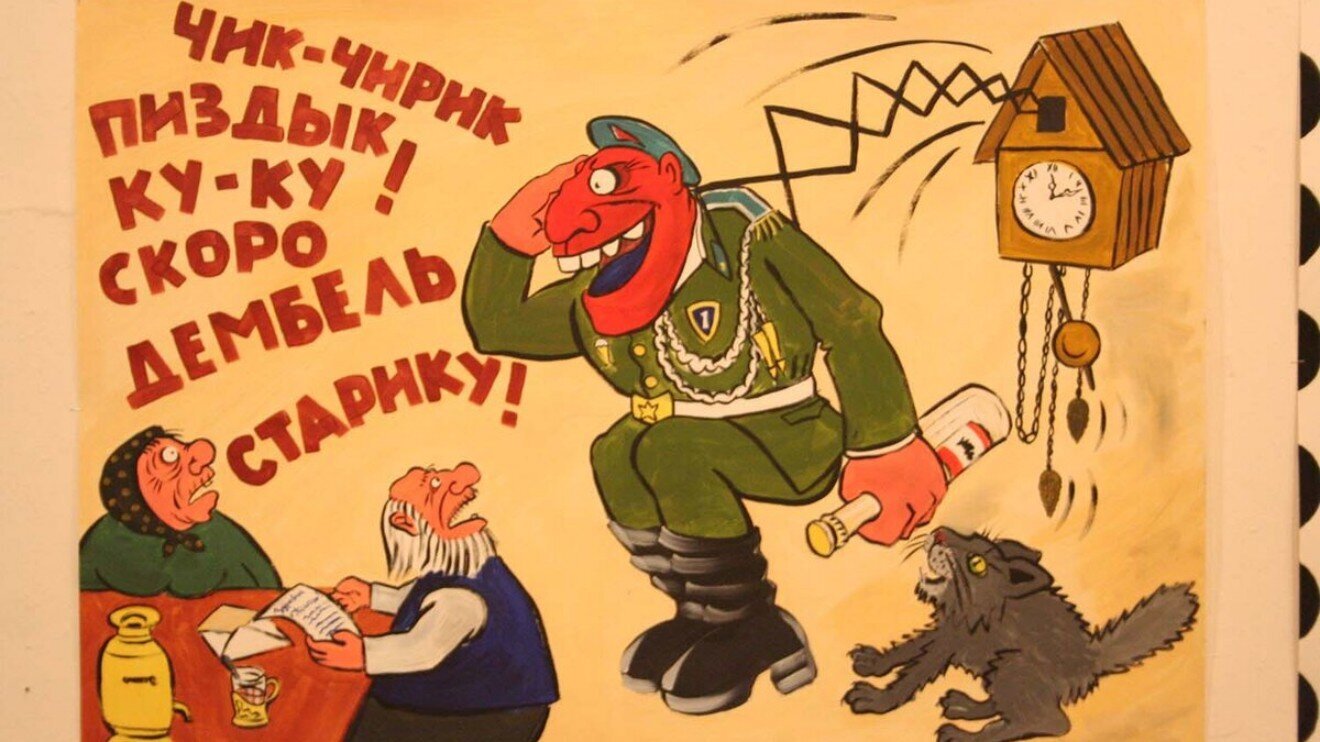
Pushkin’s «kiri-ku-ku» underwent significant changes in oral folk tradition. The onomatopoeic crow of the rooster took on new forms: «chik-chirik» («tweet-tweet»), «chirik-pizdyk,» «pizdyk-ku-ku.» This transformation reflects the natural process of folk reworking of literary material, in which a source text is adapted to living speech and takes on cruder but more expressive forms.
It’s especially interesting to trace how Pushkin’s classic formula turned into army folklore, where it acquired an entirely new layer of meaning tied to the theme of demobilization and the return home.
Army ditties and demobilization folklore
Soviet and Russian army tradition developed a distinct genre of demobilization ditties and verse, centered on waiting for «dembel» – the end of one’s compulsory military service. These works of folk creativity serve an important psychological function, helping servicemen cope with the hardships of service and keep their morale up.
Characteristic features of the genre include:
- The use of military slang and crude, explicit language
- A rhythmic structure that’s easy to memorize
- Images of home, family, civilian life
- A humorous treatment of serious themes
- Collective, communal performance
Classic variants of the demobilization ditty
The most widespread versions of the army ditty built on the «chik-chirik-pizdyk-ku-ku» motif follow this basic structure:
Variant one
Out at the forest’s edge,
the nightingale told the cuckoo,
Chirik-pizdyk, whackety-koo,
old man’s almost mustered out,
Ate the butter – day’s done,
the sergeant’s headed home,
Sleep tight, dear old-timer,
no mines under the bed,
may you dream of home sweet home,
a broad with a lush cunt,
a barrel of beer, a tub of vodka,
and Ustinov’s order –
discharge to the reserves.
Variant two
Early morning at the forest’s edge
the nightingale sang to the cuckoo
Chik-chirik, pizdyk-ku-ku,
old man’s almost mustered out.
Early morning they roused us,
worked us over at PT.
Ate the butter, day was done,
the sergeant’s headed home.
Sleep well, old-timer, good night,
dembel’s one day shorter now,
may you dream of home sweet home,
a broad with a lush cunt.
A sea of beer, a tub of vodka,
and Ustinov’s order,
discharge to the reserves.
Variant three (extended)
One summer at the forest’s edge
the nightingale sang to the cuckoo
Chik-chirik, pizdyk, ku-ku,
old man’s almost mustered out.
Ate the butter, day was done,
the sergeant’s headed home.
Sleep well, old-timer, good night,
dembel’s one day shorter now.
May you dream of home sweet home,
a broad with a lush cunt,
a sea of beer, a tub of vodka,
and Ustinov’s decree,
and the order plainly states –
every dembel, report home,
over mountains, through the forest
rides the dembel express train.
Kiss the rails, you girls back home,
the old boys are riding out,
till the order comes at last,
a hundred days are left to go…
Structural analysis
Several key elements unite all the variants of this ditty:
The opening
The action unfolds «at the forest’s edge» or «early morning at the forest’s edge» – creating a pastoral atmosphere that contrasts sharply with army reality. The dialogue between the nightingale and the cuckoo echoes folk tales and songs in which birds often serve as messengers.
The central formula
«Chik-chirik, pizdyk, ku-ku / old man’s almost mustered out» is a transformation of Pushkin’s «kiri-ku-ku,» but carrying an entirely new meaning. Here the onomatopoeia becomes a herald of liberation rather than of danger.
Everyday details
«Ate the butter, day was done» reflects the monotony of army life, where even a meal becomes a way of counting down the days to discharge.
The figure of the «old-timer»
«Old man,» «old-timer» refers to a senior conscript nearing discharge. Within the army hierarchy, these «elders» hold a special place, and addressing them in the ditty carries a tone that’s both respectful and ironic at once.
Dreams of home
The images of «home sweet home,» «a broad with a lush cunt,» «a barrel of beer, a tub of vodka» are the classic dreams of a serviceman about civilian life, delivered in a grotesque but heartfelt form.
The official procedure
«Ustinov’s order for discharge to the reserves» refers to a real military procedure. Dmitry Ustinov served as the USSR’s Minister of Defense from 1976 to 1984, and his name became a byword in army folklore.
Sociocultural function
Demobilization ditties serve several important functions within army subculture:
Psychological release
Humor and crude candor let servicemen express their true feelings and desires – especially important under strict military discipline.
Collective identity
Singing the ditties together builds a sense of camaraderie and shared experience.
Ritual function
The ditties are often performed at particular moments – before sleep, during downtime, on days when letters arrive from home.
Passing down experience
Young conscripts absorb army traditions and values through this folklore.
Linguistic features
Army ditties display characteristic traits of soldiers’ slang:
- Obscene vocabulary – used not to insult, but as a marker of belonging to a closed male group
- Euphemisms – partial words standing in for the full obscenity
- Army jargon – «dembel,» «old man,» «old-timer»
- Rhythmic organization – a clear meter suited to group performance
- Rhyme – aids memorization and transmission
Historical perspective
The tradition of demobilization ditties took shape over decades of Soviet history. It brought together:
- Classic images from Russian poetry (Pushkin’s cockerel)
- Folkloric motifs (a dialogue between birds, a forest’s edge)
- The realities of twentieth-century military service
- The particular character of male collective creativity
Variants and improvisation
One characteristic feature of army ditties is their variability. The basic structure stays constant, but details shift depending on:
- Branch of service
- The unit’s geographic location
- Historical period
- The personal experience of the performers
This keeps the folklore alive and current, constantly refreshed by the creativity of new generations of servicemen.
Semantic evolution
The semantic transformation of Pushkin’s formula is especially interesting. In Pushkin, «kiri-ku-ku» is an alarm signal, a warning of danger. In the army ditties, «chik-chirik-pizdyk-ku-ku» becomes, on the contrary, a herald of liberation and joy.
That inversion of meaning reflects the particulars of the army worldview, in which the end of service is experienced as deliverance from hardship and a return to normal life.
Context within the novel: the symbolism of farewell
In the context of the novel, the line «Chik-chirik-pizdyk-ku-ku, I’m leaving» takes on special significance. By using this army formula, Zhorik is signaling his own «dembel» – the end of a particular stage of life and the move into a new one.
His choice of exactly this phrase is no accident. It:
- Gives the farewell a ritual quality
- Invokes the collective experience of a generation that passed through army service
- Creates an effect that’s both comic and tragic at once
- Underscores the informal, trusting nature of the relationship between the characters
Zhorik had precisely these army ditties and the demobilization motif in mind when he spoke those words. Like a soldier finishing his service, he’s «mustering out» of his relationship with Roman, moving on to a new stage of life. His departure is a symbolic «dembel» – a release from his former obligations and ties.
Conclusion
The phrase «Chik-chirik-pizdyk-ku-ku, I’m leaving» is a striking example of how classic literature gets transformed by folk creativity, traveling a path from Pushkin’s fairy tale through army folklore to contemporary literary prose.
This phenomenon shows the resilience and flexibility of the Russian cultural tradition, capable of adapting and reinterpreting classic images to fit the changing social realities and needs of different social groups.
Within the literary work, such a reference creates a layered web of meaning, uniting high poetry, folk culture, and contemporary prose into a single artistic whole.