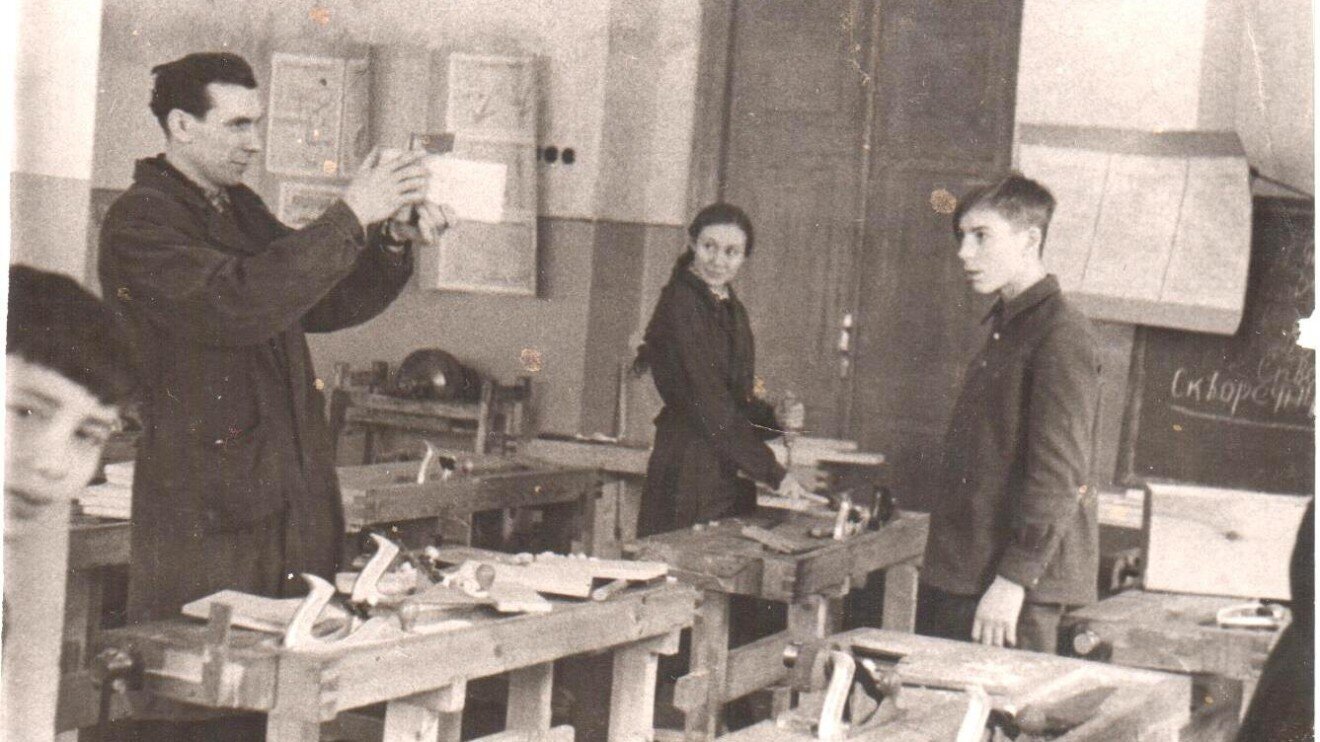
A professional-technical school (PTU) was an institution within the vocational education system, training skilled workers in various trades. In the Soviet era, PTUs became the backbone of mass workforce training for industry and agriculture.
Historical development
The roots of vocational education in Russia run deep. The oldest schools were seminaries, appearing as far back as 1749. In 1772, commercial schools were established, where students studied law, bookkeeping, and navigation alongside general subjects. The first technical schools appeared in 1865, and "real schools" (science-and-technology-focused secondary schools) in 1873.
The direct forerunners of the Soviet PTU were the factory apprenticeship schools (FZU) and trade schools that had existed since the days of the Russian Empire. These institutions laid the groundwork for practical training in the working trades.
The Soviet period
In 1954, technical schools with a 1–2-year program were opened for secondary-school graduates — an important step in the development of the vocational education system.
A radical reorganization took place in 1958–1959, when every type of vocational-technical institution was converted into urban and rural professional-technical schools (GPTU and SPTU). Management of these institutions was handed to the vocational-education committees of the union republics.
PTUs admitted young people who had finished 8 years of school. The course of study lasted 1–2 years. In 1966, technical schools with a 1–1.5-year program were reinstated.
An important milestone came in 1972, with the creation of a new type of institution — the "middle PTU" (SrPTU). These schools gave students a full secondary education alongside a trade. SrPTUs admitted graduates of 8th grade, with a course of study lasting 3–4 years.
The scale of the PTU system
By 1974, the USSR had 6,028 vocational-education institutions, enrolling 3 million students. By 1981, the number of schools exceeded 7,000, with enrollment reaching 3.6 million.
In 1975, around 700 technical schools operated across the Soviet Union, enrolling 364,000 students. Annual graduation numbered around 254,000 specialists, with 308,000 new admissions each year. In Moscow alone, more than 100 vocational-technical schools operated in the 1980s.
Types of PTUs
The vocational education system included several types of institutions:
- Technical schools (TU) — trained specialists in technical trades
- Urban vocational-technical schools (GPTU) — geared toward urban industry needs
- Rural vocational-technical schools (SPTU) — specialized in training agricultural workers
- Middle vocational-technical schools (SrPTU) — provided both a trade and a secondary education
- Special (corrective) closed-type vocational-technical schools (SpetsPTU) — for teenagers with behavioral issues
Trades and specialties
PTUs trained workers in more than 450 trades. Among the most common specialties:
- Welder
- Construction worker (various specializations)
- Locksmith/fitter
- Electrician
- Plumber
- Auto mechanic
- Carpenter
- Gardener
- Lathe operator
- Milling machine operator
- Confectioner
- Cook
Some PTUs specialized in training rare, highly skilled professions. PTU No. 90 in Leningrad, for example, was the city's only school training subway train operators.
Social guarantees and benefits
The state provided PTU students with significant social guarantees:
- Free meals and dormitory housing
- School uniforms (which, before 1954, even included raincoats and hats)
- Discounted public transit passes
- Stipends for high-achieving students
- Preferential admission to related institutes for graduates with good grades
These measures were meant to draw young people into vocational education and ensure equal access to a trade, regardless of a family's financial standing.
The curriculum and facilities
PTU training combined theoretical instruction with intensive hands-on work. The course of study ranged from six months to four years, depending on the complexity of the trade and the type of school.
PTU campus buildings typically included:
- Classrooms for theoretical instruction
- Specialized laboratories
- Production workshops
- Libraries
- Faculty rooms
- Cafeterias and kitchens
- Assembly halls
- Gymnasiums
Many schools had their own dormitories for out-of-town students, making vocational education accessible to young people from rural areas and small towns.
A broad network of specialized schools
Alongside general PTUs, the Soviet education system included specialized schools in various fields:
Military schools
These included naval, artillery, aviation, engineering, cavalry, and senior command schools. Senior military schools functioned, in effect, as military-focused institutes of higher education.
Specialized secondary schools
- Medical schools — trained nurses, paramedics, lab technicians
- Teacher-training schools — produced elementary-school teachers and kindergarten educators
- Veterinary schools — specialized in training veterinary technicians
- Legal schools — trained mid-level legal personnel
Arts schools
- Music schools
- Theater schools
- Choreography schools
- Art schools
Transport schools
- Flight schools
- Maritime and river-navigation schools
The PTU's place in the education system
Vocational-technical schools held a distinct place in the Soviet education system. Formally, they belonged to the category of primary vocational institutions (though SrPTUs could be classified as secondary vocational education).
PTUs admitted young people after they finished basic school — before 1989, after 8th grade; later, after 9th grade. They also admitted those who had not finished secondary school, but had reached the appropriate age.
Alongside PTUs, technicums and combined training-and-education complexes belonged to the category of specialized secondary institutions. Together, this system trained skilled workers for every branch of the national economy.
The PTU's social role and how it was perceived
PTUs played an important social role in Soviet society. They provided social mobility for young people from working-class families, offering a way to gain a trade and secure stable employment.
At the same time, public attitudes toward PTUs were mixed. On one hand, these were reputable institutions, training specialists in high demand. On the other, PTUs were often where students ended up who couldn't continue in general secondary school, or couldn't get into a technicum.
The colloquial term "petukhoshnik" ("PTU kid") sometimes carried a dismissive tinge, reflecting certain social prejudices. Objectively, however, PTU graduates formed the backbone of the skilled working class, and were in extremely high demand in the economy.
The system's transformation
With the start of market reforms, the PTU system underwent significant change. Many schools closed, as government funding shrank and demand for traditional trades declined.
As of September 1, 2013, primary vocational education was formally merged with secondary vocational education. Many former PTUs gained the status of technicums and colleges, formally raising their standing within the educational hierarchy.
The PTU's legacy
The system of vocational-technical schools left a deep mark on the history of Russian education. Over the decades of its existence, the PTU system trained millions of skilled workers, who formed the backbone of the country's industrial capacity.
The PTU experience — combining theoretical and practical instruction, providing social support to students, and maintaining close ties to industry — remains relevant even today. Many of the principles built into the PTU system are used in modern secondary vocational institutions.
Despite mixed public perception, PTUs played a key role in the country's industrialization and in shaping a skilled working class. Their contribution to the development of the domestic economy, and to social mobility in Soviet society, is hard to overstate.