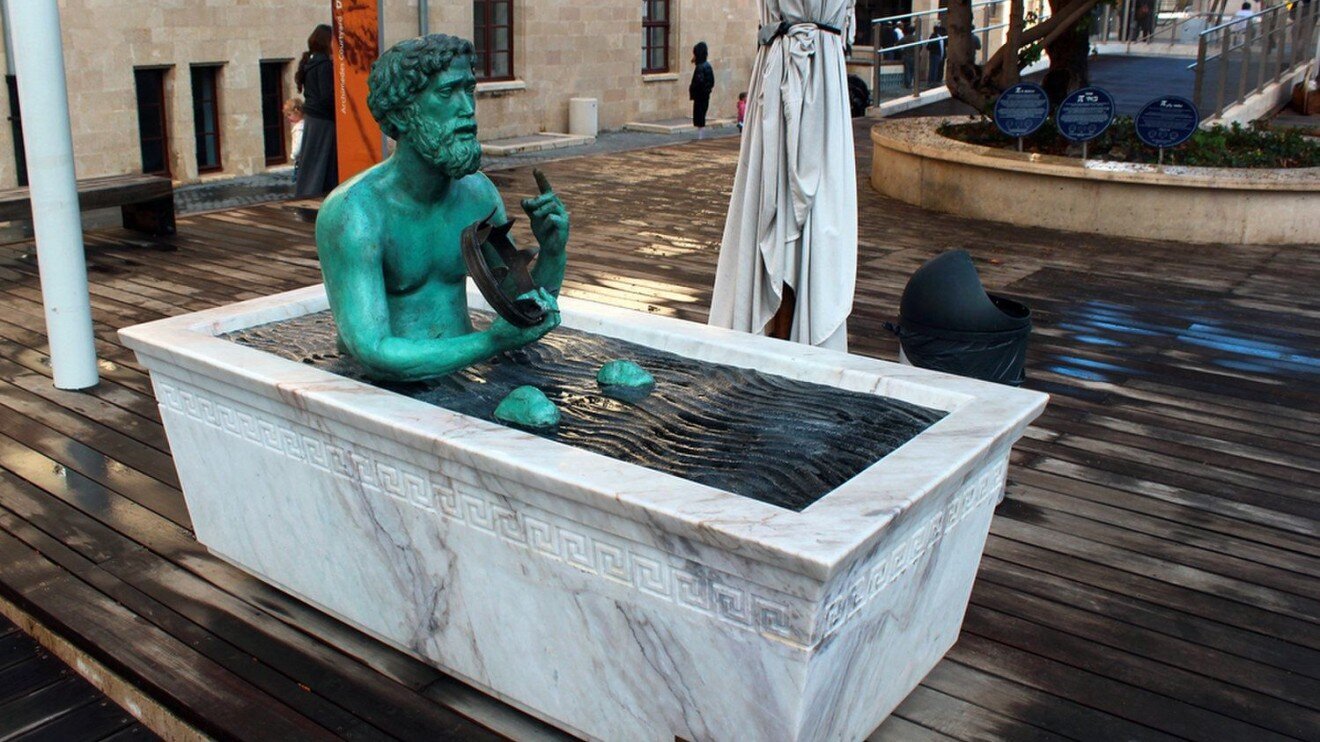
The phrase «Eureka!» (Ancient Greek heureka — "I have found it!") went down in history as a symbol of sudden insight. According to legend, Archimedes of Syracuse (287–212 BC) cried out these words upon making one of the most important discoveries in hydrostatics. King Hiero II had asked the scholar to determine whether his gold crown had been adulterated with silver, without damaging the crown itself. The solution came to him as he lowered himself into a bath and noticed that the displaced water corresponded to the volume of his body. Realizing this principle could be used to measure the crown's volume, he ran out into the streets of Syracuse in a state of ecstasy, naked, shouting «Eureka!»
Archimedes' Principle: its scientific significance
This episode became the basis for a fundamental law of physics: a body immersed in a fluid experiences a buoyant force equal to the weight of the fluid it displaces. In his treatise "On Floating Bodies," Archimedes provided the mathematical proof that:
- A body lighter than the fluid floats
- A body heavier than the fluid sinks
- A body in equilibrium stays at rest
Interestingly, the law itself isn't mentioned in ancient sources — its modern formulation only appeared in the 17th century, thanks to Simon Stevin.
The mythology of the discovery
The story of the crown was first described by Vitruvius some 200 years after Archimedes' death, and it contains chronological inconsistencies. Modern research shows:
| The myth | The reality |
|---|---|
| Archimedes ran naked through Syracuse | Hiero's palace stood on the island of Ortygia, physically inaccessible from the public baths |
| The discovery happened in an instant | Archimedes had studied the equilibrium of fluids for a long time, as reflected in his drafts |
| The law was formulated immediately | The full theory only appears in his later works |
Archimedes: a genius of ancient science
Beyond hydrostatics, the Syracusan scholar made revolutionary discoveries in:
Mathematics
- Calculated π to an accuracy of 3.14 using the method of inscribed polygons
- Laid the groundwork for integral calculus
- Discovered the volume relationship between a sphere and a cylinder
Mechanics
- Formulated the theory of the lever ("Give me a place to stand...")
- Invented the Archimedes' screw for lifting water
- Built siege engines that held off the Romans for 2 years
Cultural influence
The cry «Eureka» has become:
- The motto of the State of California (since 1849)
- The name of the EU's largest scientific research program (1984–2020)
- A symbol of creative insight in art
In 1906, the "Archimedes Palimpsest" was discovered — a unique manuscript containing previously unknown works confirming his genius. Modern researchers call Archimedes "the first scientist," whose work anticipated the discoveries of Newton and Leibniz by two millennia.