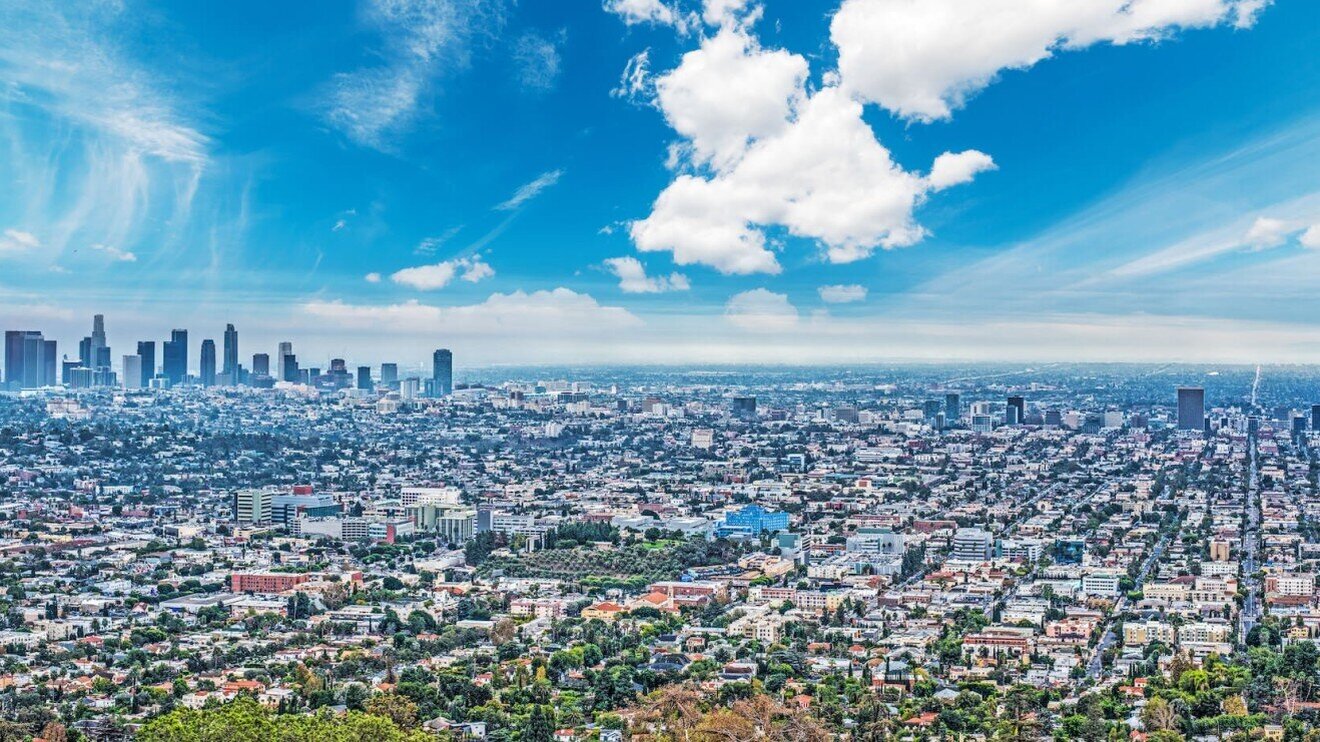
The hero’s disappointment with the «City of Angels» is understandable — Los Angeles is nothing like the conventional image of a major metropolis.
A Conglomeration of Cities
Los Angeles is a unique urban agglomeration made up of dozens of independent municipalities. Greater Los Angeles spans five California counties: Los Angeles, Orange, Ventura, San Bernardino, and Riverside. By the mid-1990s, the entire conurbation’s population stood at around 16 million.
Within the city limits of Los Angeles proper sit nine separate incorporated cities: West Hollywood, Santa Monica, Beverly Hills, Culver City, Malibu, San Fernando, Calabasas, Inglewood, and Avalon. The city itself is divided into 99 neighborhoods and 15 administrative districts.
Architectural Features
The defining feature of Los Angeles is its low building density — most residents live in private houses, mostly one or two stories. This developed historically: until 1956, city law banned buildings taller than 43 meters (roughly 14 stories).
High-rises are concentrated in just two districts:
- Downtown — the city’s historic business core
- Century City — a modern business district on the west side
By the mid-1990s, Los Angeles had only a few dozen high-rise buildings, a striking contrast to the densely built cities of the East Coast.
Oil Drilling in the City
One of the more unexpected features of the Los Angeles skyline is its oil wells. Oil was discovered in the area back in the 1890s, and by 1923 Los Angeles accounted for a fifth of the world’s entire oil output.
Derricks and pump jacks could turn up in the most unexpected places — in residential neighborhoods, on vacant lots between houses, even downtown — creating a surreal contrast between Hollywood’s «dream factory» and the industrial reality of an oil town.
City Layout
Los Angeles has a regular grid layout, with streets running strictly north–south and east–west. The city is connected by a sprawling freeway network, much of it elevated, with grand multi-level interchanges.
By the 1990s roughly 2.5 million cars were registered in the city — more than the adult population — a car wasn’t a luxury but a necessity for getting around a city stretched over dozens of kilometers.
The Contrast With the Movie Image
The hero’s disappointment makes sense: Hollywood films built up an image of Los Angeles as a glittering metropolis of skyscrapers and glamorous neighborhoods. In reality, most of the city was endless blocks of low-rise houses, cut through by freeways, vacant lots, and industrial zones.
Famous spots like Hollywood, Beverly Hills, and Rodeo Drive occupied only a small fraction of the sprawling agglomeration, with miles of fairly ordinary suburbs stretching between them, bearing little resemblance to the movies’ «dream factory.»