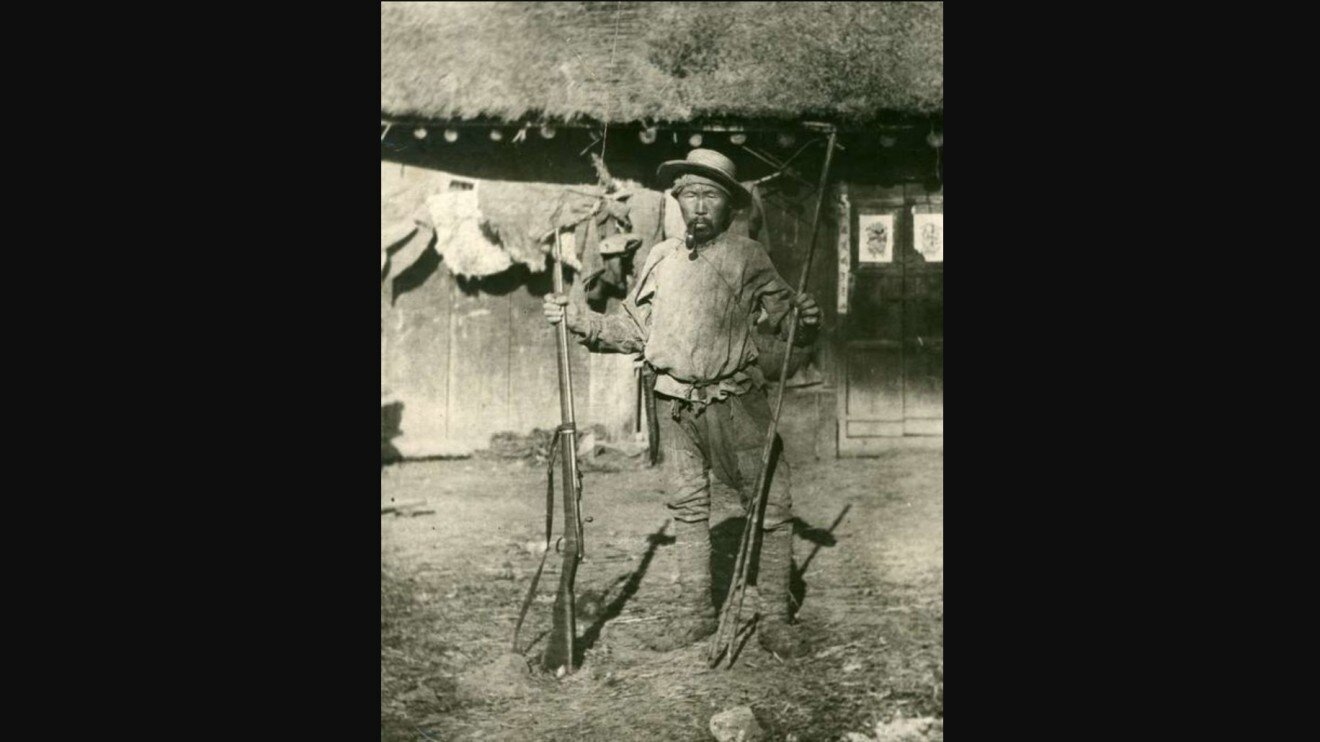
The legendary taiga guide who became a symbol of humanity’s unity with nature and the lost wisdom of the indigenous peoples of the Russian Far East
The historical figure
Dersu Uzala (c. 1849 – March 13, 1908) was a native of the Ussuri region, a hunter and guide whose life became one of the most vivid chapters in the history of Russia’s settlement of the Far East. The man’s real name was Derchu Odzhal (Derchu of the Odzhal clan), a fact confirmed by the diaries of the explorer Vladimir Arsenyev and the recollections of Arsenyev’s first wife, Anna Konstantinovna.
Dersu was born in the mid-nineteenth century in the Ussuri region; the exact date of his birth is unknown. The tragedy that shaped the rest of his life struck him in his youth – he lost his entire family to a smallpox epidemic that devastated the indigenous encampments. After that, Dersu began wandering the Ussuri River valley, hunting fur-bearing animals for a living and living in complete unity with the taiga.
Key dates
- ~1849 – born
- 1906 – meets Arsenyev
- 1906–1907 – takes part in expeditions
- 1908 – moves to Khabarovsk
- March 13, 1908 – killed
Meeting Arsenyev
Fate brought Dersu together with the outstanding Russian explorer Vladimir Klavdiyevich Arsenyev in 1906. According to the surviving expedition diaries, their first meeting took place on August 3 by the Tadushi River. Although in his literary works Arsenyev describes meeting Dersu in 1902 by the Lefu River, that was a literary device – the author likely combined the images of several guides he had worked with over different years.
From 1906 onward, Dersu served as a guide on expeditions led by Arsenyev. Their collaboration lasted until 1907, and over that time a genuine friendship, built on mutual respect and understanding, grew between the Russian officer-explorer and the taiga hunter – something far beyond a mere working relationship.
The question of ethnicity
Dersu’s ethnicity remains a subject of scholarly debate to this day. He was traditionally considered Nanai (Golde), since that is how he identified himself to Arsenyev. However, Vsevolod Sysoev, director of the Khabarovsk Regional Museum, put forward a well-argued theory of Udege origin, based on features of Dersu’s way of life, clothing, knowledge of the terrain, and even his appearance – fair hair and greenish eyes were characteristic of the coastal Udege people of that time.
The tragic end
After the 1907 expedition ended, Dersu’s life changed abruptly. By then he had already begun losing his eyesight, and Arsenyev invited his friend to live with him in his house in Khabarovsk. Dersu moved to the city, but city life weighed on him. Accustomed to the boundless expanses of the taiga, he felt like he was in prison within four walls – he felt he couldn’t breathe.
In the spring of 1908 Dersu made a decision that proved fatal. He said goodbye to his friend the «Captain» (as he called Arsenyev) and set off on foot from the Amur region toward Primorsky Krai, his homeland, toward the headwaters of the Ussuri River. It was his last road home.
On March 13, 1908, Dersu Uzala was found dead near the Korfovskaya railway station, not far from Khabarovsk. Dusk had caught him on the road, and, as usual, he had built a fire right by the roadside to spend the night. The old hunter had no valuables on him, but the robbers coveted his rifle – a highly prized item for taiga dwellers. According to Arsenyev, Dersu was killed by a convict named Kozlov near the Khekhtsir pass, close to a granite quarry.
Today, in the village of Korfovsky, not far from the site of Dersu’s death, a granite boulder has been erected in his memory, surrounded by planted pines – a symbol of eternal remembrance for a man who lived his whole life in unity with nature.
Literary legacy
Vladimir Klavdiyevich Arsenyev immortalized the memory of his friend in two outstanding works of Russian travel literature – the accounts Across the Ussuri Region (1921) and Dersu Uzala (1923). Written from his expedition diaries, these books became classics of adventure and travel literature.
By Arsenyev’s own account, the book Dersu Uzala was ready for print as early as 1917, but it wasn’t published until 1923. It describes the author’s 1907 journey through eastern Manchuria, in which he appears as a naturalist-researcher, with Dersu Uzala as the central figure.
A gripping storyline unfolding against the majestic backdrop of Far Eastern nature and the life of the region’s small indigenous peoples, combined with elevated literary language, placed this book among the finest works of Russian travel and adventure literature. The figure of Dersu in Arsenyev’s books is not merely a portrait of one man, but a symbol of a vanishing world, of ancestral wisdom, of harmony between humanity and nature.
Features of the literary portrait
- Deep knowledge of the taiga and its laws
- A philosophical relationship with nature
- Distinctive speech, conveying his particular way of thinking
- Honesty and straightforwardness
- Selflessness and readiness to help
- A tragic mismatch with civilization
The books’ censorship history
In the Soviet era, Arsenyev’s works were published in heavily abridged form – roughly cut in half – with extensive censorship edits. Full versions only became available to readers in the post-Soviet period, allowing a fresh appreciation of the scale of the writer’s talent and the depth of the figure he created.
On screen
The figure of Dersu Uzala gained worldwide fame through film. Two adaptations stand out as the most significant:
«Dersu Uzala» (1961)
Director: Agasi Babayan
Dersu played by: Kasym Dzhakibayev
The first Soviet screen adaptation, made in the tradition of domestic cinema.
«Dersu Uzala» (1975)
Director: Akira Kurosawa
Dersu played by: Maxim Munzuk
Academy Award winner for Best Foreign Language Film (1976)
Akira Kurosawa’s film became a genuine cinematic masterpiece and brought the figure of Dersu Uzala worldwide fame. It was the only film the great Japanese director ever made outside of Japanese, and the first he shot on wide-format 70mm film. Production cost $4 million – an enormous sum at the time for a Soviet-Japanese film project.
Maxim Munzuk, who played the lead role, created an unforgettable image of the taiga sage. His performance as Dersu became the standard-setting portrayal and brought the actor worldwide recognition. Kurosawa’s film not only tells the story of a friendship between a Russian officer and a taiga hunter, but raises timeless questions about humanity’s place in nature and the clash between civilization and the untouched natural world.
Symbolic meaning in the 1990s
In the context of the 1990s, the figure of Dersu Uzala took on a particular symbolic weight. Amid the era’s rapid upheaval, as old institutions and values were collapsing, many Russians looked to the past for a sense of direction. Dersu became a symbol of lost authenticity, honesty, and humanity.
The phrase «the local Dersu Uzala,» applied to regional officials and businessmen, carries a bitter irony: the real Dersu was selfless and honest, whereas in the 1990s many people sought to «get in on the process» purely for personal gain, using their knowledge of local conditions not to help but to enrich themselves.
Philosophy and worldview
In Arsenyev’s works, Dersu Uzala appears not merely as a skilled guide but as the bearer of a distinct philosophy of life grounded in harmony with nature. His worldview differs radically from European rationalism – it is the thinking of a man for whom the taiga is not an object to study or conquer, but a living organism to be in constant dialogue with.
Dersu perceives nature as animate: fire, to him, is «people»; water is a living force deserving respect; trees are beings one can talk to. This animistic worldview allows him to survive in the taiga, read its signs, predict the weather, and find his way where a European would be hopelessly lost.
The key principles of Dersu’s philosophy
- Unity with nature – man is not master but part of nature
- Mutual aid – a readiness to help anyone in need
- Practical wisdom – knowledge gained through experience matters more than book learning
- Spirituality – an understanding that the material is not what matters most in life
- Honesty – an inability to lie or deceive
Cultural legacy and memory
The figure of Dersu Uzala has become part of Russia’s cultural memory, a symbol of a vanished world where people lived in harmony with nature. His name has become a byword for a wise guide, a master of the terrain, someone able to find a way out of the most difficult situation.
In modern Russia, Dersu’s memory is kept alive in various ways: streets in Far Eastern cities, tourist routes, and public organizations are named after him. The figure of the taiga sage continues to inspire writers, filmmakers, and travelers.
The phenomenon of Dersu Uzala reaches beyond a single historical figure. He is an archetypal image of the last of a vanishing people, embodying a fading culture and ancestral wisdom. In an age of globalization and technological progress, this figure takes on particular relevance, reminding us of the importance of preserving our connection to nature and traditional values.
Dersu Uzala as a literary archetype
In world literature, the figure of Dersu Uzala stands among the great archetypal figures – the «noble savage,» the wise mentor, the last representative of a vanishing world. We find similar figures in James Fenimore Cooper (Chingachgook), Rudyard Kipling (Mowgli), and in works about the indigenous peoples of America and Australia.
Yet Dersu Uzala is unique in that a real historical figure stands behind the literary image, and the portrait Arsenyev created was based on the author’s own years of personal acquaintance with his subject. That lends the figure a particular authenticity and humanity.
Conclusion
Dersu Uzala is more than a historical figure or a literary character. He is a symbol of an age when civilization was just beginning its advance on untouched nature, a symbol of human dignity, wisdom, and nobility. The story of his life and tragic death became a metaphor for the fate of many indigenous peoples caught between two worlds – the traditional and the modern.
In the context of twentieth-century Russian history, the figure of Dersu takes on particular resonance. He is a reminder of values lost in the whirlwind of revolutions, wars, and social upheaval – honesty, selflessness, loyalty in friendship, unity with nature. Perhaps that is why this figure continues to move readers and viewers more than a century after the real Dersu Uzala’s tragic death near Korfovskaya station.
Today, as humanity confronts global environmental challenges, Dersu Uzala’s wisdom takes on new relevance. His philosophy of harmony with nature, respect for the surrounding world, and responsibility for the planet’s future sounds like a prophecy addressed to the modern world.