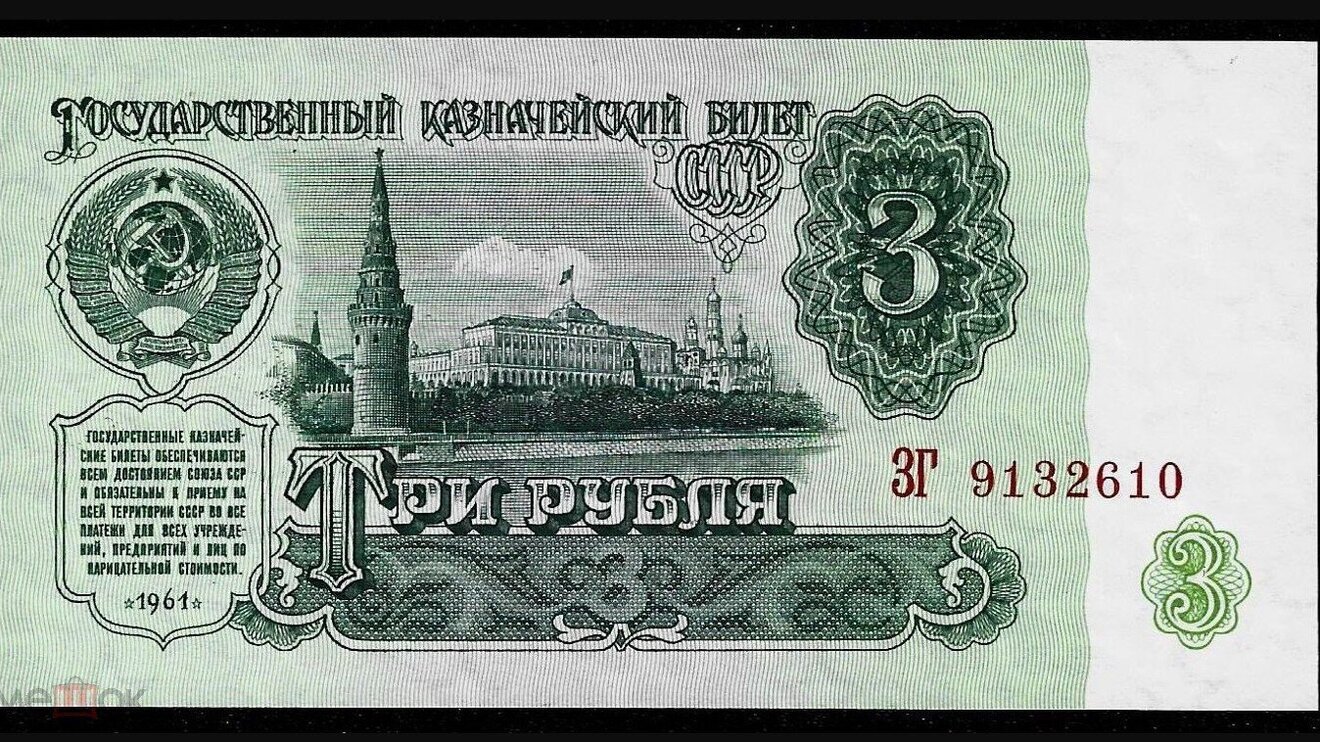
A specialized term from the professional jargon of Soviet filmmakers, denoting a specific camera angle for shooting the Moscow Kremlin from the Stone Bridge.
Origin of the Term
The name «three-ruble angle» arose among Soviet camera operators and refers to the image on the Soviet three-ruble banknote. That bill depicted precisely the view of the Kremlin ensemble that opens up when shooting from the Stone Bridge across the Moskva River.
Three-ruble banknotes had a long history in the Russian and Soviet monetary system. They were traditionally printed on pale green paper and were familiar to every Soviet citizen. It was thanks to the widespread circulation of these bills that filmmakers found a convenient shorthand for quickly and precisely identifying the desired camera angle.
Its Significance in Filmmaking
Among professional camera operators, «three-ruble angle» became an established term, letting colleagues quickly and precisely convey exactly which shot was meant. This mattered especially when working with iconic locations like the Moscow Kremlin, where even a slight rotation of the camera could radically change the composition of the frame.
This angle is considered one of the most expressive and recognizable ways of filming the Kremlin. It captures in frame:
- The Kremlin wall with its distinctive crenellations
- Several towers at once
- The domes of the Kremlin cathedrals
- The reflection of the architectural ensemble in the waters of the Moskva River
Technical Particulars
Shooting the classic «three-ruble angle» demanded particular skill from a camera operator. Several factors had to be accounted for:
Lighting conditions. The time of day and season significantly affect how the Kremlin ensemble reads on camera. Morning and evening hours are considered optimal, when the low angle of the sun brings out the volume of the architectural forms.
Weather conditions. Clear weather gives a sharp, high-contrast image, but can be too harsh for film work. Light cloud cover creates softer, more cinematic lighting.
Technical parameters. The choice of lens, aperture, and shutter speed had to ensure the necessary depth of field and correct exposure across every plane of the shot — from the foreground (the bridge, the embankment) to the background (the Kremlin buildings).
Its Place in the System of Film Shots
In the professional classification of camera shots, the «three-ruble angle» falls into the category of wide or long shots. It lets the filmmaker show the subject in its natural surroundings, creating a sense of scale and grandeur.
Soviet camera operators developed a detailed system for classifying shots:
- Long shot — a person fits entirely within the frame
- Wide shot — several people fit within the frame
- «Milk» shot (medium-close #1) — a person shot from the chest up
- «Easter» shot (medium-close #2) — from the waist up, with a bit of the legs included
- Close-up — the person’s face fills the frame
- Macro shot — the subject is smaller than a face (an eye, a mouth, a nose)
The «three-ruble angle» stands apart in this system as a specific topographic term, denoting not the scale of the subject in the frame, but a particular vantage point for a well-known architectural ensemble.
Cultural Significance
Use of the term «three-ruble angle» went beyond mere technical necessity. It became part of the professional culture of Soviet filmmaking, reflecting a particular reverence for the Kremlin as a symbol of the state and the center of political power.
This angle was the one most often used in official newsreels, documentaries, and news broadcasts. It became a kind of «trademark» of Soviet newsreel footage, an image instantly recognizable to viewers and associated with Moscow, and with the USSR as a whole.
International Equivalents
Similar topographically anchored terms exist in the film industries of various countries. In American Hollywood, for instance, there’s the concept of a «Broadway angle» for shooting the famous street, while British film has its «Tower shot» for views of the Tower of London.
But it was the Soviet school of filmmaking that stood out for the particular elaborateness and systematization of its professional jargon. This reflected the high level of development of the Soviet film industry and the need for precise coordination among large production crews.
Practical Application
In actual production practice, using the term «three-ruble angle» saved time and eliminated any misunderstanding among crew members. Instead of a lengthy explanation like «we’re shooting the Kremlin from the Stone Bridge so the Spasskaya Tower, part of the wall, and the cathedral domes are all in frame,» it was enough to say «three-ruble angle.»
This mattered especially when working under time pressure, when every minute of shooting could cost significant money. Professional jargon let crews convey creative intent and technical requirements quickly and precisely.
The Term’s Evolution
By the mid-1990s, the term «three-ruble angle» had begun to fall out of active use. This was tied to several factors:
Monetary reform. Between 1993 and 1998, Russia’s monetary system underwent radical changes. Old Soviet banknotes were replaced with new Russian bills of a different design.
A generational shift. Young professionals were entering filmmaking who weren’t familiar with the Soviet professional tradition, or who viewed it critically.
Shifting aesthetic priorities. The new Russian cinema of the 1990s often deliberately rejected the official imagery of the Soviet period, favoring more intimate, personal stories instead.
Even so, in 1998, the term was still actively used by old-school camera operators, especially when working on official commissions or historical documentaries.
Influence on Visual Culture
The «three-ruble angle» had a significant influence on shaping the visual stereotypes through which Moscow, and Russia as a whole, were perceived. The repeated reproduction of this view in film, television, and photography made it a canonical image of the Russian capital.
Even after the term itself fell out of professional use, this angle continues to be actively used in contemporary media, advertising, and tourist materials. It became part of the visual code by which viewers instantly recognize Moscow.
A Sociological Aspect
The use of the term «three-ruble angle» reflected not just professional but also social features of Soviet society. Its tie to a banknote showed that even in creative circles, state symbolism was present as a natural part of everyday life.
It was an example of how official ideology seeped into the most varied spheres of society, including the professional jargon of artistic specialists. And yet the term itself wasn’t perceived as ideological — it was a purely practical tool for professional communication.
The Technical Execution of the Shot
Achieving the classic «three-ruble angle» required a camera operator to account for a great many technical nuances. The camera’s position on the Stone Bridge demanded precise placement — even shifting a few meters could disrupt the composition, blocking or revealing extra elements of the architectural ensemble.
Camera height was also critically important. Too low a position let the foreground (the bridge parapet, the embankment) obscure important elements of the Kremlin. Too high, and it disrupted the perspective, robbing the shot of its characteristic compositional structure.
The choice of lens focal length determined not just the scale of the image but the character of the perspective distortion. A wide-angle lens could create a more dramatic effect but distorted the proportions of the architectural elements. Telephoto lenses compressed the perspective, flattening the shot.
Seasonal and Time-of-Day Variations
Professional operators knew that the «three-ruble angle» looked different depending on the season and time of day. In winter, snow-covered domes and towers created a particular character, but required exposure correction due to the high reflectivity of snow.
In spring and fall, as the trees on the Kremlin hill changed color, the angle gained extra visual richness. In summer, dense foliage could obscure certain architectural details, requiring adjustments to the shooting angle.
Time of day also affected how the shot read. Morning hours gave soft, side lighting that brought out the volume of the architectural forms. Midday sun created harsh shadows but provided maximum detail. Evening light, especially during the «golden hour» before sunset, lent the shot a romantic, almost fairy-tale quality.
Psychological Impact
The «three-ruble angle» had a particular psychological effect on viewers, which made it popular not only in documentary but in narrative film as well. The view of the Kremlin from this vantage point was associated with grandeur, stability, and historical continuity.
Film directors often used this angle to establish a particular mood in a film. It could serve as an emotional climax, underscoring the importance of a moment, or be used as a lyrical aside, creating a pause in the flow of the action.
The presence of the Moskva River’s water surface in the frame added dynamism to the composition and created a sense of a living, breathing environment. The reflections in the water doubled the visual information, making the shot richer and more engaging.
Regional Variations of the Term
Interestingly, the term «three-ruble angle» was in use not just at Moscow studios but at regional film studios across the USSR as well. This reflected the high degree of professional integration in Soviet filmmaking and the uniformity of its training standards.
Camera operators from Leningrad, Kyiv, and Tbilisi, working in Moscow, understood the term easily and used it in their own work. Moreover, some regional centers developed their own equivalent terms, tied to local architectural landmarks.
In Leningrad, for instance, there was a «palace angle» for shooting the Winter Palace from Palace Square, and in Kyiv, a «Lavra shot» for views of the Kyiv Pechersk Lavra from the Dnieper. But it was Moscow’s «three-ruble angle» that achieved the greatest fame and widest use.
Influence on Architectural Photography
The tradition of the «three-ruble angle» influenced not just filmmaking but architectural photography as well. Many photographers working with Moscow architecture oriented their own work around this canonical view.
This led to the formation of a certain standard in documenting architectural landmarks. On one hand, this approach ensured uniformity and recognizability across images. On the other, it could limit creative exploration, imposing stereotyped solutions.
Some photographers deliberately sought out alternative angles, striving to show familiar subjects from an unexpected side. Even so, the «three-ruble angle» remained the benchmark against which such experiments were measured.