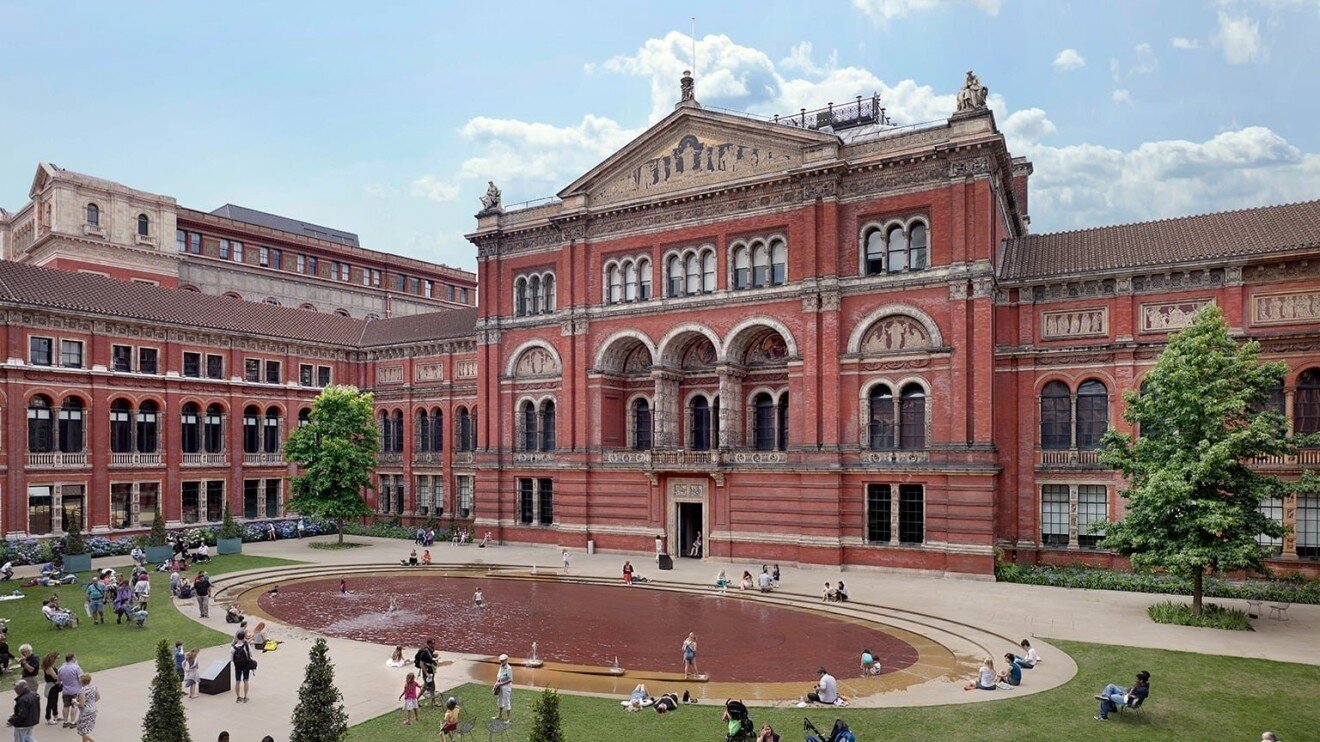
The Victoria and Albert Museum is one of the world’s great museums, located in South Kensington, London. It’s Europe’s first museum of decorative arts and design, founded in 1852 at the initiative of Prince Consort Albert, with the involvement of the distinguished German architect and art theorist Gottfried Semper.
Founding and Development
The museum grew out of discussions surrounding the display at the Great Exhibition of 1851 in London, which starkly exposed the gulf between advanced industrial technology and traditional decorative craftsmanship. Prince Albert, Queen Victoria’s consort and chairman of the exhibition’s organizing committee, concerned about the quality of English goods on the world market, asked the German architect Gottfried Semper to draft a program for training new designers and a plan for the exhibits of a future museum of art and industry.
Construction was funded by the Society of Arts, using part of the proceeds from the Great Exhibition. A plot of land in South Kensington was acquired in 1852, but the museum didn’t move to the site until 1857.
The Museum’s Names Over Time
The museum has changed its name several times over the course of its development:
- 1852 — the "Museum of Manufactures," housed at Marlborough House
- 1853 — the "Museum of Ornamental Art," with the collections moved to Somerset House in central London
- 1854 — the South Kensington Museum
- 1899 — the Victoria and Albert Museum
The museum was officially opened by Queen Victoria on June 20, 1857. Its first director, from 1857, was Sir Henry Cole, who championed the idea of broad public art education through museum collections.
Architecture and Buildings
Designed by architect Francis Fowke, the museum’s ambitious building was constructed in a "Neo-Norman" style between 1859 and 1865 — though this was only the beginning of a much larger architectural project.
A new building, designed by architect Aston Webb, began construction in 1891. On May 17, 1899, Queen Victoria laid the foundation stone of the new building, and from that point the museum was renamed in honor of the queen and her consort, becoming the Victoria and Albert Museum. Construction wasn’t completed until 1909.
From 2001 to 2015, a major renovation restored Aston Webb’s historic interiors and significantly expanded the exhibition space.
Concept and Educational Mission
Gottfried Semper envisioned the museum alongside a school of design and other educational and cultural institutions later known as Albertopolis. This led to the museum absorbing the South Kensington Museum’s School of Design (the first design school had been established in 1837 at Somerset House), later renamed the Royal College of Art.
From the outset, the museum was conceived not just as a repository for works of art, but as an educational institution, meant to raise the level of art education in Britain and improve the quality of industrial goods.
Collections
The Victoria and Albert Museum holds more than two million objects, spanning 5,000 years of art across cultures, from antiquity to the present day. Alongside European culture, it also represents the art of North America, Asia, Africa, Latin America, and the Far East — China, Japan, Korea, Malaysia — as well as Australia, New Zealand, and the Islamic world. It’s the largest museum of its kind in the world.
Decorative Arts
A significant part of the collection traces the development of artistic craft: ceramics, glass, textiles, metalwork, jewelry, furniture. The museum holds the world’s largest collection of medieval and Italian Renaissance decorative arts, including famous Italian majolica, precious-metal objects, mosaics, and post-Renaissance European sculpture.
Its ceramics and glass collections include rich holdings of Chinese, Saxon (Meissen), and Sèvres porcelain, Gallé and École de Nancy glass, Josiah Wedgwood earthenware, and much more.
Fine Art
The museum also holds sculpture, prints, drawings, and photographs. More than 600,000 drawings, 750,000 documents, and 700,000 photographs of architectural monuments from around the world make up the most complete architectural resource of its kind. Drawings and plans by English architects are a particular point of pride.
The museum displays seven of the ten surviving cartoons produced from Raphael’s designs by his students between 1513 and 1516, for the "Acts of the Apostles" tapestry series destined for the Sistine Chapel in the Vatican. More than a hundred paintings are on view, including Constable’s "Salisbury Cathedral from the Bishop’s Garden."
Islamic Art
The museum holds more than 19,000 objects from the Islamic world, spanning from the early Islamic period (7th century) to the early 20th century — one of the most comprehensive collections of Islamic art anywhere.
Fashion and Textiles
The museum holds an extensive collection tracing the history of European and Eastern dress, considered one of the most complete in the world, spanning from antiquity to the present and including both everyday clothing and ceremonial costume.
Jewelry
One of the world’s most comprehensive jewelry collections spans works by jewelers from ancient Egypt to the present day, along with design drawings on paper. The collection includes ornaments made for a diamond gown for Catherine the Great, bracelet clasps that belonged to Marie Antoinette, and the Emerald Necklace, given by Napoleon to his stepdaughter Hortense de Beauharnais in 1806.
The museum displays work by renowned jewelers, including Cartier, Jean Schlumberger, Carl Fabergé, Andrew Grima, Hemmerle, and Lalique. It also holds unique contemporary jewelry by Milanese jeweler James Rivière, including the Optical Titanio Diago, a pendant that stands as a relatively early example of titanium used in jewelry-making.
Photography
The museum holds Britain’s largest collection of early British photography, including 775 photographs by Clementina Hawarden. Large private collections of theatrical photography, including numerous images of actresses Minnie Terry, Dorothy Dene, and Connie Gilchrist, came to the museum through the bequests of their owners.
Other Collections
The museum also holds collections of book illustration, musical instruments, and arms and armor from every era and culture — each of significant scholarly and artistic value.
The Cast Courts
In 1873, the museum created its "Cast Courts," displaying plaster casts of fragments of famous architectural monuments and sculptures. This relatively compact, top-lit space recreates a substantial swath of classical art history, from antiquity to the modern era.
The idea was later adopted by many museums around the world, including by Ivan Tsvetaev when organizing the Museum of Fine Arts in Moscow in 1912 (renamed the Pushkin State Museum of Fine Arts in 1937).
Historical Significance and Influence
The Victoria and Albert Museum became the model for other European museums of art and industry. Following its example came:
- 1864 — the Museum of Applied Arts in Vienna
- 1877 — the Museum of Arts and Crafts in Hamburg
- 1881 — Baron Stieglitz’s Central School of Technical Drawing museum in St. Petersburg
- 1885 — the Museum of Decorative Arts in Prague
Interiors and Atmosphere
Part of the museum’s interior retains its historic character. Particularly notable is the Green Dining Room (1866–1868), designed by Philip Webb and William Morris, reflecting the mood and craft of Morris’s Arts and Crafts workshops.
The museum’s architecture is itself a work of art. Grand halls, elegant galleries, and spacious courtyards create a distinctive atmosphere that shows every object to its best advantage.
A Cultural Phenomenon
Admission is free, making the museum accessible to every level of society, in keeping with its founders’ original vision of educating and enlightening the broader public.
In 1988, hoping to attract a younger audience, the museum launched an advertising slogan that scandalized conservative British opinion: "An ace caff, with quite a nice museum attached." The episode illustrates the museum’s ongoing effort to balance preserving tradition with attracting new visitors.
Location and Accessibility
The museum sits in South Kensington, one of London’s major cultural districts. Nearby are the Natural History Museum, the Science Museum, the Royal Albert Hall, and other cultural institutions, making the area a true "cultural quarter" of the British capital.
Thanks to its convenient location and well-developed transport links, the museum is easily accessible to both Londoners and tourists. South Kensington Underground station sits right next to the museum.
Significance for World Art
The Victoria and Albert Museum holds a special place in world museum culture. It has not only gathered outstanding works of decorative and applied art from around the world under one roof, but also pioneered a new concept of the museum as an educational institution.
The museum’s collections serve as a source of inspiration for artists, designers, and craftspeople worldwide. Many objects have become classic examples of their era and continue to influence contemporary art and design.
The museum conducts active scholarly work, researching art history, organizing exhibitions, and publishing scholarly work. Its library and archives are vital resources for scholars and researchers around the world.
Conclusion
The Victoria and Albert Museum is more than a collection of art objects — it’s a living institution, continuing to grow and adapt to the needs of contemporary society. It remains true to its original mission of education and public enlightenment, while also serving as a custodian of humanity’s priceless cultural heritage.
For any visitor to London, this museum offers a unique opportunity to travel across centuries and continents, to encounter the richness of human creativity, and to understand how art and craft have developed over millennia. The Victoria and Albert Museum is a window onto a world of beauty, craftsmanship, and inspiration, open to anyone seeking knowledge and cultural enrichment.