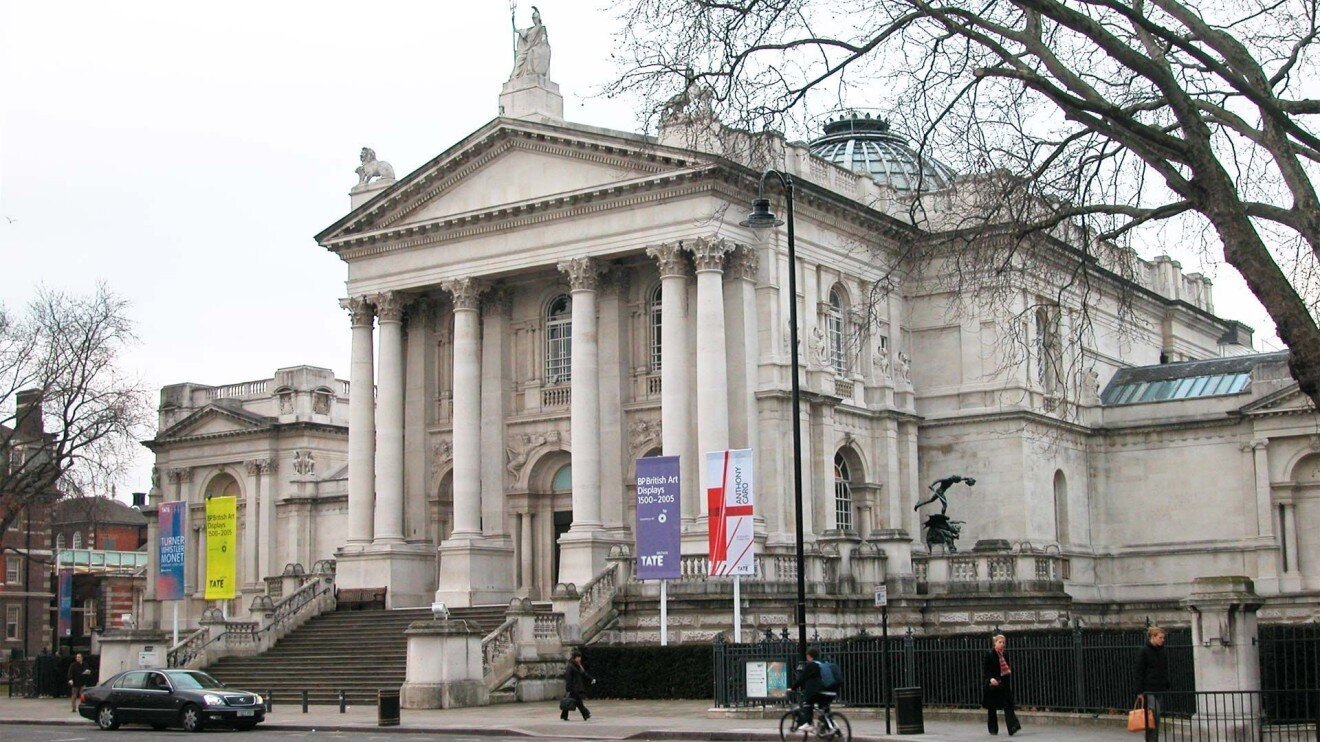
The Tate Gallery is one of the largest and most prestigious art galleries in the United Kingdom, located in London. Founded in 1897 as the National Gallery of British Art, it became the country’s most important repository of national artistic heritage.
Founding
The gallery was founded in 1897 thanks to the generosity of Sir Henry Tate, a sugar-industry magnate and founder of Tate & Lyle. It was originally called the National Gallery of British Art and occupied a building on Millbank in Pimlico, built on the site of the former Millbank Prison.
The idea of a dedicated gallery for British art was first proposed in the 1820s by Sir John Leicester, Baron de Tabley. Significant contributions to the future collection came from Robert Vernon, who donated his collection to the National Gallery in 1847, and John Sheepshanks, who gave his collection to the South Kensington Museum (later the Victoria and Albert Museum) a decade later.
The Building and Its Architecture
The Millbank building was designed in the neoclassical style, an imposing structure built of Portland stone. Its main facade features columns and a portico, lending it the solemn atmosphere befitting a national art collection.
In 1926 and 1937, the building was significantly expanded thanks to funding from art dealer and patron Joseph Duveen. His father had earlier funded the extension housing most of the Turner Bequest — the largest collection of works by the great English landscape painter J. M. W. Turner.
The Collection
The gallery was originally conceived as a collection devoted solely to contemporary British art, focused on works of the Victorian era. Over time, however, the collection grew and diversified substantially.
A turning point came with the death of Sir Hugh Lane aboard the Lusitania in 1915. Due to a mix-up in his will, his collection of European modern art, originally intended for Dublin, ended up at the Tate instead, allowing the gallery to expand into foreign art.
The Turner Bequest
A special place in the collection belongs to the Turner Bequest — the largest collection of work by the celebrated English Romantic painter. A dedicated wing was built for it in 1987, funded by Sir Charles Clore. The collection includes hundreds of paintings, drawings, and watercolors spanning every period of the artist’s career.
Modern Art
By the mid-20th century, the gallery served a dual function: presenting the history of British art while also showcasing international contemporary art — a duality reflecting London’s growing importance as a world center of artistic life.
Governance
Until 1954, the gallery was under the control of the National Gallery, before gaining full independence. It’s governed by a board of trustees who appoint a director for a seven-year term. Its principal funder is the UK’s Department for Culture, Media and Sport.
The gallery holds exempt-charity status, meaning it’s directly accountable to the government rather than the Charity Commission for its financial reporting.
Exhibitions
In the 1950s and ’60s, the Arts Council of Great Britain’s visual arts department funded and organized temporary exhibitions at the Tate. A landmark event was the 1966 Marcel Duchamp retrospective. Later, the gallery began organizing its own program of temporary exhibitions.
In 1979, a large modern extension, funded by a Japanese bank, opened, also enabling larger commercial exhibitions. The Clore Gallery, with a 200-seat auditorium, opened in 1987.
The Turner Prize
One of the events most closely associated with the Tate is the annual Turner Prize, awarded to a British artist. Established in 1984, it has become one of the most prestigious — and controversial — awards in contemporary art. The award ceremony takes place at the gallery and draws considerable media and public attention.
Location
The Tate Gallery sits in the prestigious district of Pimlico, close to Westminster and Belgravia. This area is traditionally considered one of London’s most aristocratic, lined with the characteristic white Georgian and Victorian townhouses.
Other major cultural institutions are nearby, including the Victoria and Albert Museum in South Kensington, making this part of the city a genuine hub of cultural life. The Thames runs close by, and the Millbank embankment offers scenic views of the opposite bank.
Notable Directors
The gallery has been led by distinguished figures in the art world. Its first Keeper (the title used until 1917) was Sir Charles Holroyd (1897–1906). Among its most notable directors was Sir John Rothenstein (1938–1964), under whom the gallery weathered the war years and postwar recovery.
Sir Norman Reid (1964–1979) holds a particular place, significantly expanding the gallery’s contemporary art collection during his tenure. His successor, Sir Alan Bowness (1980–1988), continued the policy of actively acquiring works by contemporary artists.
Collecting and Patronage
The gallery actively grows its holdings through a system of patronage and membership. Tate members receive benefits including free entry to ticketed exhibitions and access to special rooms. There’s also a patronage system for more substantial donors.
Henry Courtauld established a dedicated fund for acquiring artworks, which still plays an important role in growing the collection today. The gallery spends significant sums each year acquiring new works.
A Pillar of British Culture
The Tate Gallery plays a key role in preserving and promoting British artistic heritage. It doesn’t just house works of the past — it actively supports contemporary artists, giving them a platform for exhibition and recognition.
The gallery’s educational role is also crucial. It runs lectures, seminars, and educational programs for audiences of all ages, helping raise the level of artistic literacy in society.
Interior Architecture
The gallery’s interior spaces are marked by classical elegance. High ceilings, marble floors, and carefully considered lighting create ideal conditions for viewing art. Each room has its own character, matched to the works displayed within it.
Particular attention is paid to natural light — large windows and glass roofs in some galleries let visitors enjoy paintings in daylight, especially important for accurately perceiving color.
Research
The gallery conducts active scholarly work. Its specialists research the collection, attribute works, and study techniques and materials. It regularly publishes catalogues, scholarly articles, and monographs on various aspects of art history.
The gallery’s library holds an extensive collection of books and documents on British and world art history, making it an important resource for scholars and art historians.
Conservation
The gallery maintains a highly skilled conservation workshop, where works of art are preserved and restored. Modern techniques allow not only for preserving works for future generations, but for revealing their original intent by removing later overpainting and grime.
Influence on Artistic Life
The Tate Gallery has a significant influence on artistic life, not just in Britain but around the world. Exhibitions held within its walls often become events of international scale. An artist’s acquisition into the Tate’s collection can substantially shape their career and recognition.
The gallery also plays an important role in shaping artistic taste and trends. Its curators and critics are respected figures in the art world, and their opinions and assessments influence the direction of artistic practice.
Visitors and Public Significance
The Tate Gallery draws millions of visitors from around the world. For many tourists, it’s part of the essential itinerary for getting to know London, alongside the British Museum and the National Gallery. Locals also visit the gallery regularly, reflecting its deep roots in the capital’s cultural life.
Free admission to the permanent collection makes the gallery accessible to every level of society, in keeping with the democratic principles of British cultural policy.
Conclusion
The Tate Gallery is a unique cultural institution that successfully combines preserving classical heritage with promoting contemporary art. Its role in Britain’s cultural life is hard to overstate — it not only safeguards the nation’s artistic treasures, but actively participates in shaping the future of art.
Located in the heart of London, surrounded by other distinguished cultural institutions, the Tate Gallery remains one of the most important and influential art centers in the world, drawing the attention of specialists and the general public alike to the richness and diversity of British and world art.