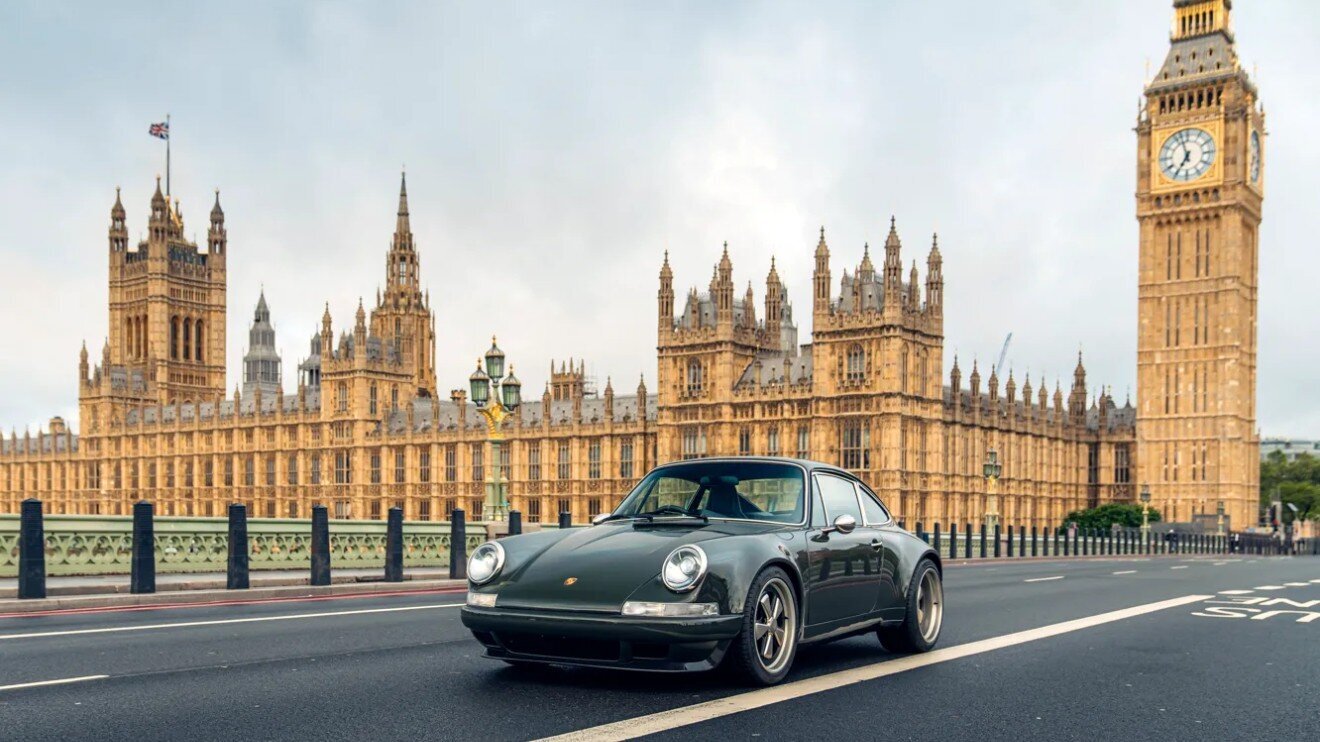
Porsche AG is a German luxury automaker founded by engineer Ferdinand Porsche in 1931. Its headquarters and main plant are located in Stuttgart, Germany. The company specializes in premium sports cars and SUVs.
Founding and early history
On April 25, 1931, Ferdinand Porsche founded the firm Dr. Ing. h.c. F. Porsche GmbH. By that point he already had considerable experience in car design, having worked on projects such as the six-cylinder racing Auto Union and the legendary Volkswagen Käfer (Beetle), which would go on to become one of the best-selling cars in history.
In 1939 the company’s first car was developed – the Porsche 64, which became the forerunner of every future Porsche model. In building it, Ferdinand Porsche used many components from the Volkswagen Käfer, a trait that would become characteristic of the marque’s early models.
The postwar period and the birth of a legend
After the Second World War, while Ferdinand Porsche was being held on war-crimes charges, his son Ferdinand Anton Ernst (nicknamed Ferry) decided to start building cars of his own. In Gmünd, together with a handful of engineers, he built a prototype of the 356, with the engine mounted amidships and an open aluminum body.
In June 1948 that car was certified for public roads, marking the official start of series production for Porsche automobiles. As with the 64, it too used Volkswagen Käfer components, including the air-cooled four-cylinder engine, suspension, and gearbox.
The Porsche 356: the first production car
The Porsche 356 was produced from 1948 to 1965 and laid the foundation of the marque’s reputation. The car boasted excellent aerodynamics, with a drag coefficient of Cx = 0.29, an outstanding figure for its day.
The key difference between the production cars and the prototype was moving the engine behind the rear axle, which cut production costs and freed up space for two extra seats in the cabin. That layout became classic for Porsche for decades to come.
In 1950 the company moved back to Stuttgart, where all body panels began to be made of steel instead of aluminum. The plant started out with coupés and cabriolets powered by 1,100cc engines producing 40 horsepower, but by 1954 the lineup had grown substantially, adding the 1100, 1300, 1300A, 1300S, 1500, and 1500S variants.
Technical refinement
The 356’s design was continually improved: engine displacement and output kept rising, disc brakes appeared on all four wheels, and the gearbox gained synchromesh. New body styles were introduced – hardtops and roadsters. Volkswagen-sourced components were gradually replaced with Porsche’s own designs.
By the time of the 356A series (1955–1959), buyers could order an engine with four camshafts, two ignition coils, and other bespoke components. Total production across all variants of the 356 came to just over 76,000 cars.
The legendary 911
In 1963, at the Frankfurt Motor Show, Porsche unveiled the 911 – the car that would define the marque’s identity for decades to come. The basic design principles stayed the same: a rear-mounted flat engine and rear-wheel drive, but this was now a thoroughly modern sports car with classic body lines.
The design was the work of Ferdinand Alexander «Butzi» Porsche, Ferry Porsche’s eldest son. Interestingly, the model was originally meant to be called the «901,» but the three-digit combination with a zero in the middle was already reserved by Peugeot, so the car was given the designation 911 instead.
The evolution of the 911
For its first two years the 911 came with a single engine option – a 2-liter producing 130 horsepower. In 1966 the Targa variant appeared – an open-body style with a glass roof panel that would become iconic for the marque.
By the late 1960s the car’s wheelbase had been lengthened, and larger-displacement engines with mechanical fuel injection were fitted. The pinnacle of the first-generation 911’s evolution came with the hardcore Carrera RS 2.7 and Carrera RSR variants of the early 1970s.
Emblem and symbolism
The Porsche crest combines the heraldic symbols of the marque’s place of origin. The black-and-red stripes and antlers are elements of the coat of arms of the German state of Württemberg, whose capital was Stuttgart. The rearing horse at the center of the emblem recalls that Stuttgart was founded as a stud farm in the year 950.
The logo was designed by Franz Xaver Reimspiess. It first appeared in 1952, when the marque entered the US market and needed better brand recognition. Before that, cars simply carried the word «PORSCHE» on the hood.
Technical innovations
Porsche has always been a pioneer in automotive technology. The company’s heavy involvement in motorsport drove the development of innovative solutions that later reached production cars. Over the years, Porsche developed:
- Synchronized manual gearboxes – which significantly simplified shifting
- Automatic transmissions with manual-shift capability – later fitted with steering-wheel-mounted buttons
- Turbocharging for a production car – the first series-production turbocharged engines
- Variable-geometry turbocharging – to improve turbine efficiency
- Electronically controlled suspension – a forerunner of today’s adaptive systems
Racing achievements
The company has been actively involved in motorsport since its earliest days. A few weeks after it was built, the prototype of the company’s first model won a city race in Innsbruck. In 1951 a specially prepared production version of the Porsche 356, with an aluminum body, took a class win at the famous Le Mans race.
Porsche’s sports and racing variants have repeatedly entered and won such prestigious events as:
- the Carrera Panamericana
- the Targa Florio
- the Mille Miglia
- the 12- and 24-hour endurance races at Le Mans
- races at Sebring and the Nürburgring
- rally championships, including the Monte Carlo Rally
- the Paris-Dakar Rally (won twice)
To date, the Porsche marque has notched up more than 28,000 race wins at every level.
The lineup as of 1997
By the mid-1990s the Porsche lineup included several landmark models:
Porsche 911 (993)
The fourth generation of the legendary 911, produced from 1993 to 1998, marked a significant step in the model’s evolution. Integrated aerodynamic bumpers, new lighting, and smoother body lines gave the car a contemporary look.
The engine was uprated, but the main focus went into reworking the rear suspension. The Turbo variant gained all-wheel drive and a heavily reworked 3.6-liter twin-turbo engine producing 408 horsepower.
Porsche 928
A front-engined car with a conventional layout, produced from 1977 to 1995. In 1978 the 928 was named European Car of the Year – the first and only time a Porsche has received that award.
Porsche 968
The company’s last front-engined car, representing a further evolution of the 924 and 944. Produced from 1992 to 1995, it remained the most affordable model in the lineup.
Status and prestige
By 1997 Porsche had firmly established itself as a symbol of success and high social status. Cars from the marque had become an integral part of the lifestyle of wealthy people the world over. This was especially visible in major financial centers such as London, where a Porsche served as a kind of marker of belonging to the elite.
Reliability, sporting performance, and the marque’s prestige made Porsche cars a coveted object for successful entrepreneurs, financiers, and creative professionals. Owning a Porsche was seen not merely as a means of transport but as a form of self-expression and a way to show off one’s achievements.
Production and geography
Porsche’s main production is concentrated in Stuttgart, home to the company’s headquarters. Production is closely tied to cooperation with Volkswagen, which allows the company to optimize costs and draw on cutting-edge technology.
The company actively builds out its dealer network worldwide, paying particular attention to its presence in key markets – the US, Japan, and European countries. This ensures the marque’s cars are available globally to well-heeled buyers.
Club culture and community
Porsche actively supports club culture, sponsoring enthusiast clubs across many countries in Europe and the Americas. Cup competitions are regularly held among the marque’s various model classes. This has created a unique community of owners bound together by shared interests and a passion for the cars.
Porsche clubs don’t just organize competitions; they also run a range of events, from technical seminars to touring trips. All of this builds brand loyalty and fosters a distinctive culture around Porsche cars.
Influence on the automotive industry
Porsche has had a significant influence on the development of the automotive industry as a whole. Many technical solutions first applied to Porsche cars later became standard across the industry – in engine design as much as in safety systems, suspension, and aerodynamics.
The philosophy of building sports cars that combine high performance with everyday practicality became a model for many premium automakers to follow. Porsche proved that a sports car could be not just fast, but comfortable enough for daily use.
Conclusion
By 1997 Porsche represented a unique phenomenon in the automotive world – a marque that successfully combined sporting tradition with commercial success. Cars from the company had become a symbol of reaching a certain standard of living and professional achievement.
Continuous technological evolution, fidelity to sporting tradition, and an understanding of its target audience’s needs allowed Porsche to carve out a unique niche in the premium sports car segment. The marque kept evolving, preparing for the challenges of the new millennium while staying true to its core principles and values.