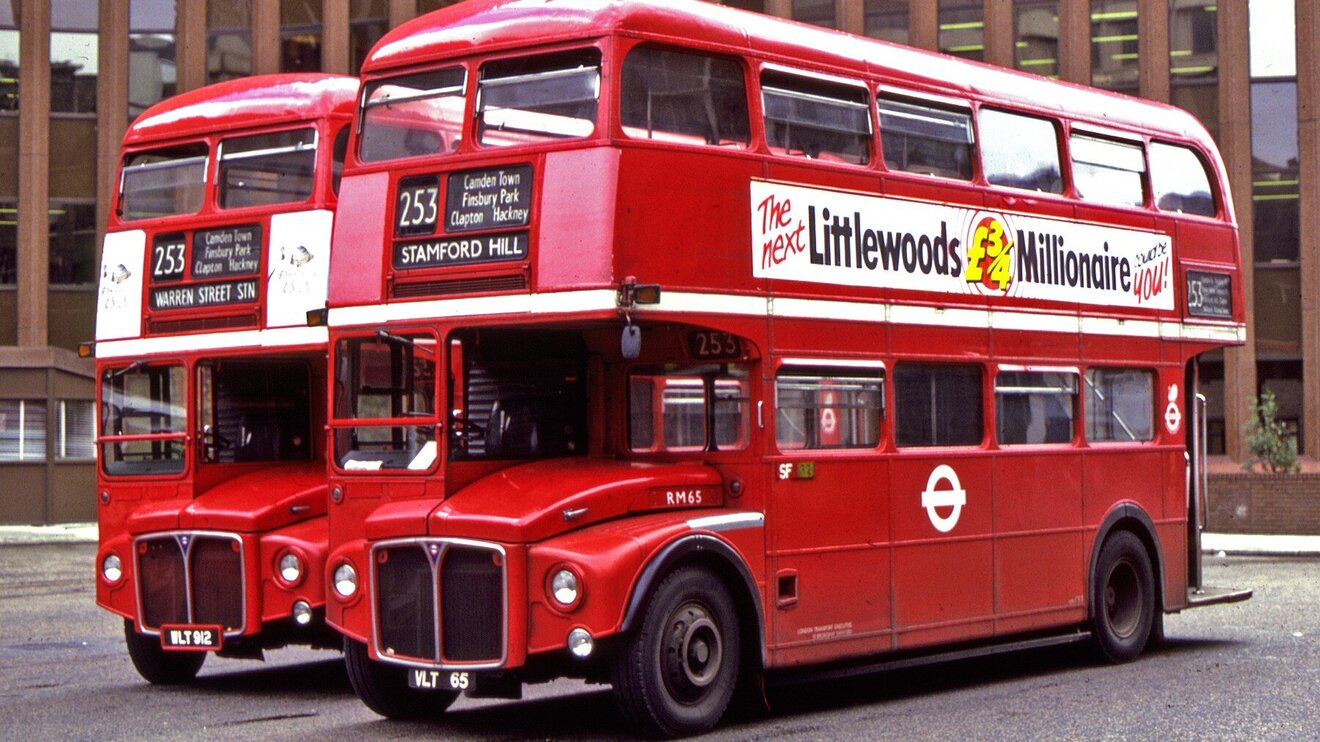
What is a double-decker?
A double-decker bus is a bus with two floors (decks). Double-decker buses were once widely used as urban transport across the United Kingdom, and they’re still used today in a number of cities in Europe, Asia, and Australia.
The best-known double-decker is London’s «Routemaster,» which became a symbol of the city and, quite possibly, the most recognizable city bus in the world.
Interesting fact
The widespread myth that double-decker buses are prone to tipping over doesn’t hold up. Most double-deckers are fitted with anti-tipping features – typically ballast made of cast-iron ingots mounted on the chassis to lower the center of gravity.
The history of London’s buses
The early years (up to the 1950s)
Bus service in London from 1855 to 1933 was run by the London General Omnibus Company, which bought buses for the entire capital. From 1911, buses began to be purpose-built for the city’s needs: in 1911 the LGOC B-type entered service, an in-house design with a wooden body on a wooden chassis and an open top deck.
In 1922 it was replaced by the NS-type bus, which likewise originally had an open top deck, but in 1925 city authorities banned the operation of open-top buses and nearly 1,700 vehicles were modified as a result.
The legendary «Routemaster» (1956–2005)
The Routemaster became a symbol of London, running on the British capital’s routes from 1956 until the end of 2005. It was designed to increase passenger capacity while staying within the vehicle-length restriction then in force in London.
The bus had no doors – an open platform at the rear allowed passengers to hop on and off quickly, not just at stops but also when the bus paused at an intersection or in traffic (which often led to injuries). Tickets were bought or shown to the conductor right there, so the crew of these buses usually consisted of a driver and a conductor, which made them fairly expensive to operate.
Routemaster specifications
- Height: 4,381.5 mm
- Crew: driver + conductor
- Distinctive feature: open rear platform
- Years in service: 1956–2005
Design features
Advantages of double-decker buses
- Greater passenger capacity for a relatively short overall length
- Better maneuverability and handling than articulated («bendy») buses
- Passenger comfort – designed primarily to carry seated passengers
- Better views from the upper deck
Design drawbacks
- Longer boarding and alighting times for passengers
- Higher operating costs due to the complex construction
- Awkward stairs for the elderly, passengers with strollers, and the disabled
- Height restrictions from overpasses and overhead wiring
- Infrastructure requirements – tall garages and workshops
Evolution of the design
Early models
Early double-decker buses had a separate driver’s cab. Passengers boarded through an open platform at the rear of the bus. Some double-deckers had an open top deck, roofless and with low sides – popular for sightseeing.
Modern models
Modern double-decker buses have their main entrance at the front of the cabin, next to the driver’s cab. Routemasters were replaced by modern double-deckers – on today’s double-decker buses, boarding is through the front door and alighting through the rear.
London buses in the modern world
In December 2007, ahead of the 2012 Summer Olympics, a project to design a new city bus for London got underway. The project was called the «New Bus for London» (originally New Bus 4 London), and the winning design was officially unveiled in 2010.
In essence the bus is a hybrid design: the front wheels are driven by a 4.5-liter diesel engine. The rear wheels are turned by electric motors powered by lithium-ion batteries. The batteries are charged by solar panels on the bus roof, and by an electric generator at night.
Structurally it echoes the Routemaster: an aluminum body mounted on a frame. The bus has extra doors and a second staircase to the upper deck. The classic rear platform remains, but it’s now enclosed behind a light door.
The New Bus for London
- ✓ Hybrid drive
- ✓ Solar panels
- ✓ Aluminum body
- ✓ Two staircases
- ✓ Enclosed rear platform
Double-deckers around the world
Asia
Hong Kong and Singapore: Most buses in Hong Kong, and roughly half of those in Singapore, are double-deckers.
India: Double-decker buses are widely used in many major Indian cities. Most are locally built, though Routemasters turn up as well.
North America
The US and Canada: The only places in North America where double-decker buses are used as urban transport are the Canadian province of British Columbia and the city of Las Vegas in the US.
The former USSR
The USSR: In 1959 three German-built double-decker buses entered service in Moscow, but by 1964 all had been decommissioned due to the difficulty of operating them.
Today: In the early 2000s, small numbers of double-decker buses were operated in Barnaul, Gomel, and St. Petersburg.
Cultural significance
A symbol of London
The London double-decker became more than just a means of transport – it became a genuine symbol of the city. Red double-decker buses show up on postcards, souvenirs, in films and books, as an inseparable part of the London landscape.
Retiring the classic Routemasters in 2005 was seen by British society as an act of cultural vandalism – that’s how deeply these buses had become embedded in English culture.
Technical specifications
| Parameter | Routemaster | Modern double-decker |
|---|---|---|
| Height | 4,381.5 mm | Around 4,500 mm |
| Crew | Driver + conductor | Driver only |
| Boarding/alighting | Open rear platform | Front door (boarding) + rear door (alighting) |
| Capacity | 64 passengers | 86–99 passengers (depending on the variant) |
| Upper-deck ceiling height | Standard | 1,700 mm |
Fun facts
🎯 Left-hand traffic
London buses are built for left-hand traffic, which means they can only be used in cities in left-driving countries and can’t be used in cities across most of the rest of the world.
🎪 Sightseeing variants
Some double-decker buses have an open top deck, roofless and with low sides – popular for sightseeing. Sitting higher up, passengers see farther, and the air is fresher on an open deck besides.
⚡ Modern technology
New London buses are fitted with hybrid engines, rooftop solar panels, and a power-balancing system between energy sources, managed by an onboard computer.
🏛️ Museum pieces
Today you can still ride a classic «Routemaster» on two heritage routes in London. Many of the retired buses have become museum exhibits or are used for special events.
Conclusion
London’s double-deckers are more than just urban transport – they’re a living symbol of the British capital. From the wooden constructions of the early twentieth century to today’s hybrid buses with rooftop solar panels, the evolution of the double-decker bus reflects technical progress and changes in urban planning.
Today the red double-decker remains one of London’s most recognizable landmarks, continuing to serve as both a practical means of transport and a symbol of the city seen by millions of tourists from around the world.