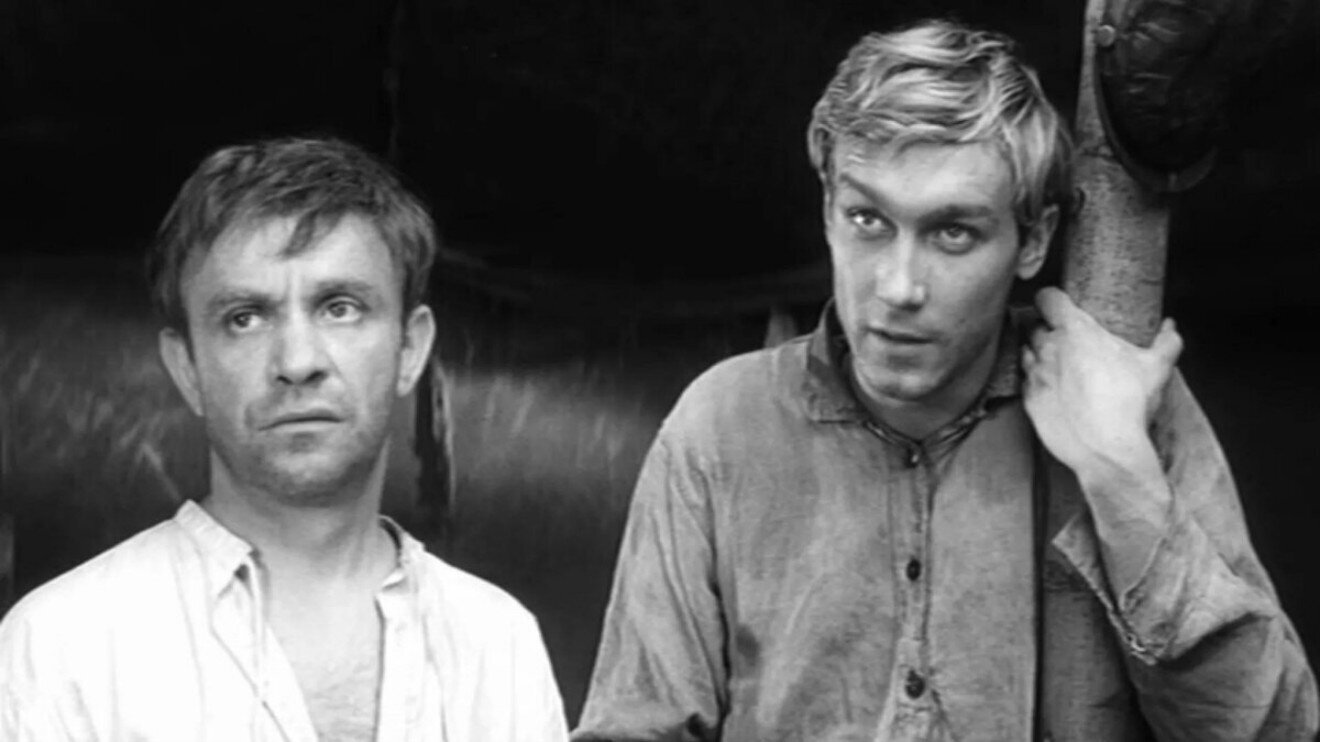
The 1968 feature film «Two Comrades Served» became one of the most significant works of Soviet cinema about the Russian Civil War. Directed by Yevgeny Karelov, from a screenplay by Yuli Dunsky and Valery Frid, the film offers a deep meditation on human fate during a turning point in Russian history.
Plot and Structure
The action unfolds in November 1920, during the final operations of the Civil War. Baron Wrangel’s forces are blockaded in Crimea, and the Red Army is preparing its last offensive. The director and screenwriters chose a symbolic moment in history — when the country’s fate was already decided, but individual human tragedies continued to unfold with the same intensity as ever.
The film is built on two parallel storylines that intersect dramatically at the end. The first follows Red Army soldiers Andrei Nekrasov and Ivan Karyakin; the second follows White Guard lieutenant Alexander Brusentsov. This structure lets the filmmakers show the tragedy of the Civil War from different sides, avoiding a one-sided portrayal.
Andrei Nekrasov is a former photographer, an intelligent, reflective man. He’s ordered to carry out aerial reconnaissance filming using a captured Debrie Parvo camera. Nekrasov admits honestly that he doesn’t know the equipment, but his objections are ignored. He’s given Ivan Karyakin as an assistant — a former company commander demoted to private for executing a military specialist without authorization.
Relations between the two comrades are difficult. Karyakin is suspicious of Nekrasov, seeing him as an «alien element» — Nekrasov openly discloses his background: «I’m, how should I put it, a priest’s son. My uncle raised me, a priest.» This admission creates further tension between the two, reflecting the real contradictions of the era.
Trials and Twists of Fate
The aerial reconnaissance ends in disaster: the plane crashes, the pilot dies, and Nekrasov and Karyakin are captured by Makhnovist forces. The situation is paradoxical, since Makhno and the Red Army were formally allies at the time, but that doesn’t save the heroes from the threat of execution. Nekrasov manages to pull off a daring escape, and holds on to the camera the whole time.
But freedom from the Makhnovists doesn’t mean the end of their troubles. Back among Red forces, the two comrades are arrested again. A woman commissar isn’t inclined to trust two unknown men without papers, especially after White Guard uniforms are found in their cart. The situation worsens when she mistakes Nekrasov for a counterintelligence officer who once tortured her.
Only a stroke of luck saves the heroes from execution — Nekrasov recognizes the chief of staff in a passing car, who cancels the sentence. The scene vividly illustrates the chaos and brutality of the Civil War, when life and death often hinged on pure chance.
Skill and Memory
The climax of the first storyline comes when the results of the aerial filming are reviewed. The film turns out to be ruined, and Karyakin immediately accuses Nekrasov of betrayal. But command doesn’t share those suspicions. Nekrasov demonstrates a remarkable ability — possessing a photographic memory, he reproduces a map of the enemy fortifications with startling accuracy. The details of his drawing match exactly with information gathered from defectors.
This episode matters not just for the plot but for characterizing the protagonist. Nekrasov emerges not merely as someone following orders, but as a man with a special gift, able to serve the common cause even amid technical failure. He’s awarded a Mauser, and Karyakin, finally realizing he was wrong, tries to build a genuine friendship with his comrade.
The White Officer’s Tragedy
The parallel storyline of Lieutenant Brusentsov unfolds in Sevastopol and carries a darker tone. The film opens with Brusentsov accidentally killing his friend, adjutant Sergei Lukashevich, in a hotel room. A nurse named Sasha is called to attend to the dead man, and Brusentsov meets her while under house arrest.
He’s soon sent to defend Perekop, where the decisive battles of the Civil War play out. After the Red Army storms Perekop, crossing the Sivash Bay, Brusentsov, like many others, flees to Sevastopol, toward the last steamships out.
It’s here that the two storylines intersect. Karyakin spots Brusentsov and wants to shoot him, but Nekrasov asks him not to. While they argue, Brusentsov and another White officer, Baron Krause, slip away. But Brusentsov, ignoring his companion’s objections, decides to use the last round in his rifle. His victim is Nekrasov.
The Final Tragedy
During the Sevastopol evacuation, Brusentsov marries the nurse Alexandra, but at the last moment, only he manages to board the departing steamship. A symbolic detail is the fate of his loyal horse, Abrek, who leaps into the water after the ship and drowns. Brusentsov can’t bear the sight and takes his own life.
The film ends with Karyakin arriving at division headquarters after the Bolshevik conquest of Crimea, handing over the camera left behind by his fallen comrade. The final shots are the footage Nekrasov himself filmed, lending the story extra authenticity and emotional power.
A Star-Studded Cast
The film assembled a brilliant ensemble. Oleg Yankovsky created a memorable Andrei Nekrasov — an intelligent Red Army soldier who kept his humanity amid a brutal war. Rolan Bykov, as Ivan Karyakin, embodied the type of revolutionary soldier who travels from suspicion to understanding and comradeship.
Vladimir Vysotsky created one of his most tragic film roles — Lieutenant Alexander Brusentsov. Though the actor later expressed disappointment with the film, since his character’s screen time was significantly cut, the portrayal came out cohesive and piercing. Vysotsky managed to show the inner drama of a man who’d ended up on history’s losing side.
Iya Savvina, as the nurse Sasha, embodied the era’s female archetype — compassionate and resilient. Anatoly Papanov, Nikolai Kryuchkov, Pyotr Krylov, and other masters of Soviet cinema created a gallery of military and civilian figures, each bearing the imprint of the historical era.
The Screenwriters: Tragic Lives
The screenplay was written by the creative duo of Yuli Dunsky and Valery Frid — two writers whose own biographies reflected tragic chapters of Soviet history. Their creative partnership began back in school and continued until Dunsky’s death in 1982.
Yuli Teodorovich Dunsky was born July 22, 1922, into the family of a USSR VSNKh employee. In 1940, he enrolled in the screenwriting department at VGIK (the Soviet film institute), but his studies were interrupted by the war and his subsequent arrest. In 1944, after passing his theoretical exams early, he volunteered for the front, but was soon arrested on charges of belonging to an anti-Soviet youth group with terrorist intentions.
Valery Semyonovich Frid was born January 13, 1922, in Tomsk, the son of Semyon Markovich Frid, a professor and director of the Belarusian Institute of Microbiology and Epidemiology. After the family moved to Moscow, he became friends with Yuli Dunsky, who studied in a parallel class. From then on, their names were mentioned together — «Frid and Dunsky.»
Trial by Repression
On April 19, 1944, both future screenwriters were arrested in the same case, along with other students from Moscow universities. In total, 13 young people were arrested, all of whom used to gather in a room of a communal apartment on the Arbat. Among those arrested were future theoretical physicist Mikhail Levin, Nina Ermakova (later the wife of Nobel laureate Vitaly Ginzburg), and the daughter of executed commissar A. S. Bubnov.
The group of young people was accused of plotting an assassination attempt on Stalin during his drive along the Arbat to the Kremlin. After interrogation at the Lubyanka, both were sentenced to 10 years in labor camps. Frid served his term at Kargopollag and Minlag in Inta, where he met film director Alexander Kapler and other prominent cultural figures.
In 1956, Dunsky and Frid were rehabilitated and returned to Moscow, where they completed their diplomas at VGIK. From that point began their prolific creative partnership, which lasted a quarter century.
Creative Method and Autobiographical Elements
Their experience of the camps and the people they met there left a mark on the screenwriters’ work. In «Two Comrades Served,» they used the real names and fates of people they knew. As the authors admitted, this was, in part, an attempt to find former camp comrades.
They gave Vysotsky’s character the first name, patronymic, and surname of one of their friends — Alexander Nikitich Brusentsov, a former lieutenant. The character of Dr. Semyon Markovich, who lectures the Red Army soldiers in verse, is based on a real episode from the life of Valery Frid’s father.
These autobiographical details lend the film a particular authenticity and human warmth. The screenwriters didn’t just reconstruct a historical era — they poured their own life experience and memory of the people fate had brought them into it.
Artistic Features and Significance
«Two Comrades Served» stands out among Soviet Civil War films for its humanistic approach to the subject. The authors avoid heavy-handed propaganda and black-and-white characterization. Even the White Guard officer Brusentsov is shown not as a villain but as a man caught in tragic circumstances.
The film raises timeless questions about the cost of historical change, human dignity under extreme conditions, comradeship and betrayal. The camera in Nekrasov’s hands becomes a symbol of memory — recording events for future generations, preserving the testimony of an era.
Special attention is due to the closing song, referenced by the author of the novel: «There goes a bullet flying, and alga, there goes a bullet flying, and my comrade fell.» These lines became a catchphrase and firmly entered popular memory as a symbol of brotherhood tested by war.
Cultural Legacy
The film left a notable mark on Soviet and Russian culture. Songs from the film, especially its closing number, became folk favorites. The band Lyube included a remix of the song on their album «Kombat,» a testament to its lasting popularity.
It’s worth noting that a novella of the same title by writer Anatoly Kucherov, published in 1954, has no connection to the film. It tells of young people’s participation in the defense of Leningrad during the Great Patriotic War, which sometimes causes confusion for readers and viewers.
The creative partnership of Dunsky and Frid ended tragically. Yuli Dunsky, who suffered for over a decade from severe bronchial asthma, took his own life on March 23, 1982, shooting himself with an antique 18th-century pistol. Valery Frid continued working until 1998, teaching at the Higher Courses for Screenwriters and Film Directors. Both screenwriters are buried side by side at Moscow’s Donskoye Cemetery.
«Two Comrades Served» remains one of the finest examples of Soviet cinema about the Civil War — a film that managed to show human fates in all their complexity and contradiction, avoiding simplified schemas and propagandistic clichés. It’s a work about how history is made by the hands of specific people, each carrying their own share of responsibility for what happens.