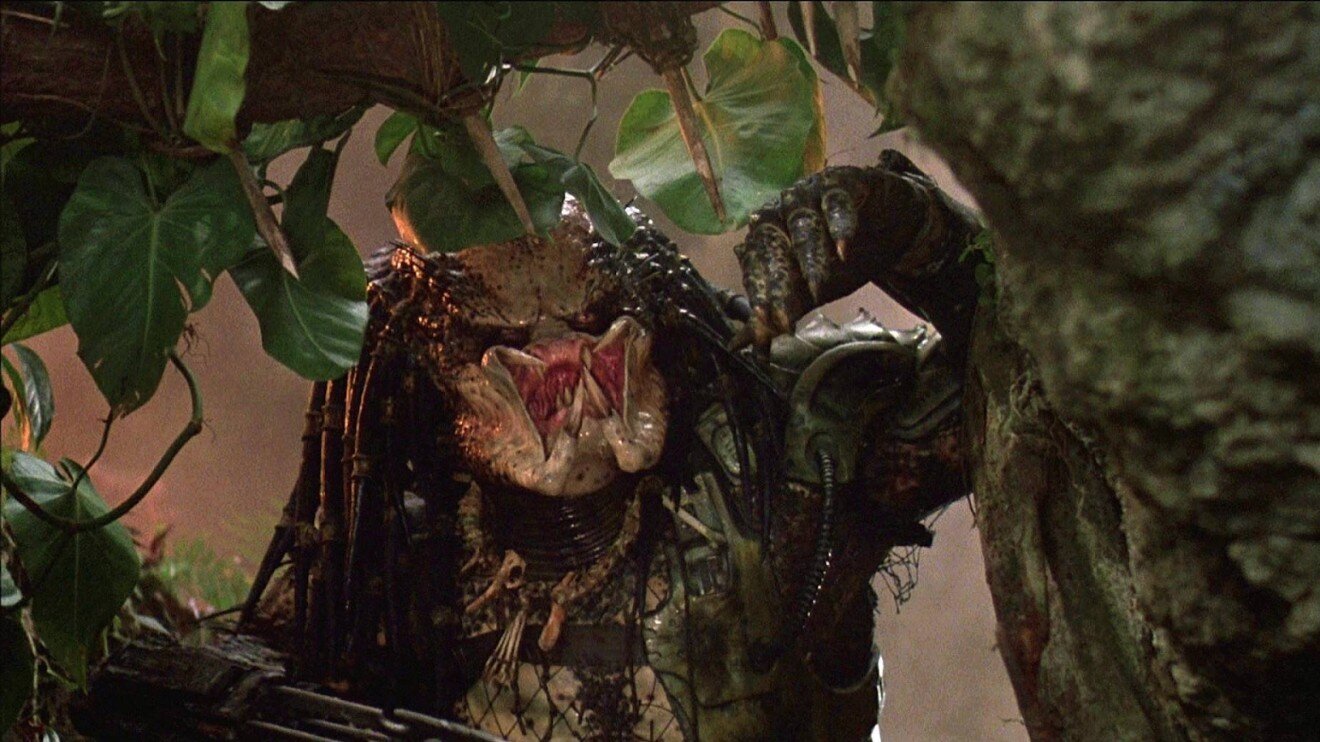
«Predator» is a 1987 American science-fiction action film directed by John McTiernan, one of the most influential films of the action and sci-fi genres of the 1980s. Starring Arnold Schwarzenegger, the film became not only a box-office hit but also spawned an entire media franchise, including numerous sequels, comics, video games, and other works.
Plot and Premise
The story follows an elite team of mercenaries led by Major Dutch Schaefer (Arnold Schwarzenegger), sent into the Central American jungle to rescue hostages. The team consists of veteran fighters: Mac (Bill Duke), Poncho (Richard Chaves), Blain (Jesse Ventura), Billy (Sonny Landham), and Hawkins (Shane Black). They’re joined by Dutch’s old friend, CIA agent Dillon (Carl Weathers).
The true mission, though, turns out to be a lie — instead of rescuing hostages, the team is meant to wipe out a guerrilla camp. After completing the job, the soldiers discover they’re being hunted by an unknown enemy — a technologically advanced alien Predator that uses camouflage and thermal vision to track its prey.
Team members are picked off one by one until only Dutch remains. In the final confrontation, he realizes that mud masks his heat signature, making him invisible to the Predator. Using improvised traps and weapons, Dutch enters a final showdown with the creature.
Development History
The screenplay was written by brothers Jim and John Thomas in 1984 under the working title «Hunter.» The original concept involved a group of alien hunters of various species, but it was later simplified to the story of a single extraterrestrial creature hunting humans.
Since the Thomas brothers were unknown writers, they struggled to get anyone to notice their project. Eventually, they slid the script under the door of 20th Century Fox producer Michael Levy. Levy passed it to producer Joel Silver, who, drawing on his experience with «Commando,» decided to turn the sci-fi story into a big-budget film.
Casting and Filming
Arnold Schwarzenegger was the first choice for the lead. The actor made significant changes to the original screenplay, insisting that the action not be limited to him and the alien, but involve a whole commando team. That decision made the film more dynamic and believable.
To build out the team of elite soldiers, the producers sought large, physically imposing actors. Carl Weathers, known for playing Apollo Creed in the «Rocky» films, was the first choice for Dillon. Jesse Ventura, a professional wrestler and former Navy SEAL, was cast as Blain for his imposing physique.
An interesting detail concerns the Predator itself. It was originally meant to be played by Jean-Claude Van Damme, who planned to use his martial-arts skills to create an agile, ninja-like hunter. But once he was placed alongside the tall, muscular Schwarzenegger, Weathers, and Ventura, it became clear a more physically imposing actor was needed. Van Damme also complained constantly about the heat inside the monster suit. He was eventually replaced by Kevin Peter Hall, who stood 7 feet 2 inches (about 218 cm) tall.
Production and Technical Aspects
Filming took place from March to June 1986 in the jungles of Mexico, mostly near Puerto Vallarta. Production was physically grueling — jungle temperatures ran surprisingly low, requiring constant use of heat lamps. Much of the cast and crew suffered from traveler’s diarrhea due to water-purification problems at their Mexican hotel.
Both McTiernan and Schwarzenegger lost 25 pounds during filming. Schwarzenegger’s weight loss was a deliberate professional choice, while McTiernan lost weight by avoiding the local food for health reasons.
The shoot was so physically demanding that Kevin Peter Hall later said in an interview: «This wasn’t a movie, it was a survival story for all of us.»
Visual Effects and Creature Design
The original Predator design was created by Richard Edlund of Boss Film Studios, but it came out as a disproportionate, clumsy creature with large yellow eyes and a dog-like head. After that failed, Stan Winston was brought in, who had previously worked with Schwarzenegger on «The Terminator.»
On a flight to the Fox studio alongside «Aliens» director James Cameron, Winston sketched out the monster. Cameron suggested giving it mandible-like jaws, an idea that became part of the Predator’s iconic look.
The invisibility effect was achieved with chroma-key technology. An actor in a bright-red suit the size of the Predator was filmed against the jungle backdrop (red was chosen as the color most contrasting with the green of the jungle and the blue of the sky). The red was then removed, leaving an empty area. A second take was shot without any actors, using a lens 30% wider. Optically combining the two takes let the jungle from the second take fill the empty area, creating a blurred outline of the creature.
Infrared film couldn’t be used for the thermal-vision shots, since it didn’t register body-heat wavelengths. Instead, the filmmakers used an Inframetrics thermal video scanner. The glowing blood was created with green liquid from glow sticks mixed with personal lubricant for texture.
Music
The score was written and conducted by Alan Silvestri, who had just scored a massive hit with «Back to the Future» (1985). Joel Silver originally wanted Michael Kamen, after working with him on «Lethal Weapon,» but Kamen was unavailable, tied up with «The Adventures of a Baby-sitter.»
«Predator» became Silvestri’s first major action score, and it’s full of the genre hallmarks he’d become known for: powerful French-horn blasts, staccato string rhythms, and rolling waves of timpani underscoring the action and tension.
Box Office and Commercial Success
The film was released on June 12, 1987, and took the top spot at the American box office in its opening weekend, earning $12 million. For the year, it ranked 12th domestically in the U.S. Worldwide grosses totaled $98,267,558, of which $59,735,548 came from the U.S. and Canada.
Critical Reception
Initial reviews were mixed. Janet Maslin of The New York Times described the film as «grim and humorless, with few surprises.» Michael Wilmington of the Los Angeles Times called it «perhaps one of the emptiest, weakest, most derivative screenplays ever shot as a major studio film.»
Critic Roger Ebert, however, was more favorable, writing: «Predator moves at a breakneck pace, has strong, simple characterizations, good location work and terrific special effects, and delivers what it promises: an effective action picture.»
Over time, critical opinion of the film improved considerably. On Rotten Tomatoes, it holds an 80% approval rating based on 60 reviews, with an average score of 7/10. The site’s critical consensus reads: «Predator is part science fiction, part horror, part action — all muscle.»
Cultural Influence and Legacy
«Predator» gradually became a classic of science-fiction and action cinema. The film has appeared on numerous «best of» lists. In 2007, Entertainment Weekly named it the 22nd-greatest action film of all time. In 2012, IGN declared it the 13th-greatest action film of all time.
The line «Get to the chopper» became closely associated with Arnold Schwarzenegger and turned into a popular meme.
The handshake between Dutch and Dillon became a viral meme, known as the «Epic Handshake» or the «Predator Handshake.» That type of handshake, performed by slapping palms in an arm-wrestling-like grip, became a symbol of masculinity and is often used in various contexts.
Analysis and Interpretation
Many critics and analysts see «Predator» as a deeper work than it might first appear. William Bibbiani of IGN, in 2018, called «Predator» «the most subversive action movie of the 1980s» and pointed to examples of its satire on the action genre as a whole.
The film can be read as a critique of militaristic masculinity and American Cold War-era imperialism. The elite team, representing the pinnacle of military might, proves helpless against a superior opponent. Each team member, embodying a particular facet of military masculinity, is systematically wiped out.
The Predator in the film represents the ideal hunter — technologically superior, physically powerful, and tactically intelligent. It hunts not out of necessity but for sport, collecting trophies in the form of its victims’ skulls. This can be read as a metaphor for colonial exploitation, or as a reflection of human nature as hunter.
Technical Craft
John McTiernan’s direction shows a skillful build-up of tension and atmosphere. The camera masterfully conveys the claustrophobia of the jungle and a constant sense of threat. Using a subjective camera from the Predator’s point of view creates a unique visual experience.
The film’s editing is built on a gradual escalation of tension — from a conventional war-action picture into a survival horror. Sound design plays an important role in building atmosphere, from the sounds of the jungle to the Predator’s signature clicking.
Influence on Cinema
«Predator» had a significant influence on the development of the science-fiction and action genres. The film set new standards for special effects and creature design. The Predator became one of the most recognizable movie monsters in cinema history, alongside the Alien from Ridley Scott’s film of the same name.
The concept of an invisible, technologically advanced hunter has been borrowed repeatedly in later films and games. The «hunter becomes the hunted» motif, in which the prey turns the tables on its pursuer, also became a popular device in the genre.
Franchise and Sequels
The success of «Predator» led to an extensive media franchise. Direct sequels followed: «Predator 2» (1990), «Predators» (2010), «The Predator» (2018), and the prequel «Prey» (2022). In 2025, the animated anthology film «Predator: Killer of Killers» was released.
Crossovers with the «Alien» franchise were also made: «Alien vs. Predator» (2004) and «Aliens vs. Predator: Requiem» (2007).
The character Dutch Schaefer appeared in the video games «Alien vs. Predator» (1994) and «Predator: Hunting Grounds» (2020), where Schwarzenegger voiced his character in paid DLC.
Conclusion
«Predator» (1987) remains a landmark achievement in the science-fiction and action genres. The film successfully blends elements of the war picture, horror, and science fiction, creating a distinctive cinematic experience. McTiernan’s masterful direction, Schwarzenegger’s charismatic performance, innovative special effects, and the creature’s memorable design made «Predator» a classic that continues to influence cinema decades after its release.
The film demonstrates how skillfully executed genre filmmaking can transcend simple entertainment and offer deeper reflection on human nature, war, and survival. «Predator» has permanently entered film history as one of the finest examples of its genre and its era.