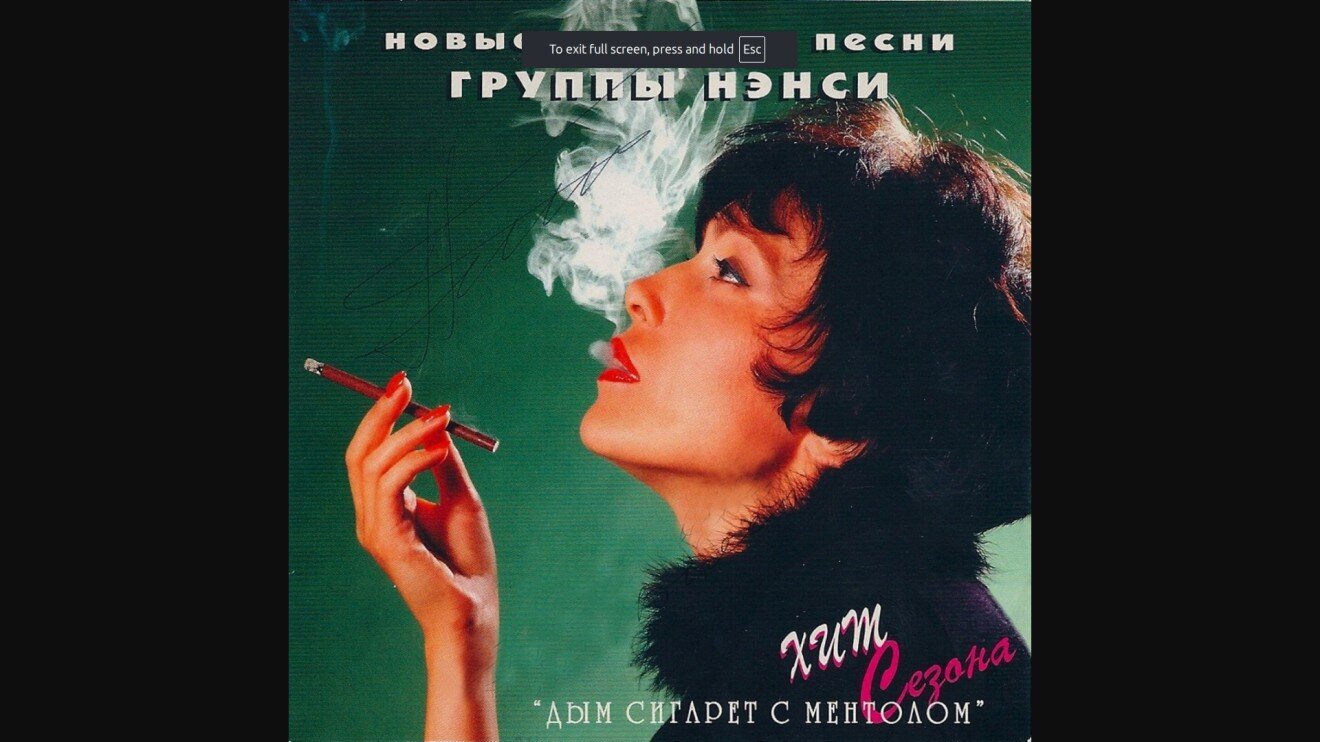
The song "Smoke of Menthol Cigarettes" became one of the most recognizable hits of the post-Soviet space, and the band "Nancy" wrote its name permanently into the history of early-1990s Russian pop music.
The song's origin
"Smoke of Menthol Cigarettes" is a Russian courtyard song (a genre of amateur, informally circulated street ballad) of Ukrainian origin, which achieved its greatest fame through the arrangement and performance of the band "Nancy." Recorded in 1992, it became the group's calling card for the rest of its existence.
Interestingly, the first known studio recording of a version of the song, titled "Menthol Cigarette Smoking," was made back in 1987, by singer Yuri Brilliantov, on the album "The Violinist." This points to the song having an earlier history, circulating among the public well before its commercial success.
The musical arrangement
A distinctive feature of "Nancy's" version was its use, in the instrumental break, of musical themes by the famous Italian composer Ennio Morricone. The 1992 arrangement incorporated the themes "Chi Mai" and "Le Vent, Le Cri," which had gained worldwide fame as the soundtrack to the 1981 French film "The Professional." The piece "Chi Mai" was written by Morricone back in 1971, and had appeared in several films. The theme "The Loft" was used as well.
This musical borrowing gave the song a distinctive cinematic atmosphere and instant recognizability, creating a unique fusion of courtyard lyricism and European film music.
The story of its creation, according to its author
According to "Nancy" frontman Anatoly Bondarenko, he is the author of "Smoke of Menthol Cigarettes," and work on it stretched over at least ten years. The first sketches appeared while he was in seventh grade, among his group of school friends. A new version of the song took shape once Andrei Kostenko joined the band.
According to Bondarenko's account, the song was written in honor of an American girl named Nancy, who gave her name not just to the song, but to the band itself. Their meeting has an almost cinematic story: thirteen-year-old Anatoly met Nancy when she came to a Soviet Young Pioneer camp as part of a Boy Scout delegation.
"In the evenings by the campfire, I'd sing my songs to the guitar, and they'd translate the words for her. She'd laugh, and sometimes I'd see her eyes shine with tears. I fell head over heels in love with her! When we parted, I gave her my guitar. The line of buses pulled away, when suddenly one of them slammed on the brakes, the door opened, and Nancy, in tears, ran to me. And right there, in front of everyone, we started kissing. Now that was emotion!"
There is also an alternate version, told by that same Anatoly Bondarenko, according to which variations of "Smoke of Menthol Cigarettes" existed even before the revolution, though he still considers himself the rightful author of this particular version — the recording, the music, and parts of the lyrics.
The history of the band "Nancy"
Origins and founding
"Nancy" is a Ukrainian, Russian-language music group, created by producer, poet, and musician Anatoly Mikhailovich Bondarenko (b. January 11, 1966, in Konstantinovka, Donetsk Oblast). He was writing music and lyrics for his own songs as early as his school years.
In 1983, Bondarenko formed the band "Hobbi" ("Hobby"), which became popular across Donetsk Oblast. The group recorded the album "Crystal Love" at the studio of the Donetsk State Radio and Television Broadcasting Center, a cycle of songs entirely of his own composition. The title track, "Crystal Love," later appeared on "Nancy's" album "Fog-Fog."
Until August 1991, "Hobbi" toured regional venues. During the collapse of the USSR, the group disbanded.
The founding of "Nancy"
In 1992, Anatoly Bondarenko assembled a new lineup for the band, including keyboardist and lead singer Andrei Alexandrovich Kostenko (b. March 15, 1971, on Iturup Island, raised from age three in Kramatorsk, Donetsk Oblast), with the aim of breaking into the Moscow music scene.
Studio recording of a new album began in the summer of 1992 and was completed by year's end. The technical recording work was handled by Anatoly Vorobyov, director of the "LIRA" studio, while creative production was provided by the Donetsk Academic Ukrainian Musical Drama Theater. The Moscow studio "Soyuz" took on responsibility for promoting the "Nancy" album across the entire post-Soviet space.
Choosing the name
In January 1993, Anatoly decided to drop the awkward band name "Hobbi" and began searching for a new one. By his account, a list of names was drawn up, but since there was no internet in 1992, they consulted friends at record shops, who kept up with every Western and Soviet band.
Many of the options turned out to already be taken in the global entertainment industry. Of everything considered, three suitable names remained: "Lyuta," "Platina," and "Nancy." The final choice fell on "Nancy" — in honor of the band founder's first love.
Commercial success and recognition
The debut album "Smoke of Menthol Cigarettes," recorded in 1992 at the "Lira" recording studio (Donetsk), brought the band significant popularity. The title track was released on numerous compilation albums, in large print runs.
By 1994, "Nancy's" songs were already playing on Russian radio stations. In 1995, the band's first compact disc was released. In 1995–1996, the group appeared regularly on central Russian and Ukrainian television. The music video for "Smoke of Menthol Cigarettes" was released in 1996.
Over its existence, the band recorded more than 20 albums, but "Smoke of Menthol Cigarettes" remained its signature hit and calling card.
Band lineup
The band's core members over the years included:
- Anatoly Bondarenko — leader, songwriter, and founder of the band
- Andrei Kostenko — keyboardist and lead singer (until November 2024)
- Sergei Bondarenko — the band's lead singer from 2007 to 2018, who died on October 18, 2018, of a sudden illness
- Alexei Tsyplakov (b. April 6, 1982) — the band's guitarist and backing vocalist since 2008, who became one of its frontmen after Kostenko's departure
Recent developments in the band's history
On November 20, 2024, a significant split occurred within the band: Andrei Kostenko, who lives in Russia, was dismissed from "Nancy" on charges of unauthorized formation of a backing band, with which he performed the group's hits, including works written by Anatoly Bondarenko.
In December 2024, Kostenko gave a solo performance on the program "Hello, Andrei!," where he noted that "Nancy" had "dissolved" in February 2022, owing to the political situation, and that communication with his "colleague" had essentially ceased. Alexei Tsyplakov, previously the band's guitarist and backing vocalist, became the new second frontman of the original "Nancy" lineup.
Critical reception
"Smoke of Menthol Cigarettes" drew mixed critical reviews. Stanislav Biryulin of "Moskovskie Novosti" called the track "a pure, glaring example of vulgarity in the art of song," calling it especially unsightly "set against the backdrop of a still-breathing rock 'n' roll."
At the same time, a journalist for "Komsomolskaya Pravda," noting the song's incredible success, called it "a masterpiece," reflecting the track's popularity with a broad audience.
Cultural significance
"Smoke of Menthol Cigarettes" became a defining track for an entire generation, symbolizing a particular era in the history of post-Soviet popular culture. The song fit organically into the atmosphere of the early 1990s, a time when traditional Soviet pop music was giving way to new musical currents.
The track shows a synthesis typical of the era — combining various musical traditions: courtyard song, European film music, and commercial pop. This combination let the song resonate with the broadest possible audience, and cemented it in the popular memory for decades.
Its lyrics, celebrating the romance of city meetings and partings, menthol cigarettes, and late-night conversations, created a recognizable image of an era when Western trappings of life (imported cigarettes, restaurants) were only just entering the everyday habits of Soviet, and then post-Soviet, society.
Today, "Smoke of Menthol Cigarettes" remains one of the most recognizable songs of its time, regularly heard at retro-music concerts and in films depicting the 1990s. The track has become an inseparable part of the cultural code of the generation that lived through the collapse of the USSR and the emergence of the new Russia.