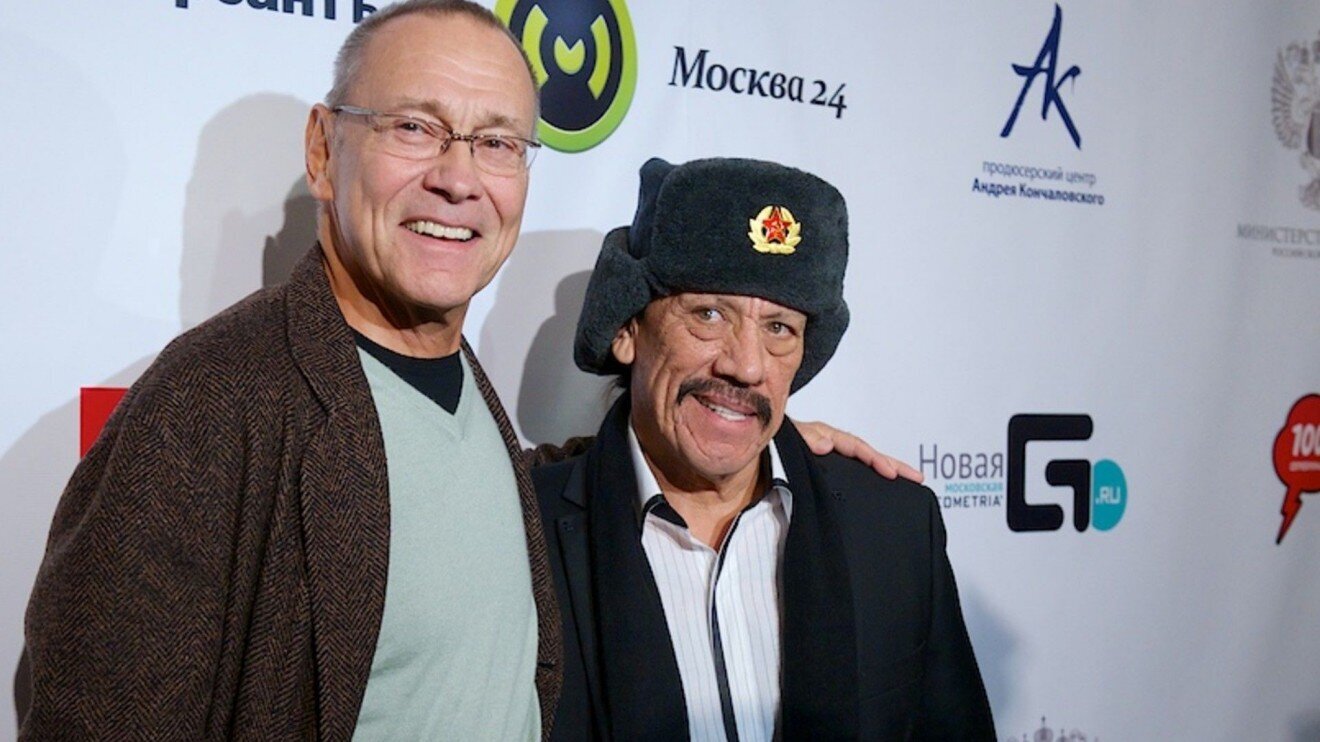
The film “Runaway Train” (1985), directed by Andrei Konchalovsky, became not only an outstanding action thriller but a landmark picture that fused Eastern film philosophy with Western dynamism. This film introduced the world to a whole cohort of actors, including Danny Trejo, and demonstrated the power of international film collaboration.
Origins of the Project: Kurosawa and an Unrealized Dream
The story of “Runaway Train” begins in the 1960s with the great Japanese director Akira Kurosawa. The master of samurai cinema, creator of “Seven Samurai” and “Yojimbo,” wrote a script about an uncontrollable train racing across the snowy expanses of Alaska. This was meant to be his first color film after “Red Beard” (1965), but difficulties with American financial backers forced him to shelve the project.
Kurosawa’s script wasn’t an ordinary technical-disaster story. In the spirit of Japanese philosophy, he treated the train as a metaphor for human fate, an uncontrollable force carrying the heroes toward their destiny. It’s no accident the film ends with a quote from Shakespeare’s “Richard III”: “The world is filled with fierce beasts, yet even the fiercest knows pity. I know not pity, and therefore I am no beast.”
Kurosawa’s regular collaborators Hideo Oguni and Ryuzo Kikushima were brought on to work on the script, though their contribution went uncredited in the final film. Reworking the script for American production fell to Djordje Milicevic, Paul Zindel, and Edward Bunker — the last of whom brought genuine knowledge of prison life, drawn from his own experience.
Andrei Konchalovsky: A Russian Perspective on an American Story
When the project was finally put into production, it was headed by Soviet director Andrei Konchalovsky. This was a bold choice for a Hollywood studio — entrusting a big-budget American film to a Soviet filmmaker at the height of the Cold War. Konchalovsky, however, proved to be the ideal candidate to realize Kurosawa’s vision.
The director preserved the original script’s philosophical depth while adding brutal realism and psychological complexity to the characters. His “Runaway Train” became not just a disaster film, but an existential drama about freedom, choice, and the price of human dignity.
Plot and Symbolism
The action unfolds during an Alaskan winter. Ruthless bank robber Oscar Manheim, known as Manny (Jon Voight), gets a chance to return to a shared cell after three years locked in solitary confinement. Warden Ranken (John P. Ryan) tries to arrange Manny’s murder, but the attempt fails. Together with young inmate Buck McGeehy (Eric Roberts), Manny makes his escape.
The fugitives find themselves aboard an uncontrollable train after the engineer dies of a heart attack. What began as an escape to freedom turns into a deadly trap. The train becomes a metaphor for fate — the characters can neither stop it nor get off, only accept their destiny.
Production: Technical Challenges and Artistic Solutions
Filming took place in Alaska’s extreme conditions, lending the film documentary authenticity. The Alaska Railroad supplied locomotives EMD GP40 No. 3010, EMD F7 No. 1500, and two EMD GP7s (Nos. 1801 and 1810) for filming. Interestingly, for filming, the GP7 diesels were fitted with imitation full-height hoods, although in real service they had shortened hoods for better visibility.
Some scenes were shot in the towns of Deer Lodge and Anaconda, Montana. The Alaska Railroad chose not to show its logo in the film, fearing negative publicity. The action takes place near Portage Glacier on the Kenai Peninsula.
The role of engineer’s assistant Sara was originally meant for Karen Allen, but ultimately went to Rebecca De Mornay, who brought the necessary strength and resolve to the character.
Danny Trejo: From a Prison Cell to the Movie Screen
For many actors, “Runaway Train” was a debut, but none of those stories can compare to Danny Trejo’s astonishing path to fame. Born May 16, 1944, in Los Angeles to Mexican immigrant parents, Trejo went through drug addiction, street gangs, and eleven years behind bars before becoming one of Hollywood’s most recognizable character actors.
A Difficult Childhood and a Criminal Youth
Trejo became addicted to heroin at age twelve. He belonged to the dangerous gang MS-13 and was repeatedly arrested as a juvenile delinquent. The streets taught him to box, and he even considered a professional career in the ring, but drugs derailed those plans.
Trejo’s total prison time added up to 11 years. He served time for armed robbery and drug trafficking. But it was in prison that he found his strength — he became the Pennsylvania state boxing champion in the lightweight and middleweight divisions. In 1968, while at Holmesburg Prison, he went through rehabilitation via the “12 Steps of Narcotics Anonymous” program and managed to beat his addiction.
An Accidental Path Into Film
After his release, Trejo worked with Western Pacific Med Corp, helping set up recovery homes for people battling addiction. It was this work that led him into filmmaking in the most unexpected way.
As Trejo tells it: “I got into movies by accident. I went to help out some guy, an assistant to someone, about drugs. I mean — getting off them. The guy called me: ‘Danny, it’s all coke here, I’m scared I’ll relapse.’ And this was ’85, the industry was up to its ears in cocaine. So I went to support him.”
On the set of “Runaway Train,” he was noticed by Edward Bunker — the film’s screenwriter and a former inmate himself. Bunker remembered Trejo’s boxing success at San Quentin and offered him a job coaching Eric Roberts, who was preparing for his role. For this work Trejo was paid between $320 and $350 a day — an enormous sum at the time for someone of his background.
Director Andrei Konchalovsky, watching Trejo work with Roberts, was impressed by his natural charisma and authority. “He was kind of scared of me. Whatever I said, he did,” Trejo recalls of working with Roberts. Konchalovsky decided to give Trejo a small role as a boxer, marking his film debut.
The Cast and Their Work
Jon Voight created, in the role of Manny, one of the most complex and contradictory characters of his career. His character is not simply a criminal, but a man who chooses death over surrender. Voight received an Oscar nomination for Best Actor and won a Golden Globe.
Eric Roberts, as Buck, created a vivid contrast with the hardened Manny. His character is a naive young criminal who dreams of fame but collides with a cruel reality. Roberts received Oscar and Golden Globe nominations for Best Supporting Actor.
Rebecca De Mornay, as Sara, brought the necessary female perspective and strength to this male-dominated story. Her character becomes the link between the fugitives’ merciless world and ordinary people.
Tommy "Tiny" Lister: Another Debut
Besides Trejo, the film also marked the debut of Tommy “Tiny” Lister, who played the inmate Jackson. Like Trejo, Lister went on to build a successful career specializing in “tough guy” roles. Both actors proved that genuine life experience and charisma can matter more than classical acting training.
The Film’s Philosophical Aspects
“Runaway Train” works on several levels. On the surface it’s a gripping action thriller with impressive technical sequences and a tense plot. But underneath lies an existential parable about freedom and choice.
The train in the film isn’t just a vehicle that’s gone out of control. It’s a metaphor for human life, hurtling toward its inevitable end. Manny, having escaped one cage, finds himself in another — but this time he chooses, himself, to stay in it.
The confrontation between Manny and Ranken is a clash of two philosophies. Ranken represents the system, order, control. Manny represents chaos, freedom, a refusal to compromise. The final scene, with Manny remaining atop the locomotive as it races toward a dead end, is the triumph of individual choice over systemic compulsion.
Critical Reception and Awards
The film received wide critical acclaim and three Oscar nominations: Best Actor (Jon Voight), Best Supporting Actor (Eric Roberts), and Best Film Editing (Henry Richardson). Voight won the Golden Globe for Best Actor in a Drama.
The film was nominated for the Palme d’Or at the Cannes Film Festival, confirming its status as a serious artistic work, not merely an entertainment blockbuster.
Critics especially praised Konchalovsky’s ability to combine philosophical depth with gripping action, along with the superb work of the cinematographer and sound designer, who created a genuine sense of being aboard the speeding train.
Impact on the Participants’ Careers
For Danny Trejo, “Runaway Train” was the start of a unique career. After this debut he played around two hundred roles, mostly villains and gangsters. His recognizable look — tattoos, mustache, hardened face — became a kind of Hollywood brand.
Especially fruitful was Trejo’s collaboration with director Robert Rodriguez. He appeared in all three “From Dusk Till Dawn” films, took the lead role in the “Machete” duology, and appeared in “Spy Kids” and other Rodriguez projects. These roles made Trejo a cult figure in modern cinema.
Interestingly, Trejo never forgot his past and continued helping people with addictions. He regularly speaks at schools about the dangers of drugs and runs rehabilitation programs. “I still do it — right now I’m pulling some actor out of a tailspin,” he said in one interview.
Tommy Lister: From His Debut to "The Fifth Element"
Tommy “Tiny” Lister also built a successful career, appearing in films like “The Fifth Element,” “The Dark Knight,” and “Jackie Brown.” His physical presence (nearly two meters tall, powerfully built) and natural charisma made him indispensable for roles as intimidating but often good-natured characters.
Technical Craftsmanship
“Runaway Train” showed the highest level of technical execution. The scenes aboard the moving train were shot under real conditions, without computer graphics, which didn’t yet exist. Camera operators risked their lives filming collision and chase footage from moving locomotives.
The film’s sound design created a sense of presence inside the iron beast. The rumble of wheels, the whistle of wind, the screech of metal — all combined into a symphony of technical catastrophe. Henry Richardson’s Oscar-nominated editing masterfully alternated close-ups of the characters with wide shots of the train racing across the snowy expanses.
Cultural Significance
“Runaway Train” became an important milestone in film history as an example of successful international collaboration. A Japanese script, a Soviet director, American actors and producers — such a combination could have been a recipe for disaster, but instead it produced a masterpiece.
The film is also important as a document of its time. Shot in the mid-1980s, it reflects the aesthetics and philosophical concerns of the era — a time when Hollywood was starting to experiment with more complex, psychologically dense blockbusters.
Influence on the Genre
“Runaway Train” influenced the development of the disaster film genre, proving that spectacle could be combined with deep psychology. Many subsequent films about technical disasters tried to repeat this balance, though few managed it with the same skill.
The film also demonstrated the potential of casting non-professional actors in small roles. Trejo’s and Lister’s success proved that authenticity of life experience can matter more than theatrical training.
Modern Reception
Today “Runaway Train” is regarded as a classic of action cinema. The film regularly appears on lists of the best films of the 1980s and remains a model for combining commercial appeal with artistic value.
For modern audiences, the film’s practical effects are especially interesting — all the stunts and collisions were shot without computer graphics, lending them a special authenticity and impact. In the age of digital cinema, “Runaway Train” is a reminder of a time when every shot demanded genuine courage and ingenuity from the filmmakers.
Danny Trejo’s career continues to develop — by 2019 he was already 75 years old, but still acting actively. His story remains one of the most inspiring in Hollywood — proof that it’s never too late to change your life and find your calling.
Conclusion
“Runaway Train” is more than just an action film. It’s a parable about human dignity, a philosophical meditation on freedom and fate, a technical achievement of cinema, and a document of its era. The story of the film’s creation, from Kurosawa’s Japanese script to Hollywood triumph, is itself worthy of a film.
Danny Trejo’s debut in this film marked the start of one of the most unusual careers in Hollywood history. His path from a prison cell to the movie screen proves that in cinema, as in life, the most unexpected turns of fate are possible.
The film remains relevant today, when questions of freedom of choice, human dignity, and struggle against the system resonate especially strongly. “Runaway Train” reminds us that sometimes the most important choice is the choice to remain true to yourself, even if it means racing toward an inevitable end.