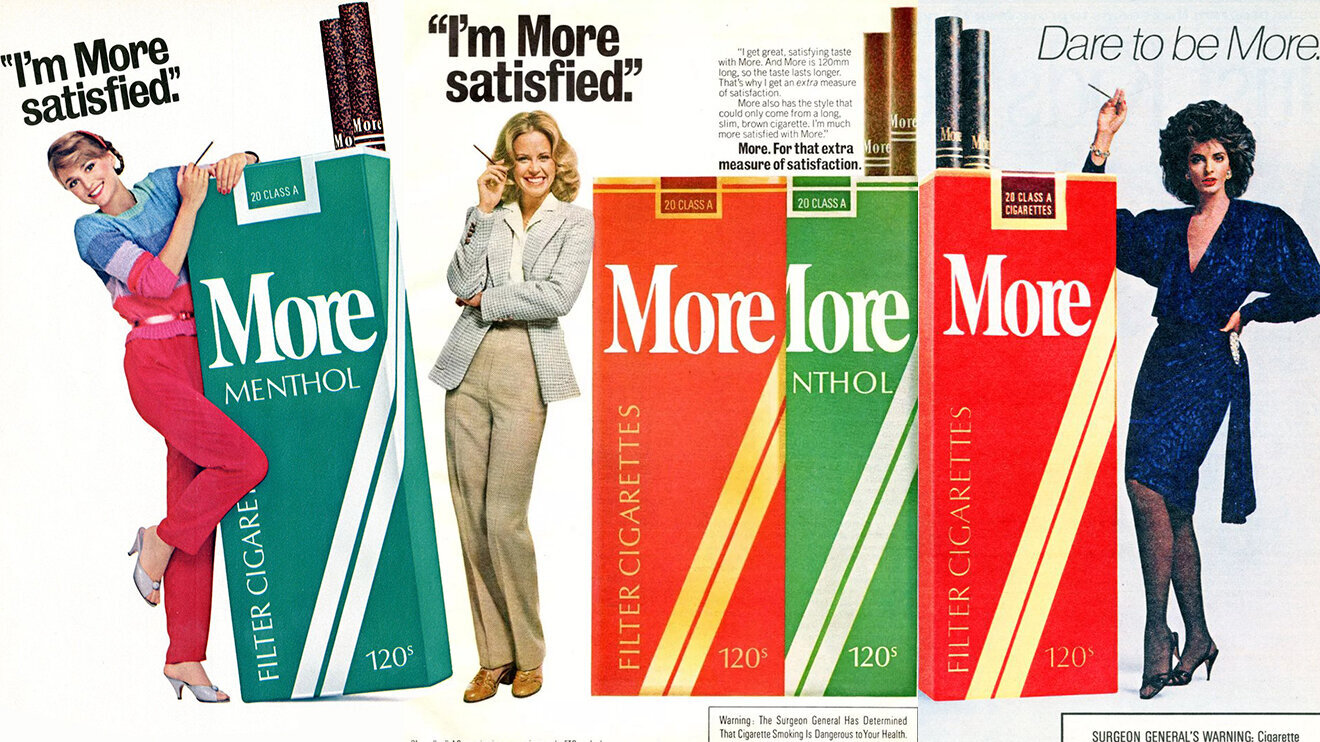
More cigarettes are an American tobacco brand that carved out a distinctive place in the history of the smoking industry, thanks to their unique characteristics and unusual design. First introduced in 1974 by the R.J. Reynolds Tobacco Company, these cigarettes were pioneers in the 120mm long-cigarette segment.
Origin and history
The More brand was launched by R.J. Reynolds Tobacco Company in 1974 as a revolutionary product on the American tobacco market. The main feature of this new offering was a format unusual for its time — the cigarettes measured 120mm in length, significantly exceeding the standard sizes of popular cigarettes at the time.
More was originally positioned as a unisex cigarette for men and women alike, though over time the marketing strategy shifted, with the main focus moving to a female audience. This was helped along by the product's elegant design and its presentation in advertising campaigns.
Unique features
Design and packaging
A distinguishing feature of More cigarettes is their characteristic dark brown wrapper, in place of the traditional white. This design choice created a visual resemblance to cigars, positioning the product as a bridge between cigarettes and cigars. The 120mm length made the smoking experience longer than with ordinary cigarettes.
More's packaging is also distinctive — slim green packs, matching the elongated cigarette format. The filter and cigarette paper are decorated with a distinctive green-and-brown camouflage-like pattern, making them easy to recognize.
Flavor characteristics
More was designed with the goal of producing a cigarette with an intense flavor. At launch, tar content stood at 21 mg, and nicotine at 1.2 mg, exceeding the levels of most filtered cigarettes of the time. This gave it a rich, strong taste, prized by smokers who preferred intense sensations.
More's flavor profile is marked by a distinctive bitterness, notes of dry wood, and light chocolate undertones. Many smokers note a refined aroma with elements of green apple and dark chocolate.
Product variants
Over time, the More lineup expanded to include several variants:
- More Slim 120s (Full Flavor) — the classic full-flavor version, with a rich taste and dark brown wrapper
- More Menthol Slim 120s — a menthol version, combining the brand's characteristic flavor with a refreshing menthol effect
- More Gold Slim 120s (Lights) — a light version with reduced tar and nicotine content
- More Silver Menthol Slim 120s (Lights) — a light menthol version
Besides the main 120mm lineup, shorter versions were also produced in traditional formats, with white wrappers and white or cork-tip filters.
International distribution
After its success on the American market, the More brand expanded internationally. The cigarettes were sold under license in various countries around the world under the trademark "More International." Its markets included the United Kingdom, the Netherlands, Austria, Spain, Italy, the Czech Republic, Romania, Bulgaria, Greece, the Baltic states, Belarus, Ukraine, Russia, Azerbaijan, Israel, Thailand, Malaysia, Hong Kong, and Taiwan.
Production across different regions
Today, the More brand is produced by three main tobacco companies:
- R.J. Reynolds Tobacco Company — for the US domestic market
- Japan Tobacco International (JTI) — for the European Union and other international markets
- Philip Morris Fortune Tobacco Corporation (PMFTC) — for the Philippine market
Marketing and advertising
In the 1980s and 1990s, R.J. Reynolds created a variety of advertising posters to promote the More brand. International versions were also supported by advertising campaigns from Japan Tobacco outside the United States.
In the Philippines, a television commercial promoting the brand was produced in the 1990s, and a radio ad appeared in 2002. In 2003, the "More Classic" version was launched with the slogan "Capture the Taste of Classic," replacing the earlier slogan "A Taste of Magic."
The brand today
Today, More is considered a niche brand in R.J. Reynolds's portfolio. The company continues to manufacture and sell these cigarettes, though active advertising support has been scaled back. Even so, the brand retains a loyal audience that values the product's unique characteristics.
Modern versions of More have adjusted tar and nicotine content in line with changed tobacco industry standards. Current levels are significantly lower than the original: tar content is around 7–12 mg, and nicotine 0.5–0.9 mg, depending on the version.
Cultural influence
More cigarettes became part of the cultural landscape of a particular era, especially in the context of the tobacco industry's development in the 1970s and 1980s. Their unusual appearance and positioning as a premium product helped shape a distinct image for the "More smoker."
Their elongated format and elegant design made these cigarettes popular among certain social groups, which was reflected in the cultural works and literature of the time.
Technical innovations
More was among the first commercially successful 120mm cigarettes, paving the way for the development of this segment of the tobacco market. Using a dark brown wrapper was an innovative choice that set the product apart from its competitors.
The cigarette's construction included a specially designed filter, adapted for the increased length, providing optimal draw and filtration characteristics.
Economic performance
Although exact sales figures aren't always published, More remains a stable niche position in manufacturers' portfolios. The product's high price reflects its positioning in the premium segment, even though sales volumes are significantly smaller than those of mass-market brands.
Pricing policy varies across different regions of the world, depending on local market conditions, taxation, and logistical factors.
Collector's value
Vintage More packaging, especially from the earliest periods of production, is of interest to collectors of tobacco memorabilia. Advertising materials from the 1970s and 1980s are also valued as examples of the design of that era.
The various regional versions of the packaging create additional interest for specialized collections, showcasing the evolution of the brand's design across different countries.
Conclusion
More cigarettes represent a unique example of an innovative approach in the tobacco industry, where a non-standard format and design became the foundation for building a recognizable brand. Despite changes in the industry and a decline in smoking's popularity, More continues to occupy its niche, serving a segment of consumers who value the product's traditional qualities and distinctive character.
The brand's history demonstrates how innovative choices in design and marketing can create a product with a long life cycle, able to adapt to changing market conditions while preserving its distinctive characteristics.