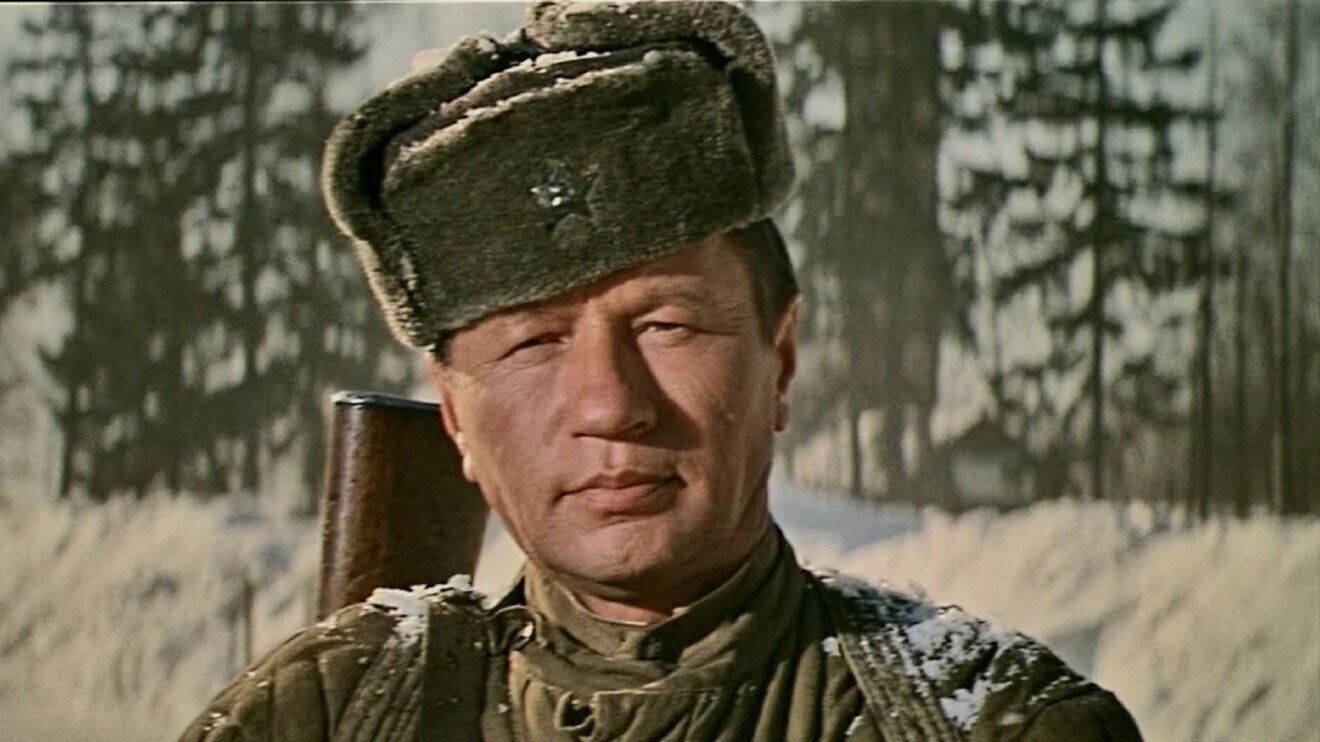
The novel invokes the name of Private Svyatkin — one of the most vivid characters in Soviet war cinema. This character, from Leonid Bykov's final film, became a symbol of soldiers' brotherhood and self-sacrifice for the sake of Victory.
"Aty-Baty, the Soldiers Marched": a master's final work
"Aty-Baty, the Soldiers Marched" is a 1976 Soviet feature film, the last work Leonid Bykov directed and the last role he played on screen. The film placed 7th at the 1977 box office, drawing 35.8 million viewers in the USSR and 378,000 in the Polish People's Republic.
The film is built on two parallel storylines: events of the mid-1970s, and the spring of 1944. Its central setting is the small station of Podbednya, where fierce fighting took place during the Great Patriotic War. By the film's end, its two timelines converge on the battlefield of March 18, 1944, a day whose memory is honored by those who gather exactly 30 years later.
Plot and characters
In the present-day storyline, Lieutenant Colonel Konstantin Svyatkin celebrates his new rank with fellow officers. That same day, he receives a postcard inviting him to visit the Podbednya station, where his father died. Konstantin never knew his father — he was only a year old when his father was killed. His mother soon died as well, and the boy was raised in an orphanage.
On the train, Konstantin meets Anna Villenstovich — the daughter of Junior Lieutenant Igor Suslin, who died in that same battle. It was Anna who wrote the postcard, having decided, together with the local collective-farm chairman, to gather the relatives of the fallen soldiers on the battle's anniversary.
Private Svyatkin: a soldier's portrait
In the wartime storyline, Private Svyatkin appears as a seasoned frontline soldier nicknamed "Svat" ("Matchmaker"). He's a joker and a wit, a former orphanage kid who has just destroyed three German tanks, been wounded, and received the Order of the Red Star in the hospital. After recovering, he is assigned to a tank-destroyer platoon under the command of the young Junior Lieutenant Igor Suslin.
Svyatkin embodies the Russian soldier: seasoned but never losing his sense of humor, experienced but ready to follow a young commander. He teases the "green lieutenant who's never seen a German tank," giving him the mocking nickname "Suslik" ("Gopher"). At first, Suslin even asks the battalion commander to remove Svyatkin from his platoon as an undisciplined soldier.
Yet it is precisely Svyatkin who is chosen as the platoon's song leader during a march past the general. The platoon sings the famous song: "Aty-baty, the soldiers marched, aty-baty, off to war," set to the tune of the Ukrainian folk song "Unharness, Lads, the Horses."
The character's tragic fate
Svyatkin asks his commander for permission to celebrate his son's birthday — that very Konstantin we see as a lieutenant colonel in the 1970s. Svyatkin himself, an orphanage kid, "has no" birthday of his own, and celebrates his son's birth as if it were his own holiday.
This detail reveals the depth of his character: a soldier who doesn't know his own birthday finds joy in the birth of a son he barely knows. Svyatkin is a type of "folk hero" — an ordinary man who became a hero not by choice, but by circumstance.
Leonid Bykov: creator of folk heroes
Leonid Fyodorovich Bykov (1928–1979) was a Ukrainian Soviet actor, film director, and screenwriter, an Honored Artist of the RSFSR and a People's Artist of the Ukrainian SSR. Born into a peasant family in the village of Znamenka, he dreamed of aviation from childhood, twice trying to enroll in flight school, but was turned away for his height and age.
His path into film
In 1951, Bykov graduated from the acting department of the Kharkiv Theater Institute. He played his first film role in 1952, in "Marina's Fate." The comedies "The Tiger Tamer" (1954) and "Maxim Perepelitsa" (1955) brought him wide fame. His role as the soldier Maxim Perepelitsa became his calling card, but also created certain problems — audiences began to see him solely as a comic actor.
In 1969, Bykov moved to Kyiv, where he ran into resistance from the leadership of the Dovzhenko Film Studio. He wanted to make a lyrical comedy, while they demanded "another Maxim Perepelitsa." This conflict led to a prolonged creative crisis.
War as a theme in his work
His breakthrough came with the film "In the Skies of the 'Night Witches'" (Russian title: "V boy idut odni 'stariki'," 1973), which, by official figures, drew 44.3 million viewers and ranked fourth at the box office. The film showed a new side to Bykov's approach to the war theme — not a parade of heroics, but something deeply humane.
"Aty-Baty, the Soldiers Marched" continued in this vein. During filming, in 1976, Bykov suffered a second heart attack, a sign of how emotionally invested he was in the characters he created.
The historical basis of the story
The film is based on real events. The prototype for the battle depicted was the feat of a tank-destroyer platoon commanded by Lieutenant Pyotr Shironin, near Kharkiv in 1943. Near the village of Taranovka, the platoon held off an enemy armored group of 25 German tanks and 15 armored personnel carriers.
From the morning of March 2 to midday on March 6, 1943, Shironin's platoon withstood every attack, destroying 10 tanks, a self-propelled gun, an armored personnel carrier, and more than 100 enemy soldiers. Most of the platoon was killed in the fighting. The fiercest fighting came on March 5, when nineteen soldiers died — men later called the "Ukrainian Panfilovtsy," after the famous Panfilov Guardsmen. On March 18, 1943, 25 members of Shironin's platoon were awarded the title Hero of the Soviet Union.
An artistic reckoning with war
In "Aty-Baty, the Soldiers Marched," Bykov created a distinctive model of the war film. It is not a heroic epic, but an intimate story about people who became heroes not by their own choosing. Private Svyatkin embodies the "folk hero" type — an ordinary man, a soldier by calling rather than by career ambition.
The symbolism of the character
Svyatkin is an archetype of the Russian soldier: seasoned but not cynical; experienced but never losing his capacity for jokes and comradeship. His nickname, "Svat," underscores his role as a unifier, someone who forges family bonds within a military unit.
The character's orphanage past is no accidental detail. It symbolizes a generation raised in hardship, yet never losing its humanity. Svyatkin doesn't know his own birthday, but celebrates his son's birth — and in that lies the whole of the character.
The tragedy of the film's creator
On April 11, 1979, Leonid Bykov died in a car accident on the Kyiv–Minsk highway. He was only 50 years old. According to one account, shortly before his death he wrote a strange letter serving as his will, beginning with the words: "Don't believe it if they tell you this was suicide."
In this testament, styled as a director's script for his own funeral, Bykov requested: "Let the guys sing 'Cranes,' 'Seryozhka from Malaya Bronnaya,' 'Grab Your Overcoat,' 'This Victory Day,' and then let the 2nd Squadron 'go all out' on 'Smuglyanka,' start to finish."
Legacy and memory
The image of Private Svyatkin became one of the most vivid in Soviet war cinema — a hero combining folk wisdom, a soldier's cunning, and a readiness for self-sacrifice. Bykov created a type of hero close and understandable to every viewer.
"Aty-Baty, the Soldiers Marched" remains, in film history, the final work of an outstanding master, one who managed to show war not as a parade of victories, but as the tragedy of ordinary people, made heroes against their will.
Cultural influence
The song "Aty-Baty, the Soldiers Marched" became a folk song in its own right. The image of Svyatkin joined the gallery of classic characters in Soviet cinema, alongside Vasily Tyorkin and other folk heroes of war-themed literature.
In viewers' memory, Private Svyatkin remains a symbol of that generation which, as the poet put it, "endured until dawn," though many never lived to see Victory. He is a hero who fights not for medals and rank, but for his children's right to live in a world at peace.
Conclusion
Private Svyatkin, from the film "Aty-Baty, the Soldiers Marched," embodies the finest qualities of the Russian soldier: courage without posturing, heroism without fanfare, a love of life unbroken by war. Leonid Bykov created an image that remains in the popular memory as a symbol of the generation of victors.
The film became the director's testament — a final word about the war, spoken with pain and love for his people. In the image of Svyatkin, Bykov showed the war through the eyes of an ordinary soldier, for whom heroism was not the exception, but the norm of life.