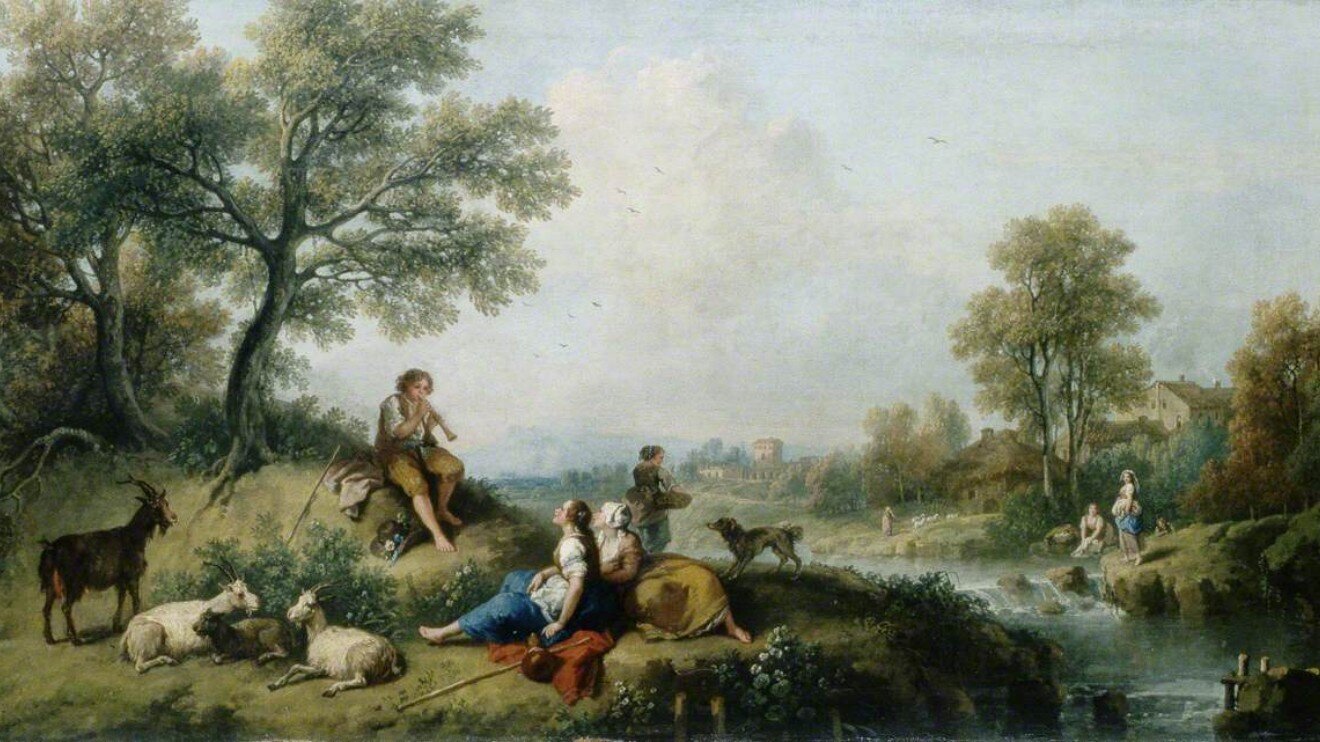
The eclogue is a short form of bucolic poetry, typically depicting idyllic scenes of shepherd life. In its classical sense, an eclogue is a dialogue between shepherds set against an idealized natural backdrop, often touching on romantic themes or philosophical reflection.
Origins
The eclogue as a genre began in ancient Greece, but reached its peak in Roman literature thanks to Virgil, whose collection "Eclogues" (42-39 BCE) became the genre’s canonical example. Virgil adapted the Greek tradition of Theocritus, giving the eclogue a more refined form and weaving in topical political allegory.
Periods of Popularity
- Antiquity (3rd-1st centuries BCE) — the genre takes shape with Theocritus and Virgil
- The Renaissance (14th-16th centuries) — a revival of interest in pastoral poetry (Petrarch, Boccaccio, Sannazaro)
- The Baroque and Classicism (17th-18th centuries) — the genre develops further in the work of European poets (Ronsard, Goethe)
- Sentimentalism (late 18th century) — the last surge of popularity for pastoral themes
The Russian Eclogue
The eclogue arrived in Russian literature in the 18th century as part of a Europeanized poetic tradition. Notable examples include the work of A. P. Sumarokov and V. K. Trediakovsky, and later N. P. Nikolev. In the 19th century, the genre gradually lost popularity, giving way to more realist forms of poetry, though traces of the eclogue can be found in Pushkin and other poets.
In the novel, the word "eclogue" is used in the sense of "some incomprehensible thing."