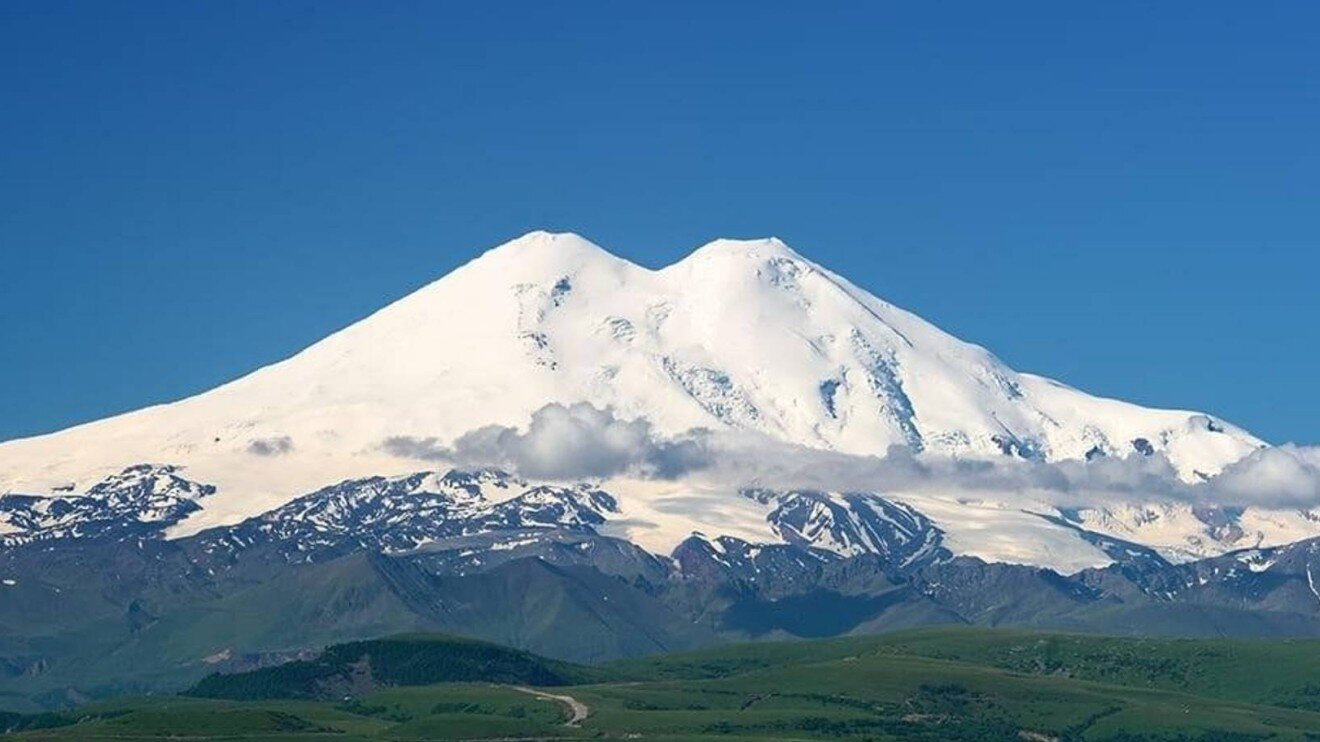
The highest peak of Russia and Europe, a symbol of grandeur and inaccessibility
General information
Elbrus is a stratovolcano in the Caucasus, 5,642 meters above sea level, the highest peak in both Russia and Europe. What makes Elbrus unique is its twin-peaked structure – the mountain has two distinct summits: the West Peak (5,642 m) and the East Peak (5,621 m), separated by a long, gently sloping saddle at 5,416 meters.
The distance between the two peaks is 1,500 meters, which makes Elbrus an easily recognizable silhouette against the Caucasus ridgeline. The base of the massif spans 15 kilometers in diameter, with an average slope gradient of 35°.
Key facts
- Height: 5,642 m
- Type: Stratovolcano
- Base diameter: 15 km
- Distance between peaks: 1,500 m
- Number of glaciers: 23
- Total glacier area: 134 km²
Where’s the best place to see both peaks?
Elbrus’s twin-peaked silhouette is most striking when viewed from the north and northeast. Both peaks are especially clearly visible from the areas around Pyatigorsk, Kislovodsk, and other towns of the Caucasus Mineral Waters region, as well as from the northern slopes of the Caucasus ridge. From these vantage points, both the West and East peaks are clearly distinguishable, divided by the characteristic saddle.
Geographic location
Elbrus sits on the Lateral Range of the Greater Caucasus, 10 kilometers north of the Main Caucasus Ridge, on the border between the republics of Kabardino-Balkaria and Karachay-Cherkessia. The mountain is a volcanic massif with a base elevation of 3,200 to 3,800 meters.
Elbrus’s height was first measured in 1813 by academician V. K. Vishnevsky, who put it at 5,421 meters. Modern precise measurements give the West Peak a height of 5,642 meters, making it the highest point in Europe, provided the border between Europe and Asia is drawn along the Main Caucasus Ridge.
A mountain of many names
Elbrus has been known to many peoples far beyond the Caucasus since ancient times, so the exact etymology of its name is uncertain. One of the more likely theories traces it to an Iranian-language origin, from the word «Elburz» – «high mountain.»
Names among Caucasus peoples
- Circassians: Elbrus Wax’e Gamakwe («holy, wondrous mountain»)
- Karachays and Balkars: Mingi-Tau («eternal mountain»)
- Kabardians: Oshkhamakho («mountain of happiness»)
- Adyghe: Qəsxhəmaf («the mountain that brings happiness»)
- Abkhaz: Orphi-tub («mountain of the blessed»)
Other historical names
- Turkic peoples: Jin-Padishah («lord of spirits»)
- Georgians: Ialbuzi («mane of snow»)
- Digors: Uarp
- Ingush: Älboarz
- Historical: Shat-Gora («snow mountain»)
Glaciers and rivers
Twenty-three glaciers flow down Elbrus’s slopes, covering a total area of 134 km². The largest are Bolshoy and Maly Azau, Terskol, Kyukyurtlyu, and Irik. The longest of Elbrus’s glaciers reach 6 to 9 kilometers.
Meltwater flowing from the glaciers feeds three of the largest rivers in the North Caucasus: the Kuban, the Malka, and the Baksan. Over the past 100 years, the total glacier area has shrunk by 18%, and the glaciers draining into the Kuban valley specifically by 33%.
Volcanic past and present
Elbrus is a potentially active volcano. The modern twin-cone stratovolcano began forming roughly 250,000 years ago. Its volcanic activity has unfolded across three discrete phases, separated by dormant periods lasting tens of thousands of years.
Most recent activity
According to radiocarbon dating, Elbrus’s last major eruption occurred around 50 CE, give or take 50 years. A less intense eruption was recorded roughly 900 years ago.
Beneath the volcano, at a depth of 7 to 13 km, lies a magma chamber holding unsolidified melt. Fumarole fields are found on the southern slope of the East Peak, and the thermal springs of Dzhily-Su are known in the Malka river valley.
A history of ascents
The first ascent (1829)
The first successful ascent of Elbrus was made during a scientific expedition led by General Georgy Arsenyevich Emanuel. On July 22, 1829, the expedition’s guide, K. Khashirov, reached the East Peak, bringing back a piece of basalt from the summit.
The expedition included several distinguished nineteenth-century scientists: professor Adolph Kupffer, physicist Emil Lenz, zoologist Édouard Ménétries, botanist Carl Meyer, architect and artist Joseph Bernardazzi, and Hungarian traveler János Besse.
Key moments in the history of ascents
- 1868: A second ascent of the East Peak by a group of English climbers led by Douglas Freshfield
- 1874: The first ascent of the West (higher) Peak, by a group led by Florence Grove
- 1890–1896: Ascents by Russian topographer and mountaineer A. V. Pastukhov
- 1910: The first «Elbrus Cross» – an ascent of both peaks in a single climb
- 1925: The first woman on Elbrus – A. Japaridze
- 1934: The first winter ascent
Wartime history
During the Great Patriotic War, on August 21, 1942, a group of German mountain troops from the «Edelweiss» division, under Captain Groth, planted their unit’s flag on both peaks. The German banners were removed by Soviet soldiers on February 13 and 17, 1943.
Mass mountaineering
From the first quarter of the twentieth century, ascents of Elbrus became a mass phenomenon thanks to growing infrastructure and improved transport access. The numbers are striking:
32
groups climbed in 1928
2,016
people reached the summit in 1935
1,395
participants in the 1960 mass climb
Speed records
Since 1989, annual speed-climbing championships have been held on Elbrus. Some of the most impressive achievements:
| Year | Athlete | Time | Route |
|---|---|---|---|
| 1990 | Anatoli Boukreev | 1 hour 47 minutes | From Priyut 11 to the East Peak |
| 2017 | Karl Egloff (Ecuador) | 3 hours 24 minutes 14 seconds | From the Azau meadow to the West Peak |
| 2016 | Oksana Stefanishina (women’s record) | 4 hours 09 minutes 39 seconds | From the Azau meadow to the West Peak |
Infrastructure and routes
High-altitude shelters
The first shelter for climbers appeared in 1909 at an altitude of 3,200 meters – a stone dugout for five people. In 1932 the famous «Refuge of Eleven» was built at 4,200 meters.
The modern infrastructure includes:
- «Bochki» shelter (3,720 m) – the main base for ascents
- «Sedlovina» shelter (5,416 m) – the highest-altitude shelter in the Caucasus
- Pastukhov Rocks (4,800 m) – named after the explorer A. V. Pastukhov
- Cable cars up to the «Gara-Bashi» station
Main ascent routes
Hazards and statistics
Accident statistics
Despite its seemingly gentle profile, Elbrus claims the lives of 15 to 20 people every year, accounting for roughly 80% of all accidents in the Elbrus region. Among the dead are both amateur tourists and experienced mountaineers.
Main hazards
- Crevasses – fissures hidden beneath the snow
- Sudden weather changes – visibility can drop to zero within hours
- Hypothermia – dangerous cooling of the body
- Altitude sickness – inadequate acclimatization
- Dehydration – fluid loss at altitude
- Disorientation – caused by poor visibility
Major tragedies
- May 9, 2006: 11 of 12 tourists in a group froze to death on Elbrus’s saddle
- September 23, 2021: A group of 23 people was caught in severe weather at 5,400 m; 5 died
Cultural and symbolic significance
Elbrus is included on the «Seven Summits» list of the highest peaks on each continent, and it’s among the ten peaks in Russia required for the «Snow Leopard of Russia» mountaineering title. The mountain has become a symbol of nature’s grandeur and of humanity’s drive to overcome the impossible.
Elbrus’s twin-peaked silhouette is recognized around the world and has become an inseparable part of the image of the Russian Caucasus. Its likeness graces coats of arms, stamps, coins, and works of art.
Interesting facts
- Elbrus is 832 meters taller than Mont Blanc
- The volcano’s relative height is 2,000 to 2,500 meters
- In clear weather, Elbrus is visible from more than 200 kilometers away
- Winter temperatures at the summit can drop to -40°C
- The first image of Elbrus was made in 1829 by the artist I. Bernardazzi
Environmental challenges
In 1991 the first environmental ascent, «Elbrus-1991,» was held to clear the mountain of trash. Around 100 climbers brought down roughly 20 tons of garbage that had accumulated over years of ascents, from an altitude of 4,200 meters.
Today Elbrus’s environmental condition remains an ongoing concern, given the growing flow of tourists and climbers. The retreat of the glaciers also poses a serious environmental threat to the region.
Elbrus is more than just the highest point in Russia and Europe – it is a symbol of nature’s grandeur, of humanity’s drive to conquer summits, and a reminder that even the most inaccessible goals can be reached with proper preparation and respect for the elements.