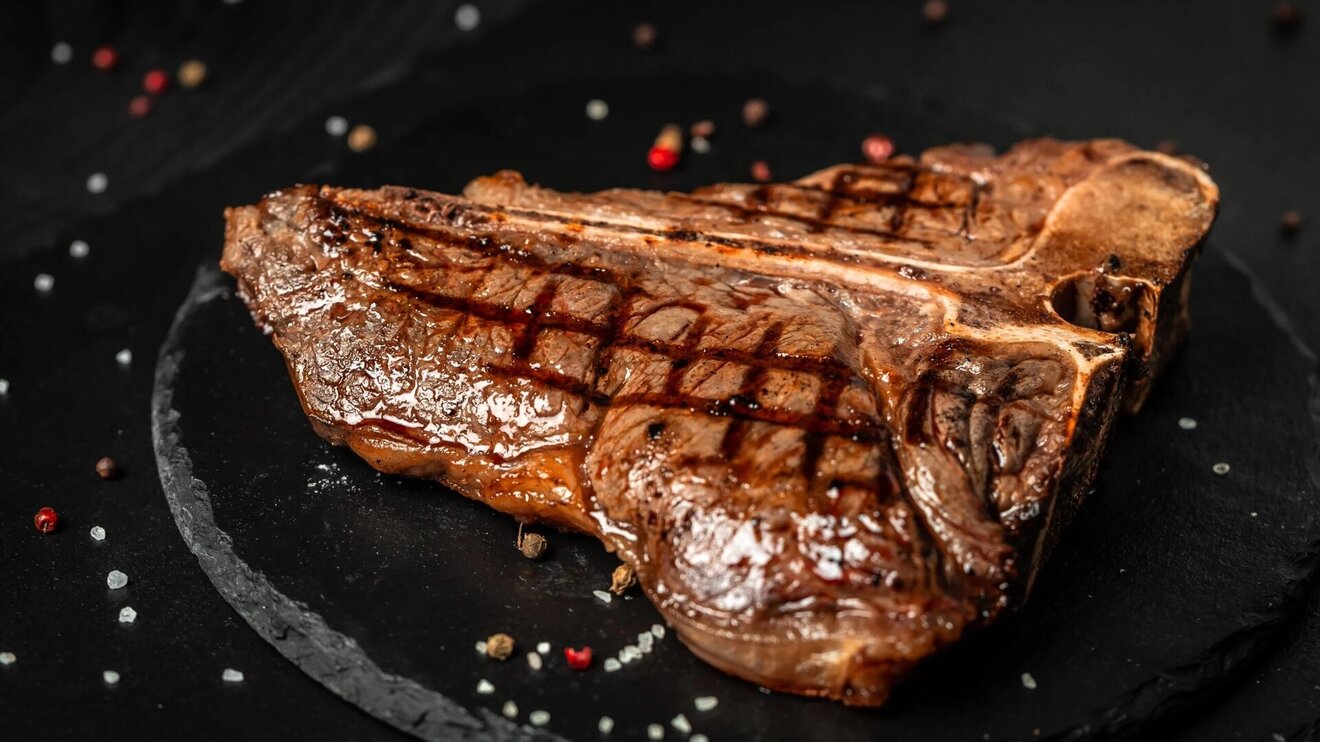
The porterhouse steak is one of the most prestigious and expensive steaks in world cuisine – a bone-in cut of beef taken from the short loin section of the carcass. This steak combines the two most prized cuts of meat – the tenderloin and the strip steak – separated by a distinctive T-shaped bone.
The anatomy of a porterhouse
A porterhouse is produced by sawing the lumbar vertebra in half through the spinal column. The distinctive T-shaped bone is literally half of a vertebra, where the lower stem of the «T» is the vertebra’s transverse process, and the meat around it is the back muscles. The small half-circle at the top of the «T» is half of the vertebral opening.
Difference from the T-bone
The main difference between a porterhouse and a T-bone is the size of the tenderloin section. Under USDA standards, the tenderloin in a porterhouse must measure at least 32 mm at its widest point, while in a T-bone it must be at least 13 mm. The porterhouse is cut from the rear portion of the short loin, so it contains more of the tender fillet.
Regional differences in terminology
In English-speaking Commonwealth countries (the UK, Australia, New Zealand), the term «porterhouse» carries a somewhat different meaning than it does in the US:
- In the UK: porterhouse often refers to a bone-in sirloin steak (the equivalent of the American strip loin) without the tenderloin portion
- In Australia and New Zealand: porterhouse means a boneless sirloin
- In the US: porterhouse means a steak with both parts (tenderloin and strip) on the T-shaped bone
The historical origin of the name
The first print mention of the term «porterhouse steak» dates to 1843, in a letter from Thurlow Weed published in the Hartford Courant on August 9. A year later, on August 24, 1844, the term appeared on a list of food prices in The New York Herald, after which it began appearing regularly in American newspapers.
Etymology of the name
There are several theories about the origin of the name «porterhouse.» The most widespread links it to porterhouses – establishments that served porter (a dark beer) alongside hearty food. These establishments were popular with laborers and sailors in the port districts of nineteenth-century American cities.
Culinary characteristics
The porterhouse is considered one of the finest steaks thanks to its combination of two cuts with contrasting textures. The tenderloin is exceptionally tender, nearly free of sinew and fat, and practically «melts in the mouth.» The strip is denser, with pronounced marbling, delivering a rich, meaty flavor.
The tenderloin
- The most tender part of the carcass
- Minimal connective tissue
- A delicate, mild flavor
- Cooks quickly
- Sold on its own as filet mignon
The strip steak
- A denser texture
- Pronounced marbling
- A rich, beefy flavor
- Needs slightly more time to cook
- Holds its shape well when grilled
Cooking methods
The porterhouse is ideally suited to quick, high-heat cooking methods – grilling, pan-searing, or roasting in a hot oven. Thanks to its minimal collagen content compared with other cuts, no lengthy cooking is required.
A cooking quirk
The main challenge in cooking a porterhouse is the differing cook rates of the tenderloin and the strip. The tenderloin cooks faster and can dry out before the strip has reached the right doneness. Experienced cooks position the steak on the grill so the tenderloin sits in the cooler zone.
A classic example: Bistecca alla Fiorentina
The Florentine steak is the classic Italian way of preparing a porterhouse, and has become a calling card of Tuscan cuisine. Bistecca alla fiorentina is traditionally made with beef from Chianina or Maremmana cattle.
Characteristics of Bistecca alla Fiorentina
- Thickness: 4–5 cm, sometimes up to 7 cm
- Weight: 800–1,200 grams
- Cooking method: over coals or wood
- Seasoning: salt, black pepper, and olive oil only
- Doneness: strictly rare
- Serving: for two or three, with white beans
The role of the bone in cooking
The T-shaped bone doesn’t just give the steak its distinctive look – it also affects the cooking process. There are two main theories about the bone’s role:
The heat-conductor theory
The bone acts as a heat conductor, helping the meat cook more evenly and preventing it from drying out and shrinking during cooking.
The insulator theory
The bone actually hinders even heating, so the meat near it cooks more slowly, which calls for extra attention while grilling.
Economic value
The porterhouse ranks among the premium steaks for several reasons:
International cuisine
The porterhouse has spread far beyond the US and become a symbol of fine dining in many countries:
| Country/Region | Name | Notes |
|---|---|---|
| Italy | Bistecca alla Fiorentina | Traditionally cooked over coals, served rare |
| France | Côte de bœuf à l’os | Classic French preparation, served with sauces |
| Argentina | Bife de chorizo con hueso | Cooked over an open fire (asado) |
| Brazil | Contrafilé com osso | Part of traditional churrasco |
Choosing and storing
A few key points to look for when choosing a porterhouse:
Signs of quality
- Bright red color of the meat
- Even marbling
- No dark spots
- Firm texture
- Minimal liquid in the packaging
Storage guidelines
- Temperature: 0–2°C
- Shelf life: 3–5 days
- Packaging: butcher paper or specialty film
- Freezing: down to -18°C, for up to 6 months
- Thawing: gradually, in the refrigerator
Marbling grades
The quality of a porterhouse is largely determined by its degree of marbling – the distribution of fat veins through the muscle tissue. The American USDA grading system identifies several main categories:
Prime is the top grade, with abundant marbling; Choice is the mid-tier grade, with moderate marbling; Select is the base grade, with minimal marbling.
Current trends
In contemporary gastronomy, the porterhouse keeps evolving. New techniques are emerging, such as reverse searing, sous vide, and the use of special marinades and dry aging.
An interesting fact
In 2025 the Oregon State Senate unanimously voted to make the T-bone the state’s official steak. The bill is still under consideration, but it shows how much cultural weight this cut of steak carries in American cuisine.
Conclusion
The porterhouse is rightly considered the king of steaks, combining the best qualities of beef – the tenderness of the fillet and the rich flavor of the strip. This steak demands skill to prepare, but rewards the right approach with an unforgettable dining experience. Whether it’s a classic bistecca alla fiorentina in Florence or a modern take at a London steakhouse, the porterhouse remains a symbol of fine cuisine and a true delicacy for serious meat lovers.