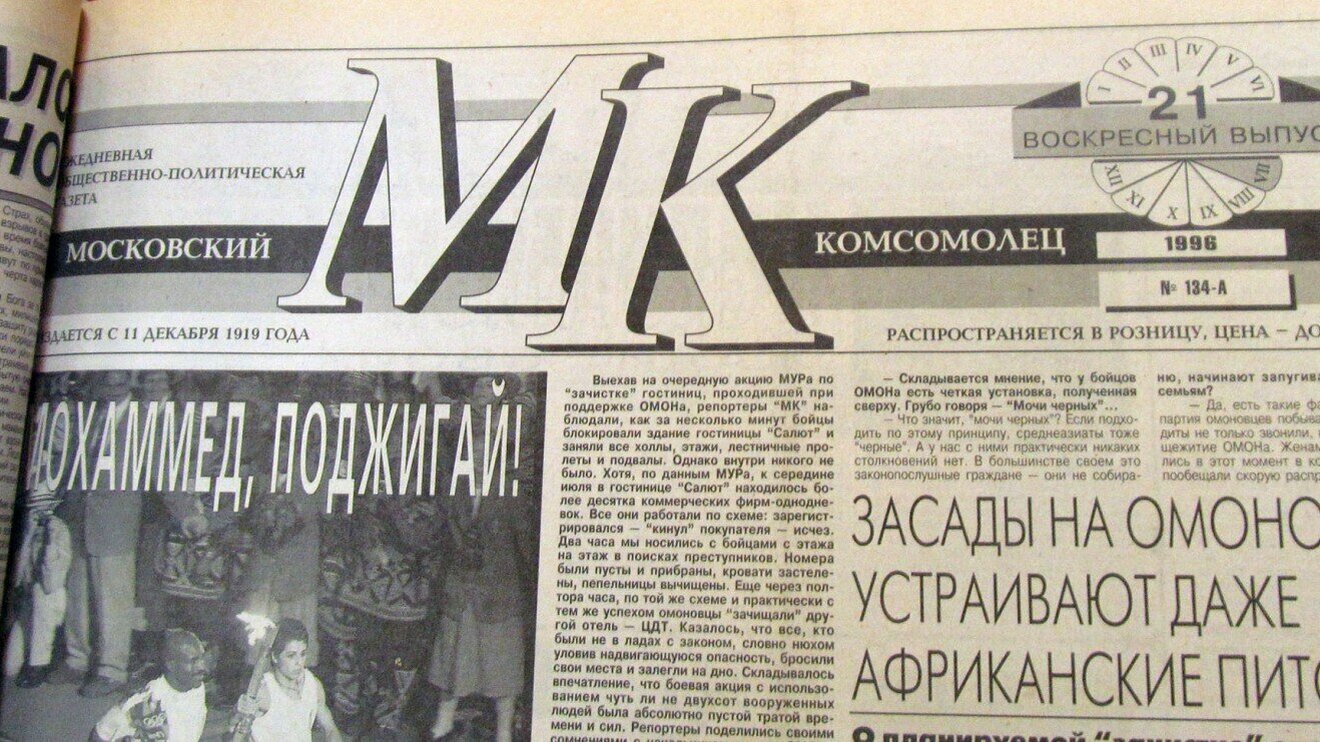
The newspaper "Moskovsky Komsomolets" (MK) was founded in 1919 and was originally called "Yuny Kommunar" ("Young Communard"). It received its modern name in 1929.
- Frequency: daily, except Sunday.
- Subject matter: a broad range of topics, including politics, economics, society, culture, sport, and entertainment.
- Circulation: one of the highest among Russian newspapers, though exact figures vary.
- Famous sections: "Zvukovaya Dorozhka" ("Sound Track"), "Srochno v Nomer" ("Stop the Presses"), "Svobodnaya Tema" ("Open Topic"), and others.
- Reputation: known for its high-profile investigations and, at times, provocative material.
- Editor-in-chief: Pavel Gusev, who has held the position since 1983. The perestroika period and the years leading up to 1993 were highly significant for MK. Here is a detailed overview of that period:
- The start of perestroika (1985–1986):
- Like many other publications, MK began printing bolder material.
- The paper started covering previously forbidden topics, including the problems of Soviet society.
- The flowering of glasnost (1987–1989):
- MK actively joined the process of press democratization.
- Sharp articles on political and social topics began to appear.
- The paper began publishing material on Stalinist repression and corruption in Party circles.
- The late 1980s:
- MK’s circulation grew significantly thanks to the popularity of its hard-hitting material.
- The paper became one of the most-read publications in Moscow and beyond.
- 1990–1991:
- MK took a clear position supporting democratic reform.
- During the August 1991 GKChP coup, the paper unambiguously sided with Yeltsin.
- After the coup’s failure, MK’s popularity grew even further.
- 1992–1993:
- After the collapse of the USSR, MK continued its critical line, now aimed at the new Russian authorities.
- The paper covered the difficult economic reforms and the rise in crime and corruption.
- MK became one of the first publications to adopt elements of tabloid journalism, which drew in additional readers.
- The October 1993 events:
- MK covered the conflict between President Yeltsin and the Supreme Soviet in detail.
- The paper supported Yeltsin’s move to dissolve parliament.
The Perestroika Period (1985–1991)
-
A shift in editorial policy: In 1985, with the start of perestroika and glasnost under Mikhail Gorbachev, Moskovsky Komsomolets became one of the first papers to begin stepping outside the strict bounds of Soviet censorship. The publication started printing material discussing acute social problems, government mismanagement, corruption, youth issues, and more. During this period MK became less official and more engaged with pressing issues.
-
A shift toward more independent journalism: Under the policy of glasnost the paper became more independent and varied in content. MK published critical articles about bureaucracy, corruption in the upper echelons of power, and economic and social problems. This won the paper an audience tired of the official tone of Soviet media.
-
Popularizing everyday life and youth culture: During perestroika the paper began paying more attention to everyday life, cultural phenomena, sport, and even crime reporting. This is precisely what made MK one of the most-read papers, as people sought alternative points of view and livelier, more truthful accounts of current events.
-
Growth in popularity and circulation: During this period Moskovsky Komsomolets’s popularity grew significantly. Circulation rose to the hundreds of thousands, and it became one of the most influential and talked-about publications. For many, MK came to embody change and a new, people-oriented approach to journalism.
The Period up to 1993 (1991–1993)
-
After the collapse of the USSR: With the Soviet Union’s collapse in December 1991, Moskovsky Komsomolets finally stopped being an official Komsomol publication and became a fully independent newspaper. This allowed MK to maintain its popularity and adapt to the new conditions of a market economy.
-
Commercialization and tabloidization: In the early 1990s the paper changed its format and content, placing more emphasis on sensational and entertaining subjects. MK increased its coverage of show business, high society, and crime, giving the publication a tabloid character. These changes brought in a mass audience but also drew criticism for reducing the share of analysis and serious material.
-
Political material and public scandals: During this period MK actively covered political events, especially in the context of Boris Yeltsin’s reforms, social problems, and privatization scandals. The paper often took an oppositional stance toward the authorities, criticizing the reforms, the consequences of the market transformation, and corruption.
-
Strengthening its position in the media landscape: Amid the new political and economic reality, Moskovsky Komsomolets remained an important source of information and debate, reflecting the changes in society and standing as one of the most influential newspapers in post-Soviet Russia. During this period MK also became a platform for new media experiments, including thematic supplements and new sections.
Thus, the perestroika period and the years up to 1993 became a time of significant transformation for Moskovsky Komsomolets — from an official youth publication to one of the most-read and most-discussed media outlets in Russia, reflecting the spirit of change and the ambitions of a new era.