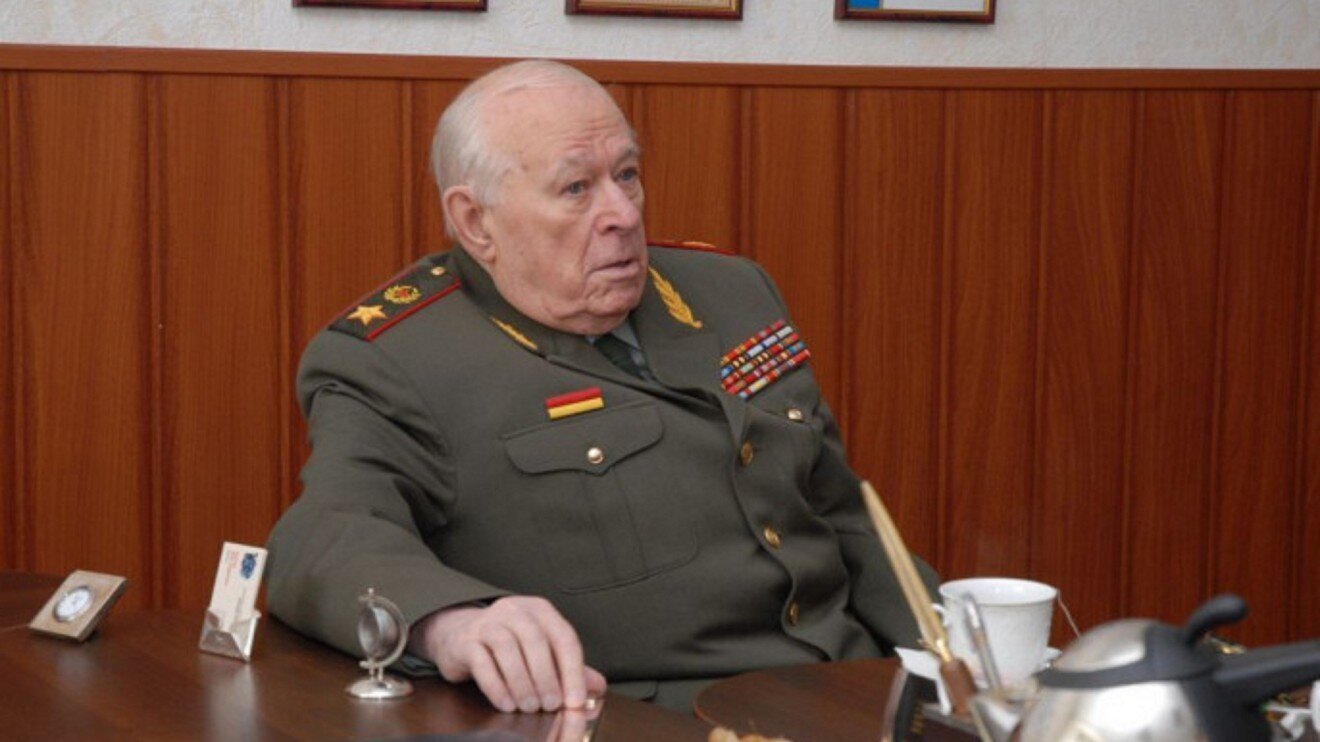
A note on the novel: The mention of General Bobkov, in the context of the protagonist’s refusal to accept an official title, reflects the complicated attitude many former security-services officers held toward a figure who embodied both the Soviet system of ideological control and post-Soviet compromises with oligarchic capitalism.
Key Facts
- Lived: 1925–2019
- Rank: Army General
- KGB Service: 1946–1991
- Head of the Fifth Directorate: 1969–1983
Filipp Denisovich Bobkov is one of the most contradictory figures in the history of the Soviet and post-Soviet security services. A frontline veteran who rose from junior case officer to First Deputy Chairman of the KGB of the USSR, he’s remembered in equal measure as the organizer of the campaign against the dissident movement and as the man who, after the USSR’s collapse, went to work for the oligarch Vladimir Gusinsky.
Military Service and Early Career in the Agencies
Bobkov was born on December 1, 1925, in the village of Chervona Kamenka, in the Kremenchuk district of the Ukrainian SSR. His path to the top of Soviet state security began on the front lines of the Great Patriotic War. At 16, having lied about his age, he volunteered for the Red Army, fought on the Western Front, and was wounded twice. His father was killed in 1944, and the young war veteran finished the war holding the rank of Guards Sergeant Major.
After the war, Bobkov was sent to the Leningrad school of SMERSH military counterintelligence, which set the course for the rest of his life. On October 23, 1946, he walked into the Lubyanka for the first time as an assistant case officer of the USSR Ministry of State Security — the start of a 45-year career in the security services.
The KGB’s Fifth Directorate: A Machine of Ideological Control
The most significant chapter of Bobkov’s career was tied to the founding and leadership of the KGB’s Fifth Directorate. In 1968, after Yuri Andropov came to power, a discredited secret-political department was replaced with a new unit — the Fifth Directorate, informally known as the «ideological» directorate.
Bobkov became deputy head of this directorate and led it outright from May 1969 to January 1983. Under his leadership, the Fifth Directorate became the USSR’s primary instrument for combating dissent.
The Campaign Against Dissidents: Methods and Scale
Under Bobkov, the Fifth Directorate’s main task was fighting so-called «ideological subversion» and «anti-Soviet elements.» In practice, this meant:
- Building informant networks among the creative intelligentsia, in academic circles, and among journalists and cultural figures
- Controlling creative unions — writers’, artists’, and theater organizations
- Combating samizdat — detecting, confiscating, and destroying illegal literature
- Preventing defection — monitoring citizens traveling abroad
- Managing interethnic conflicts and preventing mass unrest
Notable operations under Bobkov’s leadership
- Involvement in the persecution and internal exile of Andrei Sakharov to Gorky (1980)
- Operations against Joseph Brodsky and Alexander Solzhenitsyn
- Monitoring the emigration of Mstislav Rostropovich and Galina Vishnevskaya
- Investigating Armenian nationalist terrorist attacks (1977–1978)
- Overseeing chess matches, including the Spassky–Fischer standoff (1972)
A Distinctive Style
Bobkov stood out among his KGB colleagues for more «cultured» working methods. He was the only member of the KGB’s top leadership who regularly spoke publicly — at universities, creative unions, research institutes. His audiences included Moscow State University, the Bauman Moscow State Technical University, the Tchaikovsky Conservatory, and the Bolshoi Theater.
Critics noted that Bobkov leaned toward «conspiratorial thinking» and systematically exaggerated the scale of the dissident movement. Analysts believe that, for departmental self-interest, he «made a mountain out of a molehill,» planting in the leadership’s mind the myth of a mass, if controlled, dissent movement in the USSR — when in truth only a handful of the creative intelligentsia were genuine ideological opponents of the regime.
Career Advancement and Influence
• 1983 — Deputy Chairman of the KGB of the USSR
• 1985 — First Deputy Chairman of the KGB of the USSR
• 1987 — promoted to Army General
• 1986–1990 — member of the CPSU Central Committee, deputy of the RSFSR Supreme Soviet
The Twilight of His Soviet Career
Perestroika proved a serious test for Bobkov. The events of the late 1980s — interethnic conflicts in the Caucasus and Central Asia, mass unrest — exposed the limits of ideological counterintelligence in the face of real challenges. Bobkov took part in managing conflicts in Georgia, Azerbaijan, and Uzbekistan, but his agency proved powerless to stop the USSR’s collapse.
On January 29, 1991, following a 40-minute meeting with Soviet President Mikhail Gorbachev, Bobkov was relieved of his post and transferred to the Defense Ministry’s Group of General Inspectors. In January 1992, after the USSR’s dissolution, he was finally retired, closing out 45 years of service in state security.
A Turn to Oligarchic Capitalism
Bobkov’s post-Soviet career became a source of sharp controversy and criticism. In 1992, the retired KGB general accepted an offer from Vladimir Gusinsky and took charge of the Analytical Directorate of the Most Group — one of the largest financial-industrial groups in the new Russia.
Criticism of the Move to the Oligarchs
Bobkov’s decision to go to work for an oligarch drew a wave of criticism:
- Ethical questions: a retired KGB general and holder of state secrets was now serving the interests of private capital
- Use of connections: Bobkov brought several of his former KGB subordinates into Most
- Reputational damage: cooperating with a «Western-leaning oligarch» seemed to contradict his previous ideological convictions
Critics accused Bobkov of holding operational files on major bankers (Gusinsky, Smolensky, Potanin) but, for unclear reasons, helping to wind down investigations against them.
Bobkov himself explained his move to Most by saying that under the new regime he’d found himself «completely without a role,» and pointed to Gusinsky’s role in creating NTV, Russia’s first independent television network. He continued working in Media-Most’s analytical service until the second half of 2001, even after Most’s conflict with Russian authorities and Gusinsky’s flight from the country.
Admissions and Self-Criticism
Unlike many of his colleagues, Bobkov openly acknowledged responsibility in his memoirs for a number of actions later condemned by society. Above all, he expressed regret over his role in the persecution and internal exile of Academician Andrei Sakharov to Gorky in 1980.
In his later interviews, Bobkov was critical of the Politburo’s work, the inefficiency of the Soviet decision-making system, and Mikhail Gorbachev himself, whom he called an «empty figure» in 2013.
Bobkov as a Symbol
For many in the security services and military circles, Bobkov’s figure came to represent a particular kind of career path — from devoted service to the state system, to compromise with the new elites. His shift from fighting «ideological subversion» to working for an oligarch symbolized the broader transformations of post-Soviet Russia.
That’s precisely why the phrase «I’m not Bobkov,» spoken by a former intelligence officer, carries special weight — a rejection of one particular model of adapting to the new reality, an attempt to preserve professional honor and independence.
Later Years and Legacy
After leaving Most in 2001, Bobkov worked as an advisor at the Russian Academy of Sciences’ Institute of Socio-Political Research, then at RIA Novosti. From 2008, he served as a general inspector in the Russian Defense Ministry’s Group of General Inspectors.
Bobkov authored several memoirs, including «The KGB and Power» (1995) and «The Last Twenty Years» (2006), in which he was among the first to discuss many previously closed chapters of Soviet history. He died on June 17, 2019, at the age of 93.
A Contested Legacy
Bobkov remains an intensely divisive figure in Russian society. Some see him as a security-services professional who served his country honestly and, late in life, acknowledged his mistakes. Others see him as the organizer of a campaign of repression against dissidents and a symbol of the moral compromises of the post-Soviet era.
For fictional characters drawn from the 1990s security-services world, one’s attitude toward Bobkov’s legacy becomes a kind of litmus test of professional honor and loyalty to principle.