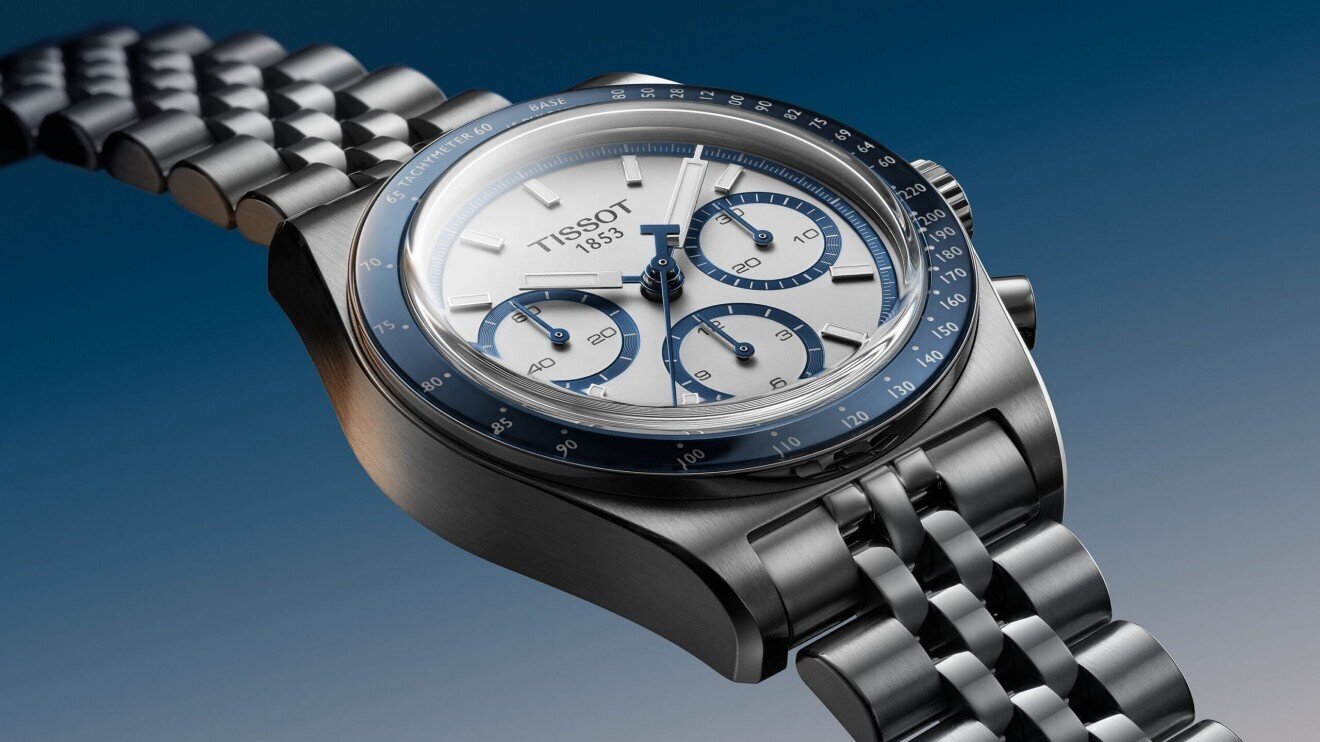
A complete guide to the legendary Swiss watch brand
Brand history
Tissot SA is a Swiss luxury watchmaker founded in 1853 in the town of Le Locle, in the Swiss canton of Neuchâtel, by a father-and-son pair – Charles-Félicien Tissot and Charles-Émile Tissot. The father worked as a case-maker, the son as a watchmaker. Their home grew into a small workshop that laid the foundation for one of the best-known Swiss watch brands.
As early as 1858, Charles-Émile Tissot traveled to Russia, where he successfully sold savonette pocket watches across the Russian Empire. Russia became Tissot’s largest market, and the brand gained popularity even at the tsar’s court. In 1885 Charles Tissot, son of Charles-Émile, moved to Moscow to run the branch his father had founded.
Corporate history
In 1929 the global economic crisis brought the watch industry nearly to a halt. Omega and Tissot merged under the leadership of Paul Tissot-Daguet, who had previously worked at Tissot before becoming Omega’s executive director. The merger created the Société Suisse pour l’Industrie Horlogère (SSIH), and Tissot-Omega watches from that period are highly prized by collectors.
In 1983 SSIH-ASUAG was formed, later becoming SMH (Société Suisse de Microlectronique et d’Horlogerie). In 1998 SMH was renamed the Swatch Group. Tissot SA remains based in Le Locle and sells its products in 160 countries. Within the Swatch Group’s classification, Tissot occupies the «mid-range» segment.
Technical innovation
Tissot has always been known for its technical achievements. The company produced the first mass-market pocket watches, as well as the first pocket watches with two time zones, in 1853. In 1929–30 Tissot introduced the first antimagnetic watches and became one of the first makers of antimagnetic wristwatches in the early 1930s.
Groundbreaking materials
- 1971 – the first plastic watch (Idea 2001)
- 1985 – a stone watch (RockWatch, made of Alpine granite)
- 1987 – a mother-of-pearl watch (Pearl watch)
- 1988 – a wooden watch (Wood watch)
Modern technology
- 1999 – the first touch-screen watch, T-Touch
- 2014 – the T-Touch Expert Solar with 25 functions
- Touch-sensitive sapphire crystals
- Built-in compass, barometer, altimeter, thermometer
Sports partnerships
Tissot has a long history of partnering with the world of sport. Its first official timekeeping assignment came in 1938 at a ski race in Villars-sur-Ollon, not far from its hometown in the Jura mountains. In 1957 Tissot timed the Davis Cup.
Today Tissot is the official timekeeper for the world championships in cycling, motorsport, fencing, and ice hockey. The company has sponsored the Lotus, Renault, and Sauber Formula One teams. Since the 2015–16 season Tissot has been the official timekeeping partner of the NBA and WNBA, supplying game clocks and stopwatches for every arena in the league.
Famous owners
Tissot watches have been worn by many notable figures: the Princess of Wales, Catherine; the famed actress Sarah Bernhardt; the singer Carmen Miranda; Grace Kelly; and Nelson Mandela. In film, Tissot watches appear in «Rear Window» (James Stewart), «Lara Croft: Tomb Raider» (Angelina Jolie), and «Mission: Impossible – Rogue Nation» (Simon Pegg).
Brand philosophy
Tissot’s corporate motto is «Innovators by Tradition,» and the company’s mission is often phrased as «gold-standard quality at a silver-standard price.» That philosophy reflects the brand’s aim to combine Swiss quality with relative affordability compared with top-tier watches.
Tissot in the Russian context
Tissot’s special place in Russian history can hardly be overstated. As early as the nineteenth century, watches under this brand enjoyed enormous popularity in the Russian Empire, and its Moscow office was one of the company’s most important. That historical connection carried through into the twentieth century.
In the 1990s, as Russia went through a period of economic transformation, Swiss Tissot watches were seen as a symbol of Western quality and status. For many Russians of that era, especially from the regions, receiving a Tissot watch as a gift was a mark of special favor and respect.
A status gift
Although Tissot watches didn’t belong to the most expensive segment of Swiss watchmaking, for provincial businesspeople of the 1990s they represented a prestigious gift. Their Swiss origin, brand recognition, and build quality made them a coveted accessory, especially at a time when access to Western goods was limited and quality watches were hard to find in Russian retail.
Model range and features
By the mid-1990s Tissot offered a wide range of models – from classic mechanical watches to modern quartz ones. Popular lines included the sporty PRC (Performance Racing Chronograph) series, the elegant Tradition line, and the innovative Rock Watch made of natural stone, which became a genuine sensation in the watch world.
Mechanical watches
Classic models with Swiss movements, embodying the traditions of watchmaking craft
Quartz watches
Precise and reliable models with modern quartz movements
Chronographs
Sporty models with timing functions for professional use
Manufacturing and quality
All Tissot watches are manufactured in Switzerland to strict Swiss Made standards. The company oversees the entire production process, from movement design to final assembly. Every watch undergoes thorough quality control, including checks on timing accuracy, water resistance, and the reliability of every component.
Watch cases are made from high-grade stainless steel, gold, or titanium. Crystals are made of sapphire – a material second in hardness only to diamond. Straps and bracelets are made from genuine leather, stainless steel, or modern synthetic materials.
Market positioning
Within the hierarchy of Swiss watch brands, Tissot occupies the mid-price segment. The brand sits above mass-market manufacturers but below prestige luxury brands such as Rolex, Patek Philippe, or Vacheron Constantin. That positioning makes Tissot watches accessible to a broad range of buyers while retaining Swiss quality and status.
Brand advantages
- • Swiss quality and precision
- • A rich history and tradition
- • A wide model range
- • Strong value for money
- • International warranty
Target audience
- • Business professionals
- • Sports enthusiasts
- • Lovers of Swiss quality
- • Watch collectors
- • People who value status
Conclusion
Tissot stands as a striking example of a successful Swiss watch brand that has preserved its identity and quality for more than a century and a half. The brand skillfully blends tradition and innovation, offering customers reliable and stylish watches at a reasonable price.
For the Russian consumer of the 1990s, a Tissot watch was more than an accessory – it was a symbol of belonging to a successful community of people who valued quality and status. Though not the most expensive gift in the world of watches, its prestige and recognizability made it a coveted present, especially in business circles.
«Innovators by Tradition» – a motto that precisely captures the essence of the Tissot brand