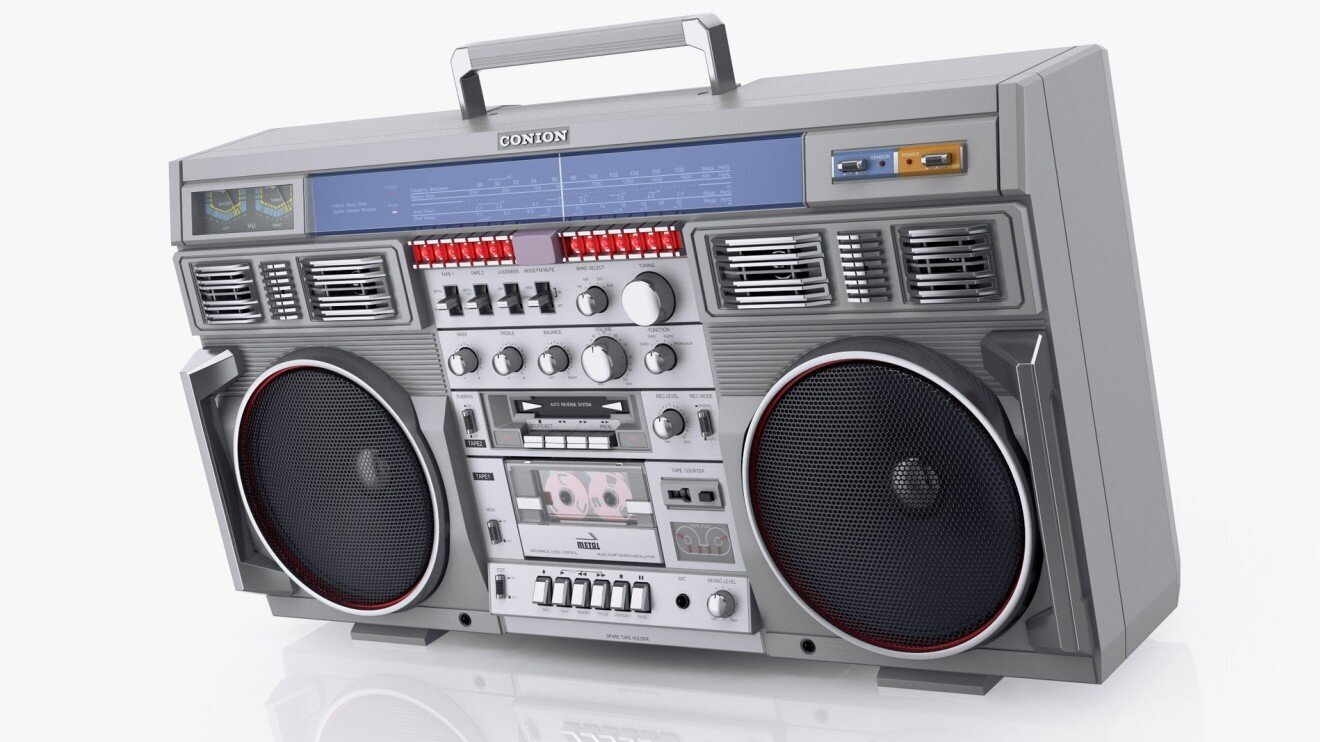
A high-power portable boombox with two or more speakers, a cassette player, and an AM/FM radio receiver, built for playing music at high volume in public places.
Origins of the Term
The term «ghetto blaster» emerged in the U.S. in the late 1970s as slang for large portable boomboxes. The word «ghetto» pointed to these devices’ popularity in African American neighborhoods of major cities, while «blaster» emphasized their ability to play music at extremely high volume. Alternate names included «boombox» (from the booming sound), «stereo box,» and, in Russian, «boombox» or simply «the box.»
In the Soviet context, these devices were often just called «boomboxes» or «portable stereo systems,» though genuine Western ghetto blasters far outstripped ordinary cassette recorders in size and sound power.
Technical Evolution
Early Models (1966–1975)
The history of ghetto blasters began in 1966, when the Dutch company Philips released its first «Radiorecorder» — a device that let people record radio broadcasts onto cassette without external microphones or cables. It was a revolutionary capability for its time, though recording quality left something to be desired, thanks to interference from passing traffic.
The first Japanese models appeared as early as 1967. Pioneers included Crown, Matsushita (now Panasonic), and AIWA. The AIWA TPR-101 became one of the first models Japan exported abroad.
The Golden Age (1976–1987)
By the mid-1970s, Japanese manufacturers — Sony, Hitachi, Toshiba, JVC, Mitsubishi Electric, Sanyo Electric, and Sharp Corporation — had turned the ghetto blaster into a mass-market product. Devices kept getting bigger and more powerful, since buyers’ main demand was volume and bass quality.
This period saw the arrival of legendary models still considered benchmarks today:
CONION C-100F (1984)
The quintessential ghetto blaster. Released in 1984, this machine instantly became a symbol of street culture and appeared in numerous films, from «Breakin’» to «Police Academy 6.» Its specs were impressive:
- Weight: 12 kilograms
- Power: 22.5 watts per channel
- Dimensions: 75×40×20 centimeters
- Power source: 10 D-cell batteries
The C-100F was so popular it spawned a whole family of clones, including the Canadian CLAIRTONE 7980 and the Asian HELIX HX-4635, with comparable specs.
JVC RC-M90 (1981)
This machine represented a high-tech approach to ghetto blasters. It featured:
- An eight-band receiver
- Super ANRS noise reduction, competing with Dolby B and C
- Touch-sensitive controls
- An ultra-low wow-and-flutter rating (WRMS) of 0.05%
- Weight: 10 kilograms
- Dimensions: 67×35×18 centimeters
- Power: 40 watts
The RC-M90 was better suited to home use, given its high price and complex controls.
Sharp GF-777 (1981)
One of the most famous ghetto blasters of all time. Its distinctive features:
- Two cassette decks
- Four large speakers
- Dimensions: 75×38×17 centimeters
- Weight: over 12 kilograms
- Power: 14 watts per channel
- A relatively affordable price: around $400
The GF-777 became a cult model thanks to its ideal balance of price, quality, and looks. In the USSR it sold in commission shops for 2,500 rubles — a sum equal to an engineer’s salary for two years.
Panasonic RX-7000 (1981)
This model represented a «home» take on the ghetto blaster, with a silver metal front and wood trim along the sides. It cost $749. At 56×33×18 centimeters and 9 kilograms, it put out just 15 watts combined power, but stood out for excellent sound quality and reliable mechanics.
The Era of Experimentation (1985–1988)
In the second half of the 1980s, manufacturers tried to lure buyers with unusual features:
The Sharp VZ Series
Unique devices with built-in vinyl record players. The turntable sat in the center of the unit and opened like a flip-top. Two tonearms let you play both sides of a record without flipping it.
Sharp MR-990 «Melody Searcher» (1985)
A ghetto blaster with a built-in mini-synthesizer, 6 watts per channel, priced at $550. The model proved too complicated for the mass market and quickly vanished.
Models With Light Shows
Starting in 1986, a line of ghetto blasters with built-in light shows appeared: the BREAKDANCER BD-8000, DIAMOND FL-990, VELA DISCO-1, COUGAR JR-800, and others. They paired four speakers with four colored lamps, creating a light show synced to the music. One such unit appeared in Madonna’s «Hang Up» video.
Design Features
Basic Configuration
A classic ghetto blaster consisted of:
- Two or more speakers (usually 4–6)
- An amplifier rated 10 to 30 watts
- An AM/FM radio receiver
- One or two cassette decks
- A power system running on batteries or mains power
- A sturdy metal or plastic housing
- A carrying handle
Additional Features
Higher-end models might include:
- Graphic equalizers (5–10 bands)
- Noise-reduction systems (Dolby B/C, Super ANRS)
- Automatic station search
- High-speed cassette dubbing
- Detachable speakers
- Microphone and external-input jacks
- Infrared remote controls
- LED signal-level indicators
Cultural Significance
A Symbol of Street Culture
Ghetto blasters became an inseparable part of 1980s American urban culture, especially in African American and Latino communities. A big unit on the shoulder became a symbol of belonging to hip-hop culture and a way of publicly declaring one’s musical taste.
Certain models earned the status of «kings of the ghetto blasters» — the JVC RC-M90 and Sharp GF-777 could «drown out» rival units and were often used in street music battles.
In Film
Ghetto blasters became part of 1980s cinematic language. The most iconic appearance came in Spike Lee’s «Do the Right Thing» (1989), where the character Radio Raheem constantly carries a large ghetto blaster playing Public Enemy’s «Fight the Power.» That image became a symbol of social protest and cultural self-assertion.
Other notable film appearances:
- «Breakin’» (1984) — a CONION C-100F
- «Police Academy 6» (1989)
- «Ghetto Blaster» (1989) — an action film named after the device
The Music Industry
Well-known musicians actively used ghetto blasters as part of their image:
- The Beastie Boys made the boombox their calling card
- The Clash always carried a ghetto blaster
- Schoolly D used a CONION C-100F while touring Britain
- Producer K-Salaam featured a Sharp GF-777 on his album cover
Japanese Manufacturers’ Technical Edge
Japanese companies quickly grasped the American taste for «bigness» in sound systems and built products perfectly suited to that market. High build quality, metal gears in the mechanisms, and reliable components made Japanese ghetto blasters a benchmark of quality.
Some manufacturers gave their models a 25-year warranty, a sign of real confidence in their durability. Many units from those years still work today, confirming the quality of their engineering.
Social Friction
The ghetto blaster’s popularity also bred backlash. Many cities began banning loud portable audio equipment in public places. The term «ghetto blaster» took on negative connotations and was used by opponents of hip-hop culture.
Ghetto blaster owners often faced social disapproval and even discrimination. Loud music on public transit or in the streets was seen as a disturbance of the peace and a lack of consideration for others.
The Decline of the Ghetto Blaster Era
By the late 1980s, the golden age of ghetto blasters was drawing to a close. Reasons for the decline:
- The rise of personal audio devices (the Walkman and its rivals)
- The arrival of compact discs and CD players
- Shifting musical tastes
- Social pressure against loud music in public places
- Improvements in home stereo systems
In the 1990s, manufacturers switched to more compact plastic models, but the magic of the original metal giants was gone.
Ghetto Blasters in the USSR and Russia
In the Soviet Union, ghetto blasters appeared in the late 1970s and early 1980s through the «Beryozka» hard-currency shops or commission stores. Prices were astronomical — a quality unit cost as much as a car.
Genuine Western ghetto blasters were available only to a narrow circle:
- Employees of trade missions
- Merchant sailors on long voyages
- Diplomats and journalists
- Members of the creative intelligentsia with foreign connections
Most Soviet citizens made do with domestic cassette recorders like the «Vesna,» «Romantik,» or «Elektronika,» which fell well short of Western equivalents in power and sound quality.
By the early 1990s, when import restrictions were lifted, the classic ghetto blaster era was already winding down. Russians encountered the phenomenon just as it was fading, which explains its smaller cultural footprint there compared to the U.S.
Modern Collectors
Today, vintage ghetto blasters are a collector’s item. The most prized include:
- Original models in working condition
- Rare and unusual variants
- Units that appeared in famous films
- Models with unique features
Auction prices can reach several thousand dollars for especially rare examples. Collectors prize not just the look, but the original sound character, which modern digital devices can’t reproduce.
The Ghetto Blaster’s Legacy
The ghetto blaster’s cultural influence proved long-lasting:
- It laid the groundwork for the modern portable audio industry
- It became a symbol of musical freedom and self-expression
- It influenced the development of hip-hop culture
- It defined the aesthetic of 1980s urban youth culture
- It showed how important quality bass was to popular music
Modern Bluetooth speakers, portable sound systems, and even smartphones all inherit the ghetto blaster’s basic concept — portability, power, and the ability to share music with the people around you.
Conclusion
The ghetto blaster remains a unique phenomenon in the history of consumer electronics. It wasn’t just a piece of hardware, but a cultural phenomenon combining technical innovation, social friction, and artistic self-expression. In a short span — roughly 1978 to 1988 — ghetto blasters became a symbol of an era and wrote their name permanently into the history of popular culture.
To understand the atmosphere of the late 1980s and early 1990s, it’s worth remembering that a ghetto blaster wasn’t just a boombox, but a statement of belonging to a certain culture, a way of asserting oneself, and a tool of musical education. In a world without the internet or digital players, these bulky metal boxes were what carried new music to the masses and shaped the tastes of an entire generation.