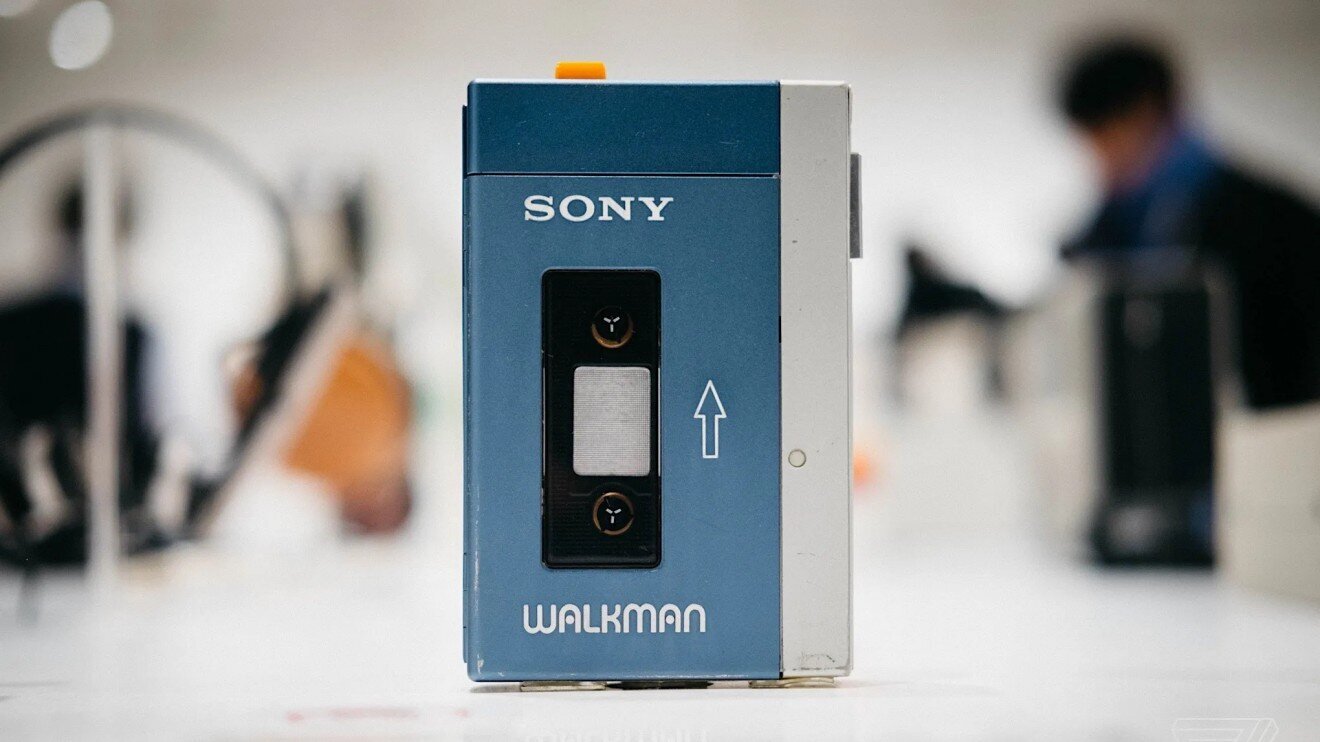
The Walkman is a brand of portable audio players made by Sony since 1979. Originally introduced as a portable cassette player, the Walkman became a cult device that completely transformed how people consumed music and had an enormous impact on popular culture.
Origins and Early Models
The Walkman’s story began in March 1979, when Sony co-founder Masaru Ibuka asked the company’s engineers to modify a small dictation recorder called the «Pressman,» used by journalists, turning it into a compact device for playing music. Ibuka wanted to listen to opera during business trips and asked for a device that would deliver high sound quality with maximum portability.
Under the direction of another Sony co-founder, Akio Morita, the company began selling the first Walkman in July 1979. Morita positioned the device for the youth market, playing up youth, energy, and fashion, and in doing so created an entire culture of headphone use.
The first model, the TPS-L2, in a metallic blue-and-silver housing, went on sale in Japan on July 1, 1979, priced at around 33,000 yen (roughly $150). Though Sony had forecast sales of about 5,000 units a month, the device sold more than 30,000 units in its first two months.
A Technical Revolution
The Walkman marked a technical revolution in portable audio. Before it, portable music-listening devices either had poor sound quality or were bulky and inconvenient. The first Walkman ran on two AA batteries and weighed about 390 grams, making it an ideal companion for an active lifestyle.
A key feature was the headphone jack combined with no external speaker, ensuring private listening. The first model even had two headphone jacks, letting two people listen to the same cassette at once. An interesting detail was a «hotline» button, which mixed in ambient sound over the music being played, letting the user hold a conversation without removing their headphones.
Going International
The Walkman won international recognition through a series of overseas releases. Because Sony’s foreign offices objected to the Japanese-English name «Walkman,» the device sold under various names: Sound-About in the U.S., Freestyle in Australia and Sweden, Stowaway in the U.K. But by the early 1980s the name «Walkman» had caught on worldwide, and Sony began using it everywhere.
In February 1980, Sony began international Walkman sales, and by that November it had adopted the unified Japanese-English name worldwide. By the end of the decade after launch, Sony held 50% of the U.S. market and 46% of the Japanese market.
The Lineup’s Evolution Through the 1980s
The 1980s were a decade of intense development for the Walkman line. In 1981, Sony released the second model, the WM-2, considerably smaller than the TPS-L2 thanks to a «reversed» motorized tape-head mount and touch-sensitive controls.
In 1982 the company added a radio to some cassette Walkman models, starting with the WM-F1, and introduced the first model with Dolby noise reduction and auto-reverse. In 1983 came the first ultra-compact, «cassette-sized» Walkman — the WM-20, with a telescoping housing.
In October 1985, the WM-101 became the first in its class with a «gum-stick» rechargeable battery. In 1986, Sony introduced the first model with a remote control, as well as a solar-powered model (the WM-F107).
Special Editions
In 1989, marking the 10th anniversary of the launch, two limited anniversary models (the WM-701S/T) were released in Japan, made of silver-plated brass. Only a few hundred units of each were made. A 15th-anniversary model was released on July 1, 1994, with top-loading, and a 20th-anniversary model followed on July 1, 1999, as a prestige model.
Commercial Success
By 1989, ten years after the first model’s launch, more than 100 million Walkmans had been sold worldwide. By 1995, 150 million units had been produced, and by 1999, twenty years after the first model’s debut, Sony had sold 186 million cassette Walkmans.
Sony sold roughly 220 million cassette Walkmans before ending production in 2010. By 2010, combined sales of all Walkman devices reached about 400 million units.
Expanding the Brand
After the cassette Walkman’s success, Sony extended the brand name to other portable, non-cassette audio products. In 1990, the company released Digital Audio Tape (DAT) players, sold as the DAT Walkman, and in 1992 launched the MD Walkman brand for portable MiniDisc players.
Sony had earlier also sold its Discman line of portable CD players, which began rebranding as the CD Walkman in 1997. Sony used the name for other products too — in 1989, for instance, it released portable Video8 recorders under the Video Walkman name.
In the summer of 2000, as cassettes became less relevant, Sony unified its entire Walkman product line under a single name and branding, developing a new «W» icon still in use today.
Cultural Impact and Social Change
The Walkman had a colossal impact on culture and became ubiquitous. According to Time magazine, the unprecedented combination of portability (it ran on two AA batteries) and privacy (a headphone jack but no external speaker) made it the ideal product for thousands of consumers looking for a compact, portable stereo system.
The Walkman became an icon of 1980s culture. In 1986 the word «Walkman» entered the Oxford English Dictionary. Millions of people used the Walkman while exercising, helping kick off the era’s aerobics craze. Between 1987 and 1997, during the Walkman’s peak popularity, the number of people who said they walked for exercise rose by 30%.
The «Walkman Effect»
Use of the Walkman gave rise to the so-called «Walkman effect» — a term describing how portable music devices and headphones let listeners control their own sound environment. The device changed people’s relationship with music and technology through its «solitary» and «personal» nature, since users listened to music of their own choosing instead of the radio.
The Walkman is seen as a forerunner of mainstream personal technologies like personal computers or mobile phones. Wearing headphones in public also became common, sparking safety debates in the U.S. and, in 1982, leading the mayor of Woodbridge, New Jersey, to ban wearing a Walkman in public places after pedestrian accidents.
Impact on the Music Industry
The Walkman’s success also helped spread the compact-cassette format widely. Within a few years, cassettes began outselling vinyl records and kept doing so until CDs overtook cassette sales in 1991.
The Walkman helped drive the compact cassette’s rise, which overtook vinyl sales in 1983. Other companies, including Aiwa, Panasonic, and Toshiba, made similar products, and in 1983 cassettes outsold vinyl for the first time.
Variants and Special Models
Sony produced many specialized Walkman versions. The Sports Walkman and some standard cassette Walkman models had built-in radios. Since Sony had made portable radios since the 1960s, there were also personal-stereo Walkman variants — region-specific versions of the same model tailored to different countries’ radio bands.
The SRF-37 model, for instance, came in 4 variants: the FM/MW/LW Walkman SRF-M37L for Europe and other markets (the only portable long-wave Walkman), the TV/Weather/FM/AM Walkman SRF-M37V for the U.S. (the most portable TV and weather-radio Walkman), and the Weather/FM/AM Walkman SRF-M37W for the U.S. (the most portable weather-radio Walkman).
Marketing and Advertising
Marketing for the original Walkman helped embed the idea of «Japaneseness» in global culture, associated with miniaturization and high technology. «Walk-men» and «Walk-women» in advertising were crafted as ideal reflections of the target audience.
Sony ran a marketing strategy of hiring young people to walk around in public wearing the Walkman and inviting passersby to try the product. Sony also hired actors to pose with the Walkman on the streets of Tokyo as an additional form of promotion.
The core of the Walkman ad campaign was the device’s extreme specialization. Before the Walkman, the standard portable music device was a portable radio, which could only offer listeners standard music broadcasts. The ability to build your own playlist was a new and thrilling revolution in how people consumed music.
Genericization of the Trademark
In German-speaking countries, use of the word «Walkman» became generic, meaning a personal stereo of any brand, to the point that Austria’s Supreme Court ruled in 2002 that Sony couldn’t stop others from using the term «Walkman» to describe similar products. It’s a textbook example of what marketers call brand «genericide.»
The Digital Era and Today
On December 21, 1999, Sony launched its first digital audio players under the name Network Walkman. The first digital Walkman used the Memory Stick as storage for audio files in flash memory and was branded the MS Walkman, shortly before the Walkman brand was unified.
In its early years, the digital Walkman shipped with OpenMG copyright protection and, until 2004, exclusively supported Sony’s proprietary ATRAC format; there was no support for the industry-standard MP3, since Sony wanted to protect its Sony BMG recording division from piracy.
Sony was unable to repeat the cassette player’s success in the twenty-first-century digital audio player market. Rival Apple’s iPod line became a massive success, cutting into international Walkman sales, though within Japan the devices performed better.
Current Products
With the market for dedicated portable media players narrowing in the 2010s, Sony streamlined its Walkman lineup, selling a narrower range of products with a greater focus on high-end audiophile players. This began with the launch of the ZX Walkman series in 2013 and culminated in the luxury WM1 series, first released in 2016, featuring gold plating and selling for several thousand U.S. dollars.
As of 2024, the current product lineup includes: the A series (mid-range players), the B series (budget thumb-drive-style players, excluding Japan), the E series (entry-level players), the S series (Japan-only entry-level players), the W/WS series (wearable music players), the WM1 series (flagship luxury high-end players), and the ZX series (high-end music players).
Legacy and Recognition
The Walkman’s impact on consumer electronics is compared to that of later devices like mobile phones and personal computers. A large statue of the Sports Walkman FM was installed in Tokyo’s Ginza district in 2019, marking the 40th anniversary.
In 2025, the 1979 cassette Walkman (model TPS-L2) was included in the «Pirouette: Turning Points in Design» exhibition at the Museum of Modern Art, featuring «widely recognized design icons that highlight turning points in the history of design.»
Over the brand’s entire history, more than 400 million Walkman devices of various types have been sold, making it one of the most successful consumer-electronics brands in history. The Walkman forever changed the way people listen to music, creating a culture of personal audio that continues into the era of smartphones and streaming services.