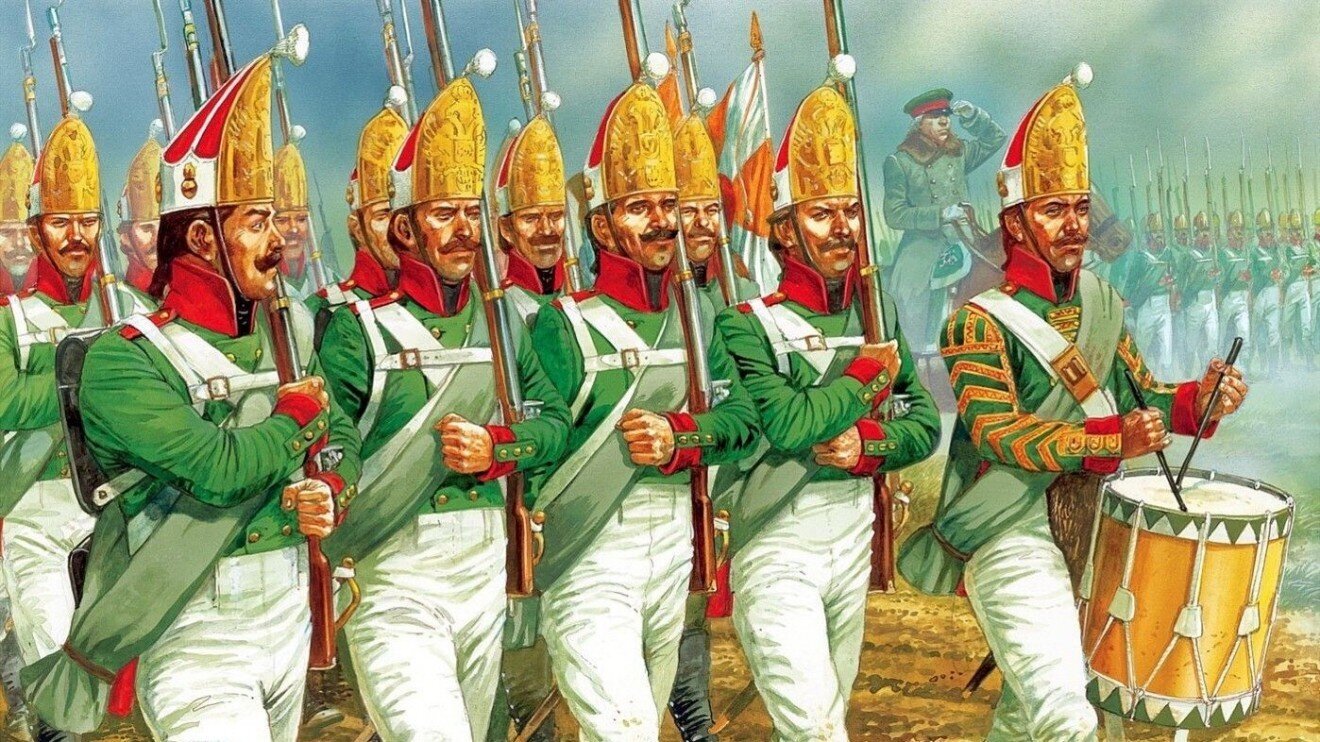
"I'm no grenadier, but let it be, it might come in handy" — these words of the novel's hero refer to a centuries-old military tradition, when being a grenadier meant belonging to the army's elite, to those who went first into the assault on enemy fortifications.
The origin of the name and its purpose
Grenadiers (from the French grenadiers, where grenade means "grenade") were elite units of infantry and cavalry, originally created to storm enemy fortifications during siege operations. Their main weapon was the hand grenade — a hollow cast-iron sphere filled with gunpowder and fitted with a fuse, called at the time a "grenada" or "grenadka."
The grenadier's profession demanded exceptional courage and physical strength. Given the grenade's short throwing range (about 20-30 meters), a soldier had to approach enemy fortifications to a dangerously close distance, light the fuse, wait the right amount of time, and accurately throw the device at the target — all under enemy fire.
The birth of grenadier warfare
The first mentions of hand grenades used in warfare date to the period of China's Ming dynasty, when defenders of the Great Wall used primitive explosive devices against besiegers. In Europe, hand grenades appeared in the Spanish and Austrian armies, and were also used in England during the civil war of the 17th century.
The official birth of grenadiers as a military specialty took place in 1667 in England. It was decided at that point to assign the four strongest and most accurate soldiers in each company specifically to throwing grenades. These soldiers were named "grenadiers." Other European armies quickly adopted the innovation — the French king Louis XIV introduced grenadiers into the French army, and within a few years the new branch had spread across all of Europe.
The weapons and equipment of early grenadiers
Early hand grenades were cast-iron spheres 7 to 15 centimeters in diameter, filled with gunpowder. A short fuse was lit by hand right before the throw. An 18th-century grenade was nearly as dangerous to the grenadier himself and his comrades as to the enemy — the explosives of the time were extremely unpredictable.
Every grenadier carried several grenades (sometimes several dozen) in a special bag called a "grenadière." Besides grenades, grenadiers were armed with ordinary infantry equipment: a musket with a bayonet, and a short sword.
A distinctive item of their equipment was the grenadier cap — a special headgear that replaced the tricorne hat. The need for this replacement arose because tricorne hats got in the way of swinging a musket onto the back, and hampered movement when throwing grenades. The first grenadier caps were low and round, often trimmed with fur. Later they became taller, took on a pointed shape, and were richly decorated with embroidery, brass plates, and bright tassels.
Tactics and features of grenadier service
In battle, grenadiers usually advanced ahead of the attacking infantry columns, clearing the way for the main force. Using large formations made up entirely of grenadiers was impractical, so grenadier companies were incorporated into ordinary infantry regiments.
The procedure for using grenades demanded precise coordination and iron discipline. On the command "Grenadiers, muskets to the back!" a soldier had to perform a complex drill movement: grip the musket by the neck of the stock, extend it in front of him, cross his bent arms, and swing the weapon onto his back. Only the pointed grenadier cap made this maneuver possible — a tricorne hat could not pass between the strap and the musket.
The grenade was thrown with the right hand, from below upward, over the head. The grenadier had to light the fuse, wait a certain amount of time (so the enemy could not throw the grenade back), and accurately hurl the device at the target. All of this required not just physical strength, but precise timing and distance judgment.
Elite status and special privileges
Already by the second half of the 17th century, grenadier units were seen as elite, and received various privileges. One of the most notable was the privilege of wearing a mustache — while other soldiers were required to be clean-shaven, grenadiers could wear a mustache as a mark of distinction. To achieve uniformity, fair-haired grenadiers often dyed their mustaches black, and those who could not grow one glued on or painted one.
Having noticed that tall, large soldiers were often more resilient in battle, commanders began specially selecting grenadiers by height. In most armies, the minimum height was at least 170 centimeters, an impressively tall figure for the time. The Prussian king Frederick II, known for his passion for the army and especially for grenadiers, recruited tall, strong men from across Europe, raising the minimum height for his guard grenadiers to nearly 190 centimeters. His "Potsdam Giants" regiment became legendary.
Mounted grenadiers
Besides infantry grenadiers, there were also mounted grenadiers. The first company of mounted grenadiers was formed in France in 1676, by order of Louis XIV. This was a mixed-purpose unit: depending on the circumstances, it could act as cavalry in field battles, or dismount to storm fortifications with hand grenades.
Interestingly, the mounted grenadier company was the only unit among the royal household cavalry that could admit men of non-noble birth — so highly were the physical and combat qualities of these soldiers valued.
The era of the Napoleonic Wars
Grenadiers reached their highest flourishing in the era of the Napoleonic Wars. By this time, battlefield tactics had changed and the use of grenades had declined, but grenadiers survived as elite units, staffed by hand-picked soldiers.
Napoleon's French grenadiers became legendary. They wore distinctive bearskin caps, dark-blue uniforms, and were armed with muskets with bayonets and sabers. It was largely the French grenadiers who created the modern image of these elite soldiers in the popular imagination.
In Napoleon's army, there was a clear hierarchy: soldiers admitted into the Imperial Guard grenadiers were selected especially carefully. All of them had to have an impeccable reputation, combat experience, and a height between 178 and 184 centimeters. In 1804, the grenadier regiment took first place among all the regiments of the Imperial Guard.
Grenadiers in the Russian army
The Petrine reforms
In Russia, grenadiers appeared in 1704, under Peter I. Following European practice, a grenadier company was formed within every infantry and cavalry regiment. Four years later, separate grenadier regiments were created; these were disbanded after Peter I's death, but restored in 1765 under Catherine II.
Interestingly, the use of grenadier units in Russia is recorded even earlier — during the Chigirin campaigns. The Scottish general Patrick Gordon, who served in the Russian army, repeatedly mentions the term "grenadier" in his diary for 1677-1678, describing soldiers specializing in throwing grenades.
Russian grenadiers differed in several ways from their European counterparts. Their fusils (a type of musket) were slightly shorter and lighter than standard infantry muskets, making it more convenient to carry the weapon on the back while throwing grenades. The cartridge pouches of Russian grenadiers bore an image of a burning grenade — a symbol that became a recognizable mark of this branch of service.
The heyday of grenadier units
By 1763, Russia already had four army grenadier regiments. This number gradually grew, through the conversion of musketeer regiments into grenadier ones and the creation of new units. Grenadiers took part in all the major battles of the time, distinguishing themselves especially at the Battle of Kagul, where a bayonet charge by Russian grenadiers decided the outcome of the fight.
By the start of the Patriotic War of 1812, the Russian army had 14 grenadier regiments, organized into two divisions (the 1st and 2nd Grenadier Divisions): the Life Guards Grenadier, Kiev, Siberian, Tauride, Yekaterinoslav, Little Russia, Moscow, Fanagoria, Astrakhan, St. Petersburg, Kherson, Georgian, and Pavlovsk regiments, and Count Arakcheyev's regiment.
The Palace Grenadiers
In 1827, a special company of Palace Grenadiers was established, reporting directly to the Ministry of the Imperial Court. This was the elite of the elite: the company's officers held Guards ranks, its sergeant-major was equal in rank to an army second lieutenant, and its non-commissioned officers to army ensigns. The grenadiers themselves held the rank of non-commissioned officer.
The company was filled exclusively with distinguished lower-ranking soldiers — retired or long-serving veterans, who had necessarily seen action against the enemy. Service in the Palace Grenadiers was considered the highest honor a soldier could receive.
The First World War: a revival of grenadier tactics
With the onset of trench warfare on the fronts of the First World War, the warring sides faced the need to change tactics. Traditional methods of attack led to enormous losses for the capture of insignificant patches of ground.
In 1915-1916, the Russian army began forming special elite units, intended to break through enemy defenses under conditions of "trench warfare." The main skill required of these soldiers was accuracy in throwing grenades into narrow trenches, and mastery of hand-to-hand combat.
The founder of such units in the Russian army is considered to be General of Cavalry P.A. Pleve, who, in an order to the 5th Army dated October 4, 1915, directed:
"...I order that special bomb-throwing teams be formed from them within each company... men chosen for boldness and energy, each armed with ten grenades conveniently hung on the belt, and axes of any pattern, and each supplied with a spade, as large as possible, and hand shears for cutting wire."
From the end of 1915, "assault platoons" or "grenadier platoons" appeared in every infantry and grenadier regiment of the Russian army. A platoon consisted of one officer, four non-commissioned officers, and 48 lower ranks.
The weapons and tactics of First World War grenadiers
Grenadiers of the First World War era were equipped with:
- "Adrian helmets" (French steel helmets)
- carbines (officers — revolvers)
- bebut daggers
- 7-8 grenades in special canvas pouches, worn crossed over the shoulder
- steel shields (at least one for every two grenadiers)
- two bomb-throwers per platoon
Their tactics were well established: grenadiers would cut passages through wire entanglements, throw grenades into the enemy's trenches, and only then storm into them. A grenade was thrown into every bend of a trench before the grenadiers rushed in. The guiding principles were decisiveness and speed — this ensured victory and kept losses to a minimum.
Grenadier units were used in the largest offensive operations of the Russian army: the Naroch offensive, the Baranovichi offensive, the Brusilov Offensive. They were often tasked with suppressing enemy machine guns, so that ordinary infantry could advance.
The Civil War: the last Russian grenadiers
During the Civil War, grenadier units were re-formed within the Armed Forces of South Russia. Initially, grenadiers served within the legendary Markov Regiment, marching with it through the First and Second Kuban campaigns.
Later, grenadiers were split off into separate units: first the Combined Grenadier Battalion, then a regiment of 16 companies within the 6th Infantry Division of the Caucasian Army. Through the efforts of Colonel B.P. Kochkin, an entire Combined Grenadier Division was formed.
The last battle
The last battle of the Russian grenadiers took place on August 2, 1920, in the Primoro-Akhtarskaya area. Three companies of the grenadier battalion moved forward, and were attacked by superior Red cavalry forces. For several hours, the grenadiers repelled the attacks, but the forces were unequal. When ammunition ran out, the battalion commander, Colonel Smirnov, ordered a retreat, but the withdrawal failed — the battalion was surrounded and destroyed.
The next day, 59 Alekseyevets grenadiers were buried, including the battalion commander. Of the entire battalion, only a handful of soldiers and officers survived. According to Red forces' accounts, 3 machine guns were captured, and around 100 men were taken prisoner, of whom 50 officers were shot.
This was the end of the centuries-long history of the Russian grenadiers. Until the start of the Second World War, émigrés marked every anniversary of this event with memorial services for their fallen comrades.
The modern legacy
Although grenadiers as specialized grenade-throwers disappeared with the development of military technology, their legacy lives on in modern armies. In Great Britain, a ceremonial Grenadier Guards regiment survives. In Germany, mechanized units are still called Panzergrenadier units, and their soldiers Panzergrenadiers.
The word "grenadier" became a synonym for an elite warrior, ready to go first into the assault, heedless of danger. It is in exactly this sense — as a symbol of courage and readiness for self-sacrifice — that the novel's hero uses the word, picking a grenade up off the sand: "I'm no grenadier, but let it be, it might come in handy."
Interesting facts
- The diameter of early grenades ranged from 7 to 15 centimeters, and they weighed about 1-2 kilograms
- The minimum height for grenadiers in the 18th century was 170 cm, significantly above the average male height of the time (about 160 cm)
- The Prussian "Potsdam Giants" were recruited up to a height of 190 cm, and were a particular source of pride for Frederick II
- The French word "grenade" comes from the Latin "granatum" (grainy), since the shape of the grenade resembled a pomegranate fruit
- The grenadier cap was not only practical headgear but also a means of psychological effect on the enemy — the tall, pointed caps made grenadiers look even more imposing
This background note is based on historical documents, and is intended to help the reader better understand the context of the literary work.