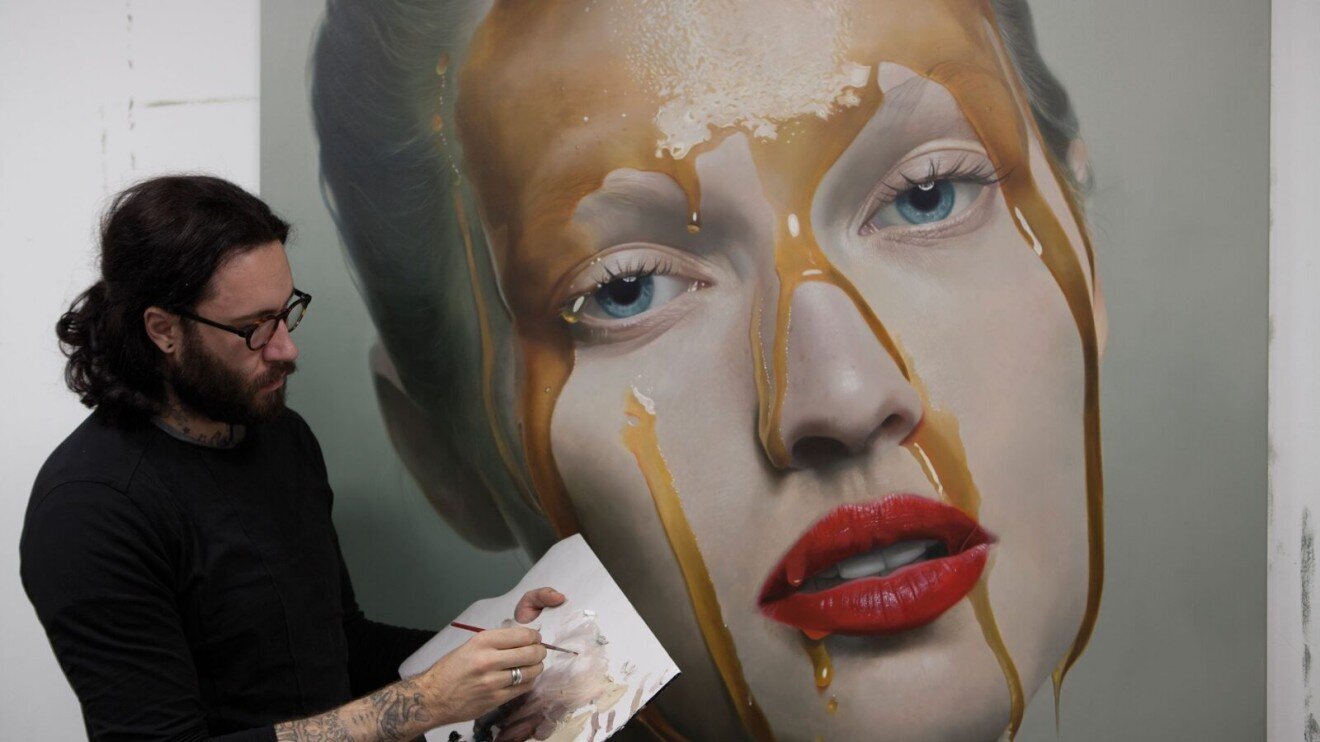
Hyperrealism is an art movement that emerged in the late 1960s in the US and found particular development in the Soviet Union in the 1970s-80s, where it took on unique traits that set it apart from its Western counterpart.
Origins and Definition
The term «hyperrealism» was coined by Belgian gallerist Isy Brachot in 1973 as a French synonym for «photorealism.» It was initially associated with the work of European photorealists of the 1970s, but was later understood more broadly as a current running through various forms of contemporary art — painting, sculpture, and film — from the late 20th into the early 21st century.
The name took hold after a major exhibition in Brussels in 1973, which showcased the work of American photorealists Ralph Goings, Chuck Close, Don Eddy, Robert Bechtle, and Richard McLean, alongside European artists Domenico Gnoli, Gerhard Richter, Konrad Klapheck, and Roland Delcol.
Style and Method
Unlike traditional 20th-century photorealism, hyperrealism moved away from a literal approach to copying reality. Hyperrealist artists use photographic images as a starting point for creating a sharper, more detailed image that carries its own narrative and emotional weight.
Key characteristics of hyperrealism:
- Hyper-detail: Textures, surfaces, light effects, and shadows become sharper and more distinct than in the reference photograph, or even the object itself
- The illusion of reality: Creating a convincing illusion based on imitating reality, without being an exact copy of it
- Scale: Hyperrealist images are typically 10-20 times larger than the original photographic reference
- Technical means: The use of photographic slide projectors, multimedia projectors, and grids to ensure the image transfers accurately
Philosophical Foundations
Hyperrealism’s roots can be traced to the philosophy of Jean Baudrillard, who spoke of the «simulation of something that never actually existed.» Hyperrealists create a false reality, a convincing illusion built on imitating reality. Where photorealism relied on analog photography, hyperrealist paintings and sculptures are built from extremely high-resolution digital photography.
Western hyperrealism was an art of «after everything» — after modernism and the avant-garde, after Marcel Duchamp, after pop art, after classical aesthetics. It was the art of an era in which photography began to be recognized as a medium and an art form in its own right.
Hyperrealism in the USSR
Spreading across Europe, hyperrealism reached the Soviet Union through the Baltic republics. In the late 1960s, a group of hyperrealists emerged in Tallinn; in the late 1970s, another in Tartu. The 1980s, the peak period for hyperrealism’s development in the USSR, saw the formation of the well-known Moscow «Group of 6,» whose members called themselves «hypers.»
Geographic Spread
Following Estonia, hyperrealism spread to Ukraine, Armenia, and Kyrgyzstan. Beyond the group associations, many individual artists tried their hand at the hyperrealist technique, including conceptualist Erik Bulatov.
The first to call themselves «hyperrealists» was a group of Kyiv artists who had relocated to Moscow: Sergei Sherstyuk, Sergei Bazilev, and Sergei Geta. They became the stars of youth exhibitions in the first half of the 1980s.
Features of Soviet Hyperrealism
Soviet hyperrealism differed substantially from its Western counterpart. Where Western hyperrealism was an art of «after everything,» Soviet hyperrealism was an art of «in between» — between the official establishment, which was trying to revive critical realism, and the underground, which was trying to move away from realism altogether.
Main characteristics of Soviet hyperrealism
Subject Matter
In the Soviet hyperrealist tradition, paintings often took on deliberately «boring,» everyday subjects. Through a detached way of recording objects, artists achieved a kind of «hyper-objectivity» in their images, and the art stopped passing judgment on the reality it depicted.
Social Context
As researcher Cristina Morandi has noted: «Formally, the Soviet hyperrealists adopted the full arsenal of the American pioneers of this style. But the differences are conceptual. Where the Americans had virtually no social or political agenda, artists in Russia, Estonia, and Latvia used their work to signal clear disagreement with official discourse.»
Technique and Method
Young artists were drawn to the chance to combine virtuosic technique with the realistic documentary style that Soviet aesthetics encouraged. A favorite pastime among these artists was viewing slides together as a group, with chosen scenes then transferred to canvas.
Regional Differences
Estonian artists favored the romance of travel and sport. Moscow artists tried to heighten the effect of an unexpected look at real urban life:
- Andrei Volkov focused on the poetic play of light in city windows
- Alexander Petrov focused on the contrast between industry and human relationships
- Yevgeny Amaspyur depicted symbols of Soviet dysfunction
Key Figures
Group "6" and the Moscow Artists
The movement’s ideological leader was Sergei Sherstyuk, a graduate of the art history department at Moscow State University’s Faculty of History. Together with Sergei Bazilev and Sergei Geta, they formed the core of the «Group of Six.»
Other notable figures include:
- Semyon Faibisovich — later drifted toward critical, denunciatory realism
- Alexander Petrov — one of the movement’s leaders
- Georgy Kichigin — a representative of the Moscow school
- Andrei Volkov — author of the famous painting «On a Border Ship»
- Sergei Shablavin — drifted toward illusionism and optical experimentation
Baltic Artists
Estonia was the first Soviet region where hyperrealism took hold:
- Jaan Elken
- Ando Kesküla
- Rein Tammik
- Lemming Nagel
From Lithuania: Vytas Lukas, Pranas Grušys, Kazimieras Zoromskis.
Other Regions
Representatives from other Soviet republics:
- Nikolai Belyanov
- Olga Grechina
- Miervaldis Polis (Latvia)
- Nikolai Meshkov — author of the politically charged work «Ulster. No Unrest.»
Critical and Official Reception
Hyperrealism found itself in a unique position: artists could exhibit officially, which in turn produced official criticism. Liberal Soviet critics accepted the new style, using softer terms than «hyperrealism» — «photorealism» or «documentary romanticism.»
Critics called the hyperrealists «troubadours of the scientific-technical revolution,» praised them for their «documentary realism» (Alexander Kamensky), and warned of the dangers of «verisimilitude without truth» (Valery Turchin). The artists constantly walked a tightrope: they could either be denounced for formalism and kowtowing to the West, or hailed as the great hope of young Soviet art.
Materials and Technique
Soviet hyperrealists worked with limited access to materials, which left its mark on their art:
- Color film: East German color film was used, giving the paintings a characteristic ochre tone
- Slide projectors: The main tool for transferring images onto canvas
- Painting technique: Many works were done with an airbrush, acrylics, oils, or a combination of all three
- Scale: The works significantly exceeded the size of the source photographs while retaining high resolution
Imagery and Motifs
A recurring figure in Soviet hyperrealism was the long-haired young man in glinting dark sunglasses and the inevitable pair of jeans. This image became a symbol of the era, reflecting young people’s longing for a Western way of life.
Typical motifs included:
- Empty streets and windows
- Apartment gatherings
- Arguments in artists’ studios
- Urban landscapes
- Portraits of contemporaries
- Still lifes with household objects
Ties to Other Movements
On Soviet soil, hyperrealists never developed the aesthetic rivalry with conceptualists that existed in the West. Many artists actively used photography as both a source and a means of expression.
A group of nonconformists made a sharp turn from metaphysical abstraction to detached observation of Soviet reality in the early 1970s. For Erik Bulatov, Eduard Gorokhovsky, and even Ilya Kabakov, the direct use of photography was a way to distance themselves from Soviet reality.
Historical Significance
Hyperrealism turned out to be the last style to unite artists across the USSR. For many artists of the Soviet period, it was only a temporary stage, after which they continued their artistic search in other directions of contemporary art, from conceptualism to Sots Art.
The cold, frozen, seemingly timeless reality captured on the canvases of Soviet hyperrealists reads today as an image of the era of stagnation. Art historians see hyperrealism as a Cold War-era style, unfolding across the landscape of mass media — the very media «reality» the artists were drawing on.
Legacy and Influence
Soviet hyperrealism built a unique artistic tradition, distinct from its Western counterparts in its social orientation and its particular relationship to reality. The movement showed that contemporary art could exist even under ideological constraints, finding ways to express itself through a form that was outwardly neutral but inwardly defiant.
Hyperrealism in the USSR became an important stage in the development of unofficial art, a bridge between traditional realism and the new forms of artistic expression that developed in the decades that followed.
Primary sources: materials from the State Tretyakov Gallery, the Moscow Museum of Modern Art, and research by K. Svetlyakov, Y. Vorotyntseva, K. Morandi, and other art historians.