The Birth of a Character
Travis Bickle was created by screenwriter Paul Schrader as a reflection of his own inner crisis. In the mid-1970s, Schrader was going through a rough patch: divorce, alcoholism, depression, and total isolation in Los Angeles. Months spent in isolation, with only a bottle and a television for company, formed the basis of the main character’s psychological portrait.
In creating the character, Schrader drew inspiration from the diary entries of Arthur Bremer, the man who attempted to assassinate Alabama governor George Wallace in 1972. Those entries revealed the inner world of a lonely, alienated man dreaming of fame through violence. French director Robert Bresson’s films, especially «Pickpocket» (1959), and John Ford’s western «The Searchers» (1956), were also significant influences.
Psychological Portrait
Travis Bickle, twenty-six, is a Vietnam War veteran suffering from chronic insomnia, depression, and profound loneliness. His decision to work night shifts as a cab driver is no accident — it’s an attempt to fill an emptiness, to find some kind of meaning in existence. In his eyes, mid-1970s New York appears as a rotting organism, full of «filth» and «scum» that needs to be «washed off the streets.»
Schrader built a character embodying the concept of «the man in the room» — an isolated individual cut off from normal human connection. Travis keeps a diary, trying to make sense of his life and the world around him, but his entries are full of bitterness, despair, and mounting aggression. He watches the city’s life through the window of his cab, remaining entirely detached from it.
Travis’s alienation shows especially clearly in his relationships with women. His attempt at a romance with Betsy (Cybill Shepherd) collapses from a total misreading of social norms — he takes her to a porn theater for a date. His «rescue» of the 12-year-old prostitute Iris (Jodie Foster) becomes a projection of his own need for redemption and significance.
Visual Symbolism
Martin Scorsese and cinematographer Michael Chapman built a distinctive visual style reflecting the character’s inner state. New York is shown as a nighttime city of neon lights, steam rising from manhole covers, and smoking streets — an urban hell where Travis’s soul has lost its way.
A key visual motif is mirrors. The famous mirror scene with the line «You talkin’ to me?» shows Travis rehearsing an imagined confrontation. The mirror becomes a symbol of a fractured self, incapable of genuine connection with others. He talks to himself because there’s no one else left to talk to.
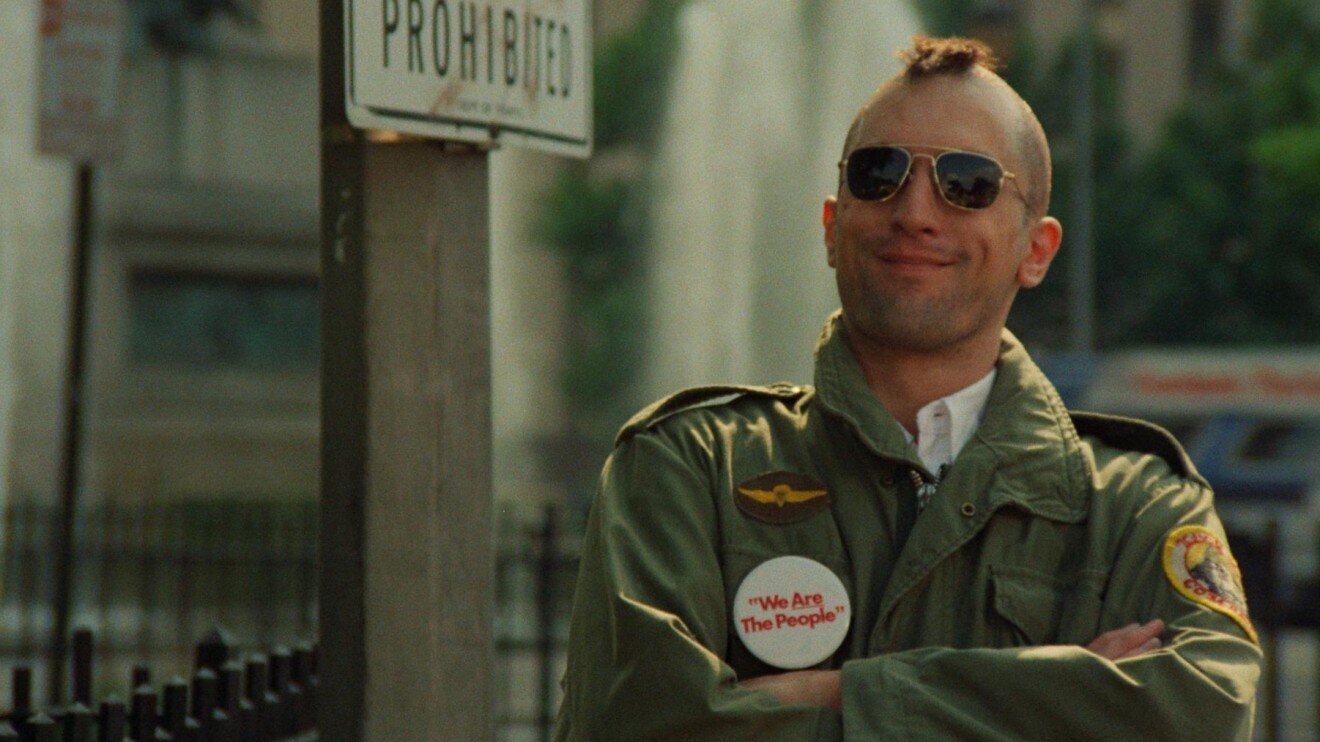
The character’s transformation — from an unremarkable cab driver to a man with a mohawk in a military jacket — visualizes his inner changes. The mohawk becomes a symbol of militancy and a rejection of any attempt to fit into society.
Social Context
«Taxi Driver» was made during a period of deep crisis in American society. The mid-1970s came after Watergate, defeat in Vietnam, economic troubles, and rising crime in major cities. New York at the time stood on the edge of bankruptcy, and crime rates had hit critical levels.
Travis Bickle embodies the mood of a large part of American society — disillusionment, alienation, a lost faith in institutions and social justice. His dreams of «cleansing» the city reflect populist sentiment and a longing for simple solutions to complicated problems.
The character’s veteran status matters especially in the context of American society’s relationship to the Vietnam War. Travis represents the «lost generation» of veterans who came home to a country that greeted them without honors or understanding. His trauma is personal, but also a collective trauma of the nation.
Robert De Niro’s Performance
Playing Travis Bickle earned Robert De Niro an Academy Award nomination and became one of his most memorable performances. The actor prepared for the role with his characteristic thoroughness: he got a taxi license and drove nights for several weeks, studying the city and its inhabitants.
De Niro built a convincing portrait of a man balancing on the edge of a psychotic break. His Travis isn’t simply a madman or a villain, but a deeply traumatized person deserving of sympathy despite his actions. The actor masterfully showed the character’s evolution from a quiet loser into a potential killer.
The improvised mirror scene stands out especially. According to Schrader, the «You talkin’ to me?» dialogue was De Niro’s own invention, based on a New York comedian’s act. The scene became the quintessence of the character’s loneliness and one of the most quoted moments in film history.
Scorsese’s Direction
For Martin Scorsese, «Taxi Driver» was a breakthrough work that defined his signature style. The director used techniques that later became his trademark: slow-motion shots, sharp editing cuts, subjective camerawork, and dense sound design.
Scorsese saw the film as an exploration of the modern spiritual crisis. His Catholic upbringing shows through in its themes of sin, redemption, and the search for salvation. Travis dreams of becoming a savior, but his methods lead only to destruction.
The final massacre scene at the brothel was shot with elaborate camera choreography, creating a sense of chaos and inevitability. Scorsese doesn’t glorify the violence, but shows it as the tragic outcome of the character’s spiritual sickness.
The Score
The film’s music was written by Bernard Herrmann, the legendary composer who collaborated with Alfred Hitchcock. «Taxi Driver» was his final work — Herrmann died just hours after finishing the recording. The film is dedicated to his memory.
Herrmann’s score reflects Travis’s inner state — anxiety, loneliness, and mounting tension. The saxophone conjures the atmosphere of the nighttime city and jazz clubs, while dramatic orchestral passages underscore the psychological strain.
Influence on Cinema
«Taxi Driver» had an enormous influence on world cinema. The image of Travis Bickle became an archetype for countless characters, from Arthur Fleck in Todd Phillips’ «Joker» (2019) to the protagonists of «American Psycho» and «Fight Club.»
Paul Schrader developed the «man in the room» concept further in a trilogy of films: «American Gigolo» (1980), «Light Sleeper» (1992), and «The Walker» (2007). Each explores the theme of alienation in the modern urban environment.
The film’s influence can be seen in the work of directors like David Fincher, Nicolas Winding Refn, and Denis Villeneuve. The theme of urban loneliness and social alienation remains as relevant today as ever.
A Tragic Echo in Reality
On March 30, 1981, John Hinckley Jr. attempted to assassinate President Ronald Reagan in an effort to impress Jodie Foster. Hinckley was obsessed with «Taxi Driver» and mimicked Travis Bickle’s appearance and behavior, down to the mohawk and the military jacket.
The incident raised questions about cinema’s influence on unstable individuals. Martin Scorsese was so shaken by the event that he even considered ending his directing career. But most critics and scholars agreed the film doesn’t promote violence — quite the opposite, it shows its destructive consequences.
A Philosophical Reading
«Taxi Driver» can be read as an existential drama about the search for meaning in an absurd world. Travis embodies Albert Camus’ philosophy of the absurd — a man who has grasped the meaninglessness of existence and tries to create his own values.
His diary entries recall Fyodor Dostoevsky’s «Notes from Underground» — the confession of an alienated man who both despises society and longs to be accepted by it. Travis dreams of a heroic act that will give his existence meaning, but his «heroism» turns into tragedy.
The film’s final scene remains a subject of debate among critics. Is Travis’s recovery real, or a dying hallucination? Scorsese deliberately left the question open, leaving the character’s fate for viewers to decide.
Legacy Today
Nearly half a century after its release, «Taxi Driver» remains relevant. In an age of social media and digital alienation, the image of Travis Bickle takes on new resonance. The internet has created new forms of loneliness and radicalization, making the issues the film raised even sharper.
Today’s incels, internet trolls, and «lone wolves» often reproduce Travis’s behavioral patterns — alienation from society, a hunt for someone to blame, and dreams of «righteous» retribution. The film anticipated many phenomena of contemporary culture.
In 1994, «Taxi Driver» was added to the US National Film Registry as «culturally, historically, or aesthetically significant.» The American Film Institute placed Travis Bickle on its list of the 30 greatest villains in film history, though many critics see him as more of a tragic hero.
Conclusion
Travis Bickle remains one of the most complex and multifaceted characters in film history. He repels and evokes sympathy in equal measure, embodying the dark sides of human nature and the social ills of the modern world.
Martin Scorsese’s «Taxi Driver» isn’t just a crime drama, but a philosophical study of alienation, loneliness, and the search for meaning in an urban world. The film forces us to consider the price of individualism, and what happens to a person when every social bond is severed.
The image of Travis Bickle continues to shape contemporary culture, a reminder of how fragile the human psyche is, and of the need for understanding and compassion toward those who’ve gotten lost in the maze of the big city. In an age of globalization and digitization, that lesson matters more than ever.