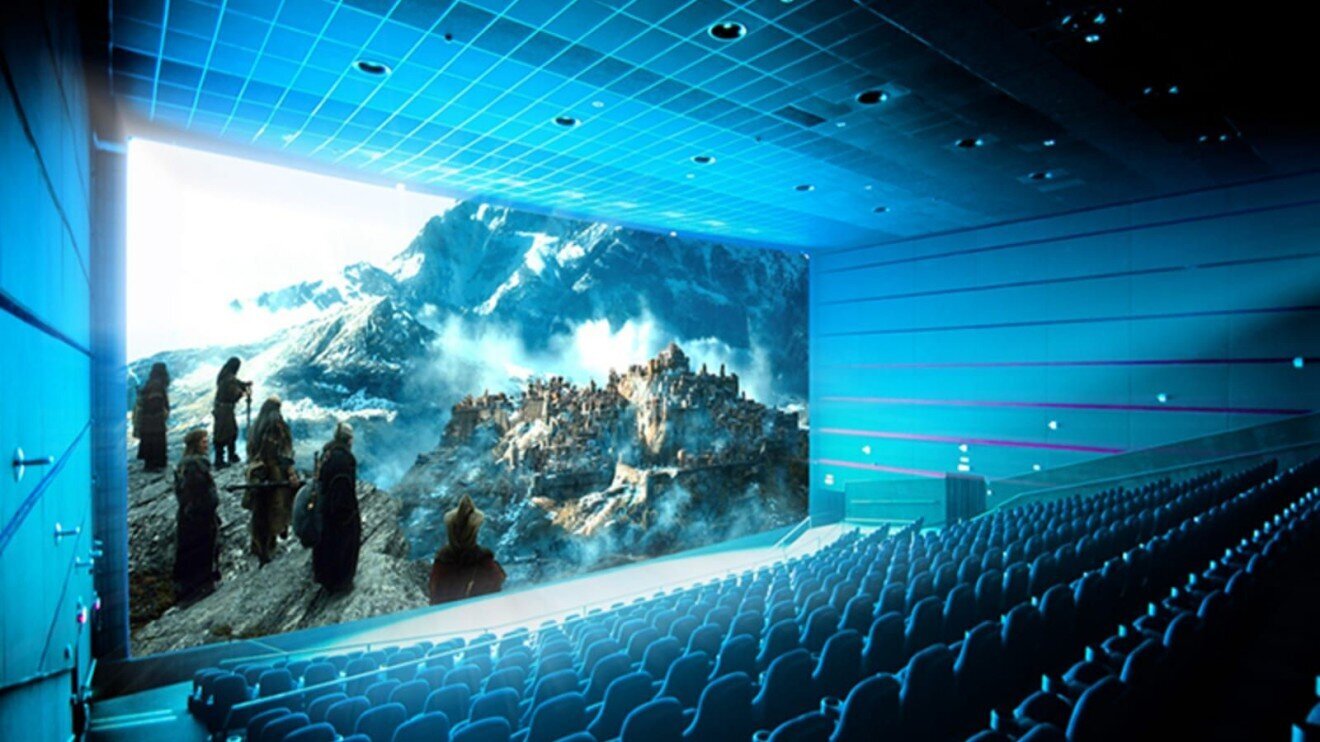
Wide-gauge cinema is a category of film systems that use film stock wider than the standard 35mm. This technology opened up a new visual world for audiences, where the image fills far more of the human field of vision, creating an unprecedented sense of presence.
What Wide-Gauge Cinema Is
Wide-gauge film systems are defined by a large frame area that doesn’t need heavy magnification and allows high-quality images on large screens. The image’s angular size for viewers reaches 128° horizontally, approaching the field of human binocular vision. For the IMAX system, this figure exceeds the human field of view, making the screen’s edges nearly invisible.
It’s important not to confuse wide-gauge cinema with widescreen cinema. Systems like VistaVision, Technirama, and Super Technirama 70, which use 35mm film, are not considered wide-gauge, despite their larger frame area. The term «wide-gauge cinema» is used in Soviet and Russian terminology, while outside the CIS similar systems are called «70mm film.»
The Origins of Wide-Gauge Cinema
Surprisingly, wide-gauge film systems appeared at almost the same time as cinema itself. Early engineers chose large frame sizes because of the limited length of the first movie theaters: without short-focus projection lenses available, they had to enlarge the projector’s frame window and the width of the film.
One of the first movie cameras, Léon Gaumont and Léopold Decaux’s «Chronophotographe,» used 60mm film with a 35×45mm frame in 1895. The Mutoscope and Biograph company began using 70mm film with a 57mm frame pitch in November 1899. The whole variety of film-stock sizes only settled on the common 35mm standard by the end of the first decade of the 20th century.
Sound as a Catalyst for Development
Contrary to popular belief, the first appearance of wide film stock had less to do with attempts to improve image quality than with the need to fit a combined soundtrack on the same strip as the image. Optical sound required extra room on the film, which led to non-standard widths or a nearly square frame.
Wide film elegantly solved this problem — it could carry a soundtrack of any width alongside a large widescreen image. RKO Radio Pictures proposed a 63.5mm film stock for shooting as early as 1926. In 1929, Warner Bros. shot two films on 65mm «Vitascope» film.
Pioneering Formats of the 1920s–30s
In 1928, the 70mm «Grandeur» format, developed by 20th Century Fox, became the first to see commercial use. Technically it’s close to the modern Todd-AO format, but used different perforation: for the same frame pitch, Grandeur used only 4 enlarged perforations instead of the standard 5.
Paramount developed 65mm «Magnafilm» stock with standard perforation in 1929. The project was international — the camera equipment was built by the French company Debrie, and the projectors by the German firm Zeiss Ikon.
Attempts to introduce wide film in the 1930s failed, thanks to the global economic crisis and the mass rollout of sound cinema on standard-gauge film. Theater owners, having just survived the switch to sound, weren’t eager to bear the extra cost of re-equipping.
Revival in the 1950s: An Answer to Television
The next stage in wide-gauge cinema is tied to the appearance of panoramic film systems in the early 1950s. The explosive spread of television significantly cut into box-office revenue and demanded new technical solutions. Cinema needed something home television couldn’t offer — a truly grand spectacle.
Attempts to improve the «Cinerama» system led to the development of wide-gauge cinema and the invention of modern formats. Hollywood producers wanted «Cinerama from a single projection port,» which is exactly what the new systems delivered.
Todd-AO: The First Commercial Success
The first commercially successful wide-gauge system, in 1955, was Todd-AO, developed at the initiative of Broadway businessman Michael Todd, one of the creators of Cinerama, by the American Optical company. The system used 70mm film with a 5-perforation frame and gave a 2.2:1 aspect ratio.
A further development of Todd-AO was the Dimension-150 system, based on ultra-wide-angle lenses and a curved, semicircular screen offering a horizontal field of view up to 150°. The image was specially warped during printing to compensate for distortion on such a screen.
A Variety of Systems: From MGM to Ultra Panavision
Unlike the USSR, which standardized a single system, Western film producers were in constant search of the most advantageous technical solutions. This produced a whole range of formats:
MGM Camera 65 used anamorphic lenses with a 1.33× squeeze factor and delivered an on-screen aspect ratio of 3:1. «Ben-Hur,» shot in this format, became the widest-aspect-ratio film ever released for home viewing.
Ultra Panavision 70 used a 1.25× anamorphic squeeze and a 2.75:1 aspect ratio. In 2015, Quentin Tarantino shot «The Hateful Eight» entirely in this format, and about 100 anamorphic projection lenses had to be specially ordered from Germany for its release.
Super Panavision 70 used spherical lenses and a 2.2:1 aspect ratio. «2001: A Space Odyssey,» «Lawrence of Arabia,» and «My Fair Lady» were all shot in this format.
The Soviet NIKFI System
In 1956, a USSR team from NIKFI, working with the Mosfilm studio under the direction of Ye. M. Goldovsky, developed a wide-gauge film system. Unlike Western equivalents, it used 70mm film both for making release prints and for shooting the negative, and was designed only for flat screens.
In the Soviet Union, the wide-gauge system stayed in use longer than abroad, owing to economic factors. While Western studios were abandoning wide negative stock, in the USSR wide-gauge films continued to be shot into the late 1980s.
Experimental Formats
CinemaScope 55 was an experimental 1956 system that used 55.625mm film and anamorphic optics. The negative frame size was four times larger than standard CinemaScope, giving excellent quality. Only two films were ever shot in it.
Showscan was Douglas Trumbull’s system, shooting and projecting at 60 frames per second instead of the standard 24. It delivered smooth motion but never caught on widely.
Iwerks was the 8/70 format, with a transverse frame of 52.83×37.59mm and an aspect ratio close to the classic standard. It’s used for 3D and 4D theme-park attractions.
IMAX: The Pinnacle of Wide-Gauge Cinema
The format with the greatest image information density is IMAX, with a 15-perforation frame pitch and an enormous image area. Its large size required fundamentally new technical solutions — for example, IMAX projectors use a «rolling loop» mechanism instead of the traditional intermittent claw.
The IMAX system exceeds the human field of view, making the screen’s edges nearly imperceptible and creating a full sense of immersion in the on-screen action.
The Modern State of the Art
Modern wide-gauge cinema is governed by the ISO 2467:2004 standard. Shooting uses 65mm film stock and spherical optics. Positive 70mm print stock differs from the negative only in having a wider edge to accommodate the magnetic soundtrack.
Improvements in negative film quality led studios to abandon shooting on wide-gauge negative. Even so, wide-gauge release prints continued to be produced thanks to their higher projection and sound quality. In big-budget filmmaking, wide-gauge film is still used for shooting the most demanding scenes.
Today, wide-gauge projection is being rapidly displaced by digital. Only a handful of 70mm-capable projectors remain in Russia, and most of them don’t work. For the 2016 release of «The Hateful Eight,» working equipment had to be gathered from various film distributors.
Difference from Widescreen Cinema
It’s important to distinguish wide-gauge cinema from widescreen cinema. Widescreen cinema uses standard 35mm film and achieves a wide image by cropping the frame height (matting) or through anamorphic lenses. Wide-gauge cinema physically uses wider film stock.
In digital cinema, the distinction between these formats has lost its original meaning, and all films with a large aspect ratio are simply called «widescreen.»
Effect on Perception
A wide-gauge image fundamentally changes how a film is perceived. The wide horizontal field of view creates a sense of presence unattainable in ordinary formats. The viewer becomes not an observer but a participant in what’s happening on screen.
This very effect is what gave rise to the figurative use of the phrase «widescreen picture» — as a metaphor for a full, three-dimensional perception of reality, when a person sees not a fragment but the whole panorama of events.
Wide-gauge cinema showed that technical innovation can do more than improve image quality — it can change the language of cinema itself, opening new possibilities for artistic expression and impact on the viewer.